
Filters:
A congress of Central American Criollos in …
Years: 1816 - 1827
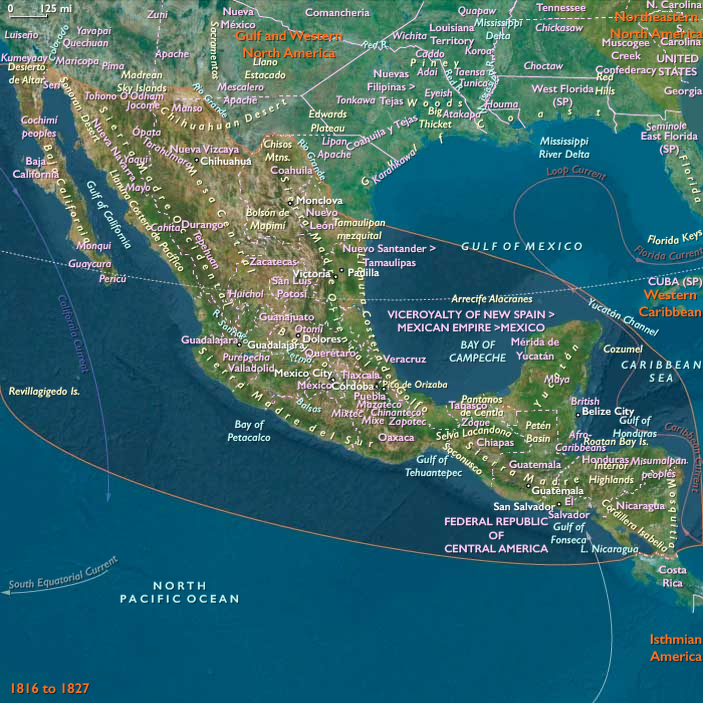
A congress of Central American Criollos in Guatemala City in 1821 composes the Act of Independence of Central America to declare the region's independence from Spain, effective on September 15 of this year. (This date is still marked as independence day by most Central American nations.)
The Spanish Captain General, Gabino Gaínza, sympathizes with the rebels and it is decided that he should stay on as interim leader until a new government can be formed.
Independence is short-lived, for the conservative leaders in Guatemala welcome annexation by the First Mexican Empire of Agustín de Iturbide on January 5, 1822.
Central American liberals object to this, but an army from Mexico under General Vicente Filisola occupies Guatemala City and quells dissent.
When Mexico becomes a republic the following year, it acknowledges Central America's right to determine its own destiny.
On July 1, 1823, the congress of Central America declares absolute independence from Spain, Mexico, and any other foreign nation, including North Americas, and a Republican system of government is established.
In 1823, the nation of Central America is formed.
Intended to be a federal republic modeled after the United States of America, it is provisionally known as "The United Provinces of Central America," while the final name according to the Constitution of 1824 is "The Federal Republic of Central America."
It is sometimes incorrectly referred in English as "The United States of Central America."
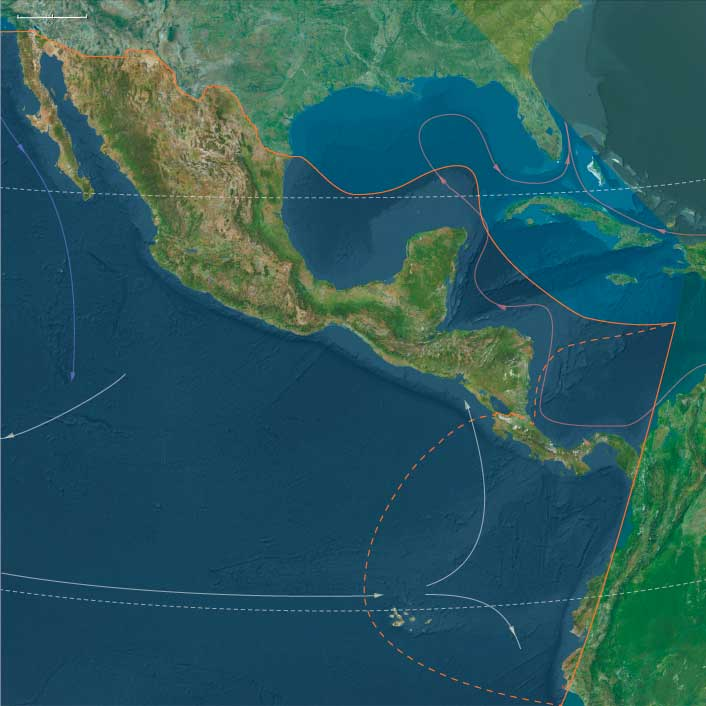
The Central American nation consists of the states of Guatemala, El Salvador, Honduras, Nicaragua, and Costa Rica.
The Spanish Captain General, Gabino Gaínza, sympathizes with the rebels and it is decided that he should stay on as interim leader until a new government can be formed.
Independence is short-lived, for the conservative leaders in Guatemala welcome annexation by the First Mexican Empire of Agustín de Iturbide on January 5, 1822.
Central American liberals object to this, but an army from Mexico under General Vicente Filisola occupies Guatemala City and quells dissent.
When Mexico becomes a republic the following year, it acknowledges Central America's right to determine its own destiny.
On July 1, 1823, the congress of Central America declares absolute independence from Spain, Mexico, and any other foreign nation, including North Americas, and a Republican system of government is established.
In 1823, the nation of Central America is formed.
Intended to be a federal republic modeled after the United States of America, it is provisionally known as "The United Provinces of Central America," while the final name according to the Constitution of 1824 is "The Federal Republic of Central America."
It is sometimes incorrectly referred in English as "The United States of Central America."
The Central American nation consists of the states of Guatemala, El Salvador, Honduras, Nicaragua, and Costa Rica.
Locations
Groups
- Guatemala, Captaincy General of (Spanish Colony)
- Spain, Bourbon Kingdom (first restoration) of
- Mexico, Empire of
- Central America, United Provinces of
- Guatemala, Republic of
- Mexico, Second Federal Republic of
Topics
- Colonization of the Americas, Spanish
- Spanish American wars of independence
- Spanish attempts to reconquer Mexico
Subjects
Regions
Subregions
Years: 1816 - 1827
Locations
Groups
- Guatemala, Captaincy General of (Spanish Colony)
- Spain, Bourbon Kingdom (first restoration) of
- Mexico, Empire of
- Central America, United Provinces of
- Guatemala, Republic of
- Mexico, Second Federal Republic of
Topics
- Colonization of the Americas, Spanish
- Spanish American wars of independence
- Spanish attempts to reconquer Mexico
Subjects
Regions
Subregions