
The earliest reference to an iron fish-like …
Years: 1302 - 1302
The earliest reference to an iron fish-like compass in the Islamic world occurs in a Persian talebook from 1232; the earliest Arabic reference to a compass—in the form of magnetic needle in a bowl of water—comes from the Yemeni sultan and astronomer Al-Ashraf in 1282.
He also appears to be the first to make use of the compass for astronomical purposes.
Since the author describes having witnessed the use of a compass on a ship trip some forty years earlier, some scholars are inclined to antedate its first appearance in the Arab world accordingly.
Another Arabic treatise written in 1300 by the Egyptian astronomer and muezzin Ibn Simʿūn describes a dry compass for use as a "Qibla indicator" to find the direction to Mecca.
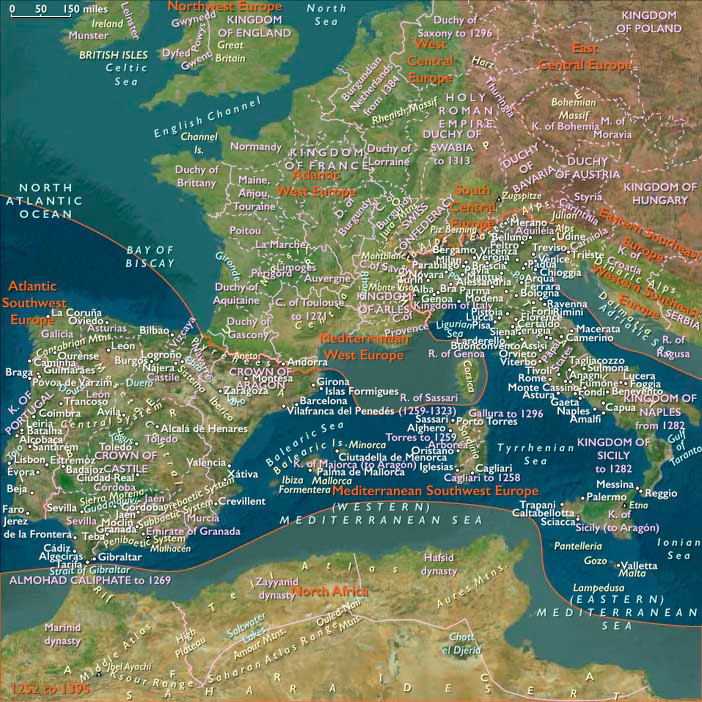
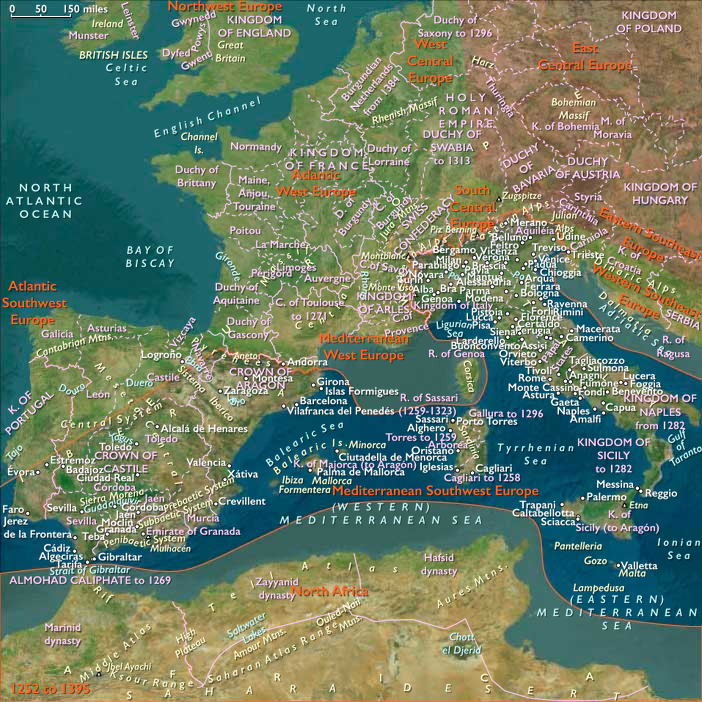
Like Peregrinus' compass, however, Ibn Simʿūn's compass did not feature a compass card In the Mediterranean, the introduction of the compass, at first only known as a magnetized pointer floating in a bowl of water, had gone hand in hand with improvements in dead reckoning methods, and the development of Portolan charts, leading to more navigation during winter months in the second half of the thirteenth century.
While the practice from ancient times had been to curtail sea travel between October and April, due in part to the lack of dependable clear skies during the Mediterranean winter, the prolongation of the sailing season has resulted in a gradual, but sustained increase in shipping movement: By around 1290 the sailing season could start in late January or February, and end in December.
The additional few months are of considerable economic importance.
For instance, it enables Venetian convoys to make two round trips a year to the Levant, instead of one.
At the same time, traffic between the Mediterranean and northern Europe has also increased, with first evidence of direct commercial voyages from the Mediterranean into the English Channel coming in the closing decades of the thirteenth century, and one factor may be that the compass made traversal of the Bay of Biscay safer and easier.
The familiar dry compass (commonly called a mariner's compass), invented in Europe around 1300, consists of three elements: A freely pivoting needle on a pin enclosed in a little box with a glass cover and a wind rose, whereby "the wind rose or compass card is attached to a magnetized needle in such a manner that when placed on a pivot in a box fastened in line with the keel of the ship the card would turn as the ship changed direction, indicating always what course the ship was on".
Later, compasses would often be fitted into a gimbal mounting to reduce grounding of the needle or card when used on the pitching and rolling deck of a ship.
While pivoting needles in glass boxes had already been described by the French scholar Peter Peregrinus in 1269, and by the Egyptian scholar Ibn Simʿūn in 1300, there is an inclination to honor tradition and credit Flavio Gioja, an Italian marine pilot from Amalfi who flourishes around 1302, with perfecting the sailor's compass by suspending its needle over a compass card, giving thus the compass its familiar appearance.
The compass, in conjunction with the rudder, is to greatly ease maritime navigation.
Locations
Groups
Commodoties
Subjects
Regions
Subregions
Related Events
Showing 10 events out of 38 total
Years: 1302 - 1302
Locations
Groups
Commodoties
Subjects
Regions
Subregions