
Vigevano is crowned by the Castello Sforzesco, …
Years: 1494 - 1494
Vigevano is crowned by the Castello Sforzesco, a stronghold rebuilt 1492–94 for Ludovico Maria Sforza (Ludovico il Moro), the great patron born in the town, who has transformed the fortification/hunting lodge of Luchino Visconti (who in turn had reused a Lombard fortress) into a rich noble residence, at the cusp of Gothic and Renaissance.
Leonardo da Vinci is his guest at Vigevano, as is Bramante, who is ascribed with the tall tower that watches over the piazza from the Castello Sforzesco.
The old castle has a unique raised covered road, high enough for horsemen to ride through, that communicates between the new palace and the old fortifications; there is a Falconry, an elegant loggiato supported by forty-eight columns, and, in the rear area of the mastio, the Ladies' Loggia made for Duchess Beatrice d'Este.
Vigevano's main attraction is one of the finest piazzas in Italy, the Piazza Ducale, which is also said to have been laid out by Bramante, and is certainly built for Ludovico il Moro, starting in 1492-93 and completed in record time, unusual for early Renaissance town planning.
Piazza Ducale is actually planned to form a noble forecourt to his castle, unified by the arcades that completely surround the square, an amenity of the new North Italian towns built in the thirteenth century.
The town's main street enters through a sham arcaded façade that preserves the unity of the space as at the Place des Vosges.
Ludovico had demolished the former palazzo of the commune of Vigevano to create the space.
The earliest records of Vigevano date from the tenth century CE, when it was a favored residence of the Lombard king Arduin, for the sake of the good hunting in the vicinity.
Vigevano had been a Ghibelline commune, favoring the Emperor and was accordingly besieged and taken by the Milanese in 1201 and again in 1275.
It finally surrendered in 1328 to Azzone Visconti, and thereafter shared the political fortunes of Milan.
The Church of San Pietro Martire (St Peter Martyr) was built, with the adjacent Dominican convent, by Filippo Maria Visconti in 1445.
In the last years of Visconti domination it sustained a siege by Francesco Sforza.
Once he was settled in power in Lombardy, Sforza arranged for Vigevano to be set up as the seat of a bishop and provided its revenues.
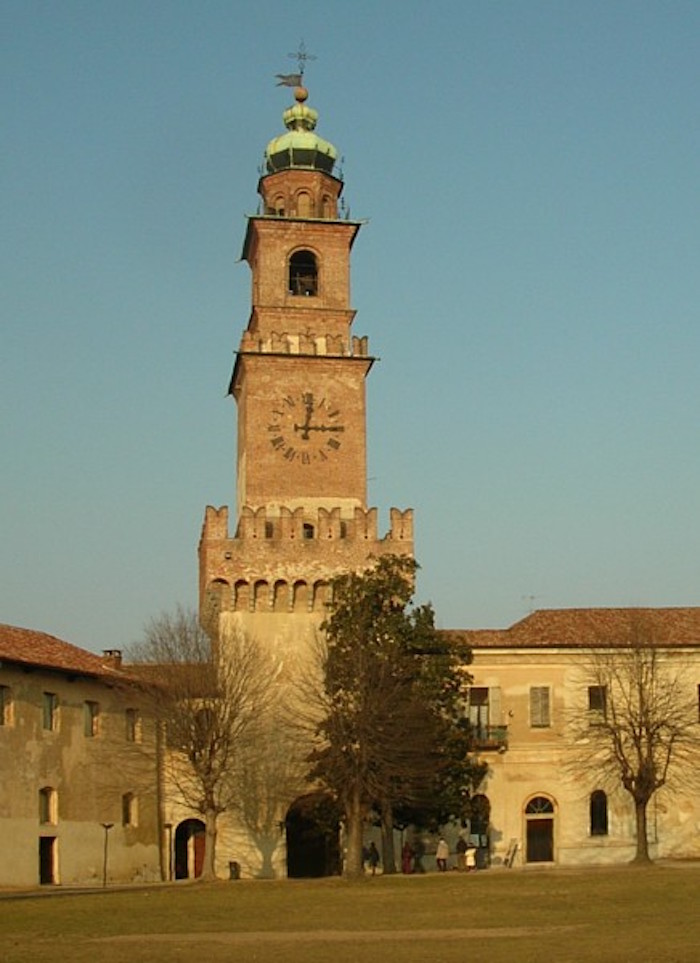
Vigevano, Torre del Bramante Photo taken 15 January 2006 by Idéfix~commonswiki)
Locations
People
Groups
Topics
Commodoties
Subjects
Regions
Subregions
Years: 1494 - 1494
Vigevano, Torre del Bramante Photo taken 15 January 2006 by Idéfix~commonswiki)
Locations
People
Groups
Topics
Commodoties
Subjects
Regions
Subregions