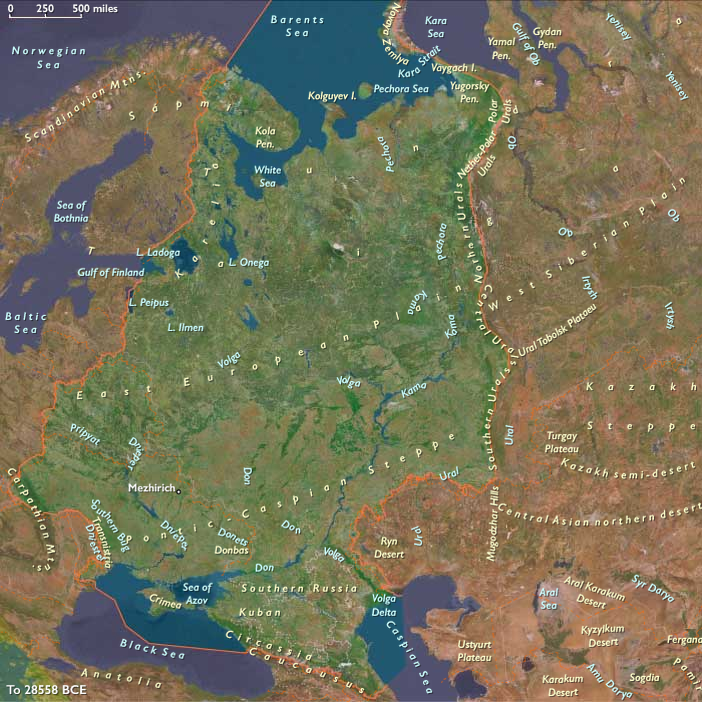
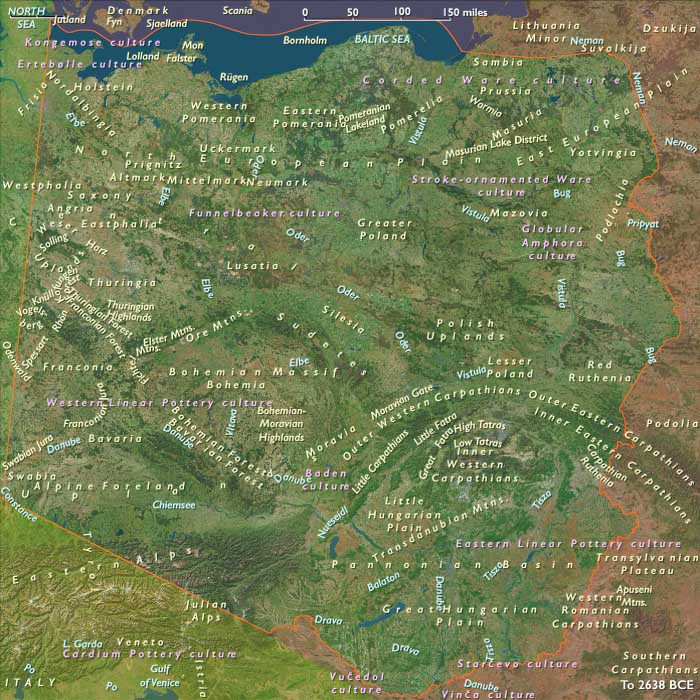
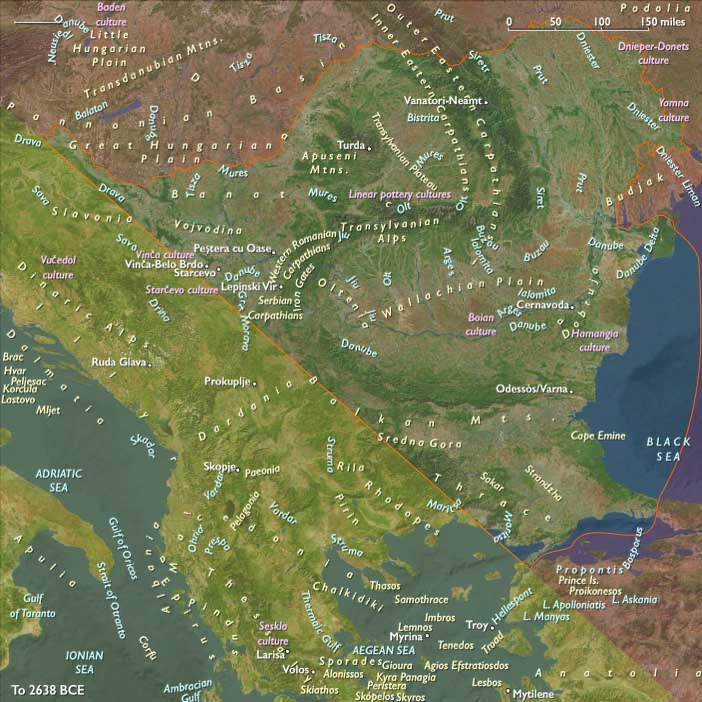
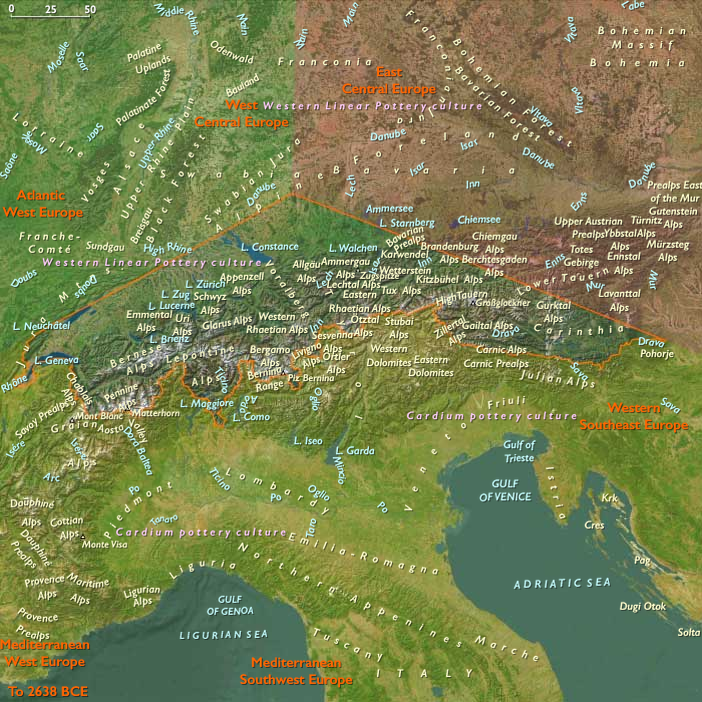
The earliest known remains of …
Years: 37197BCE - 35470BCE
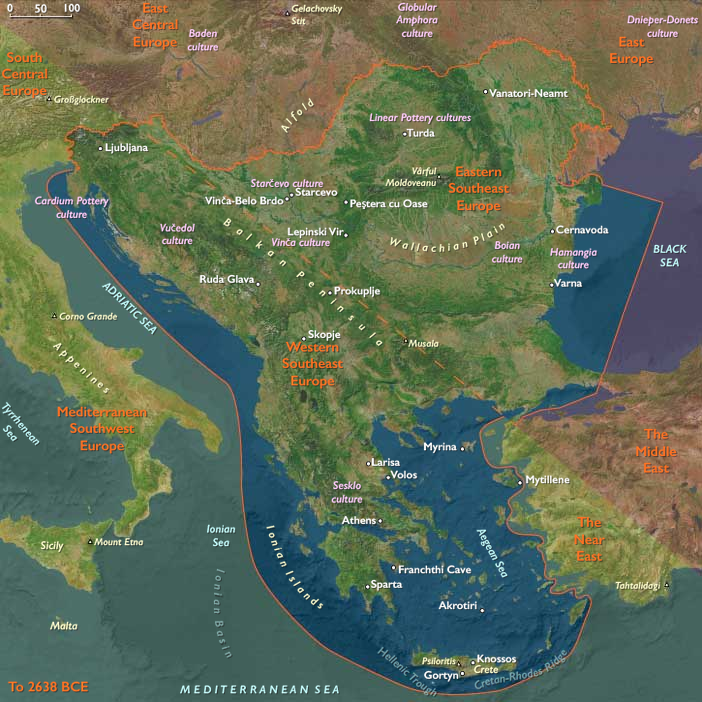
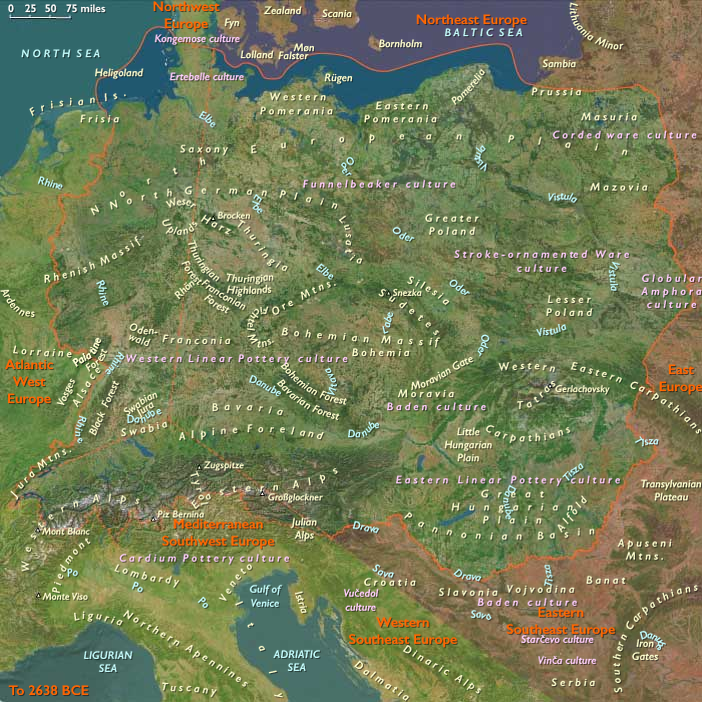
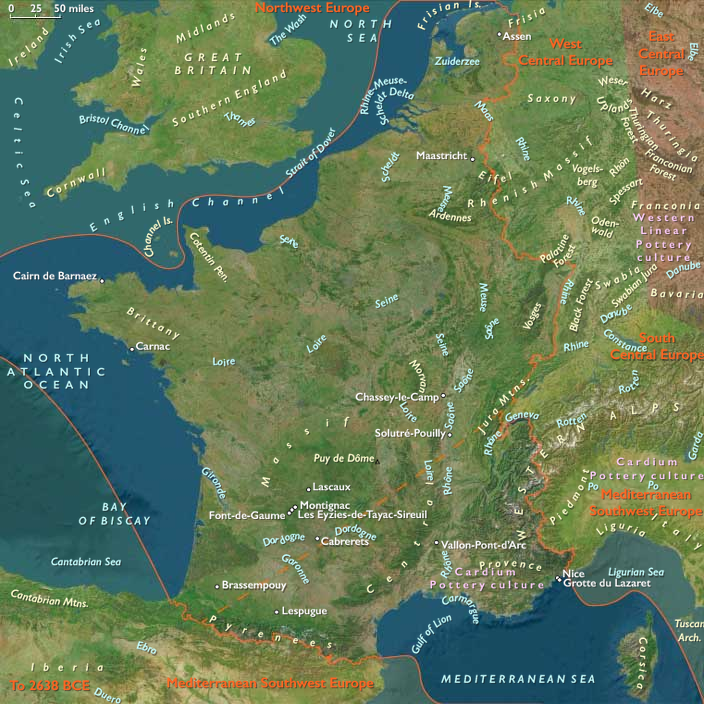
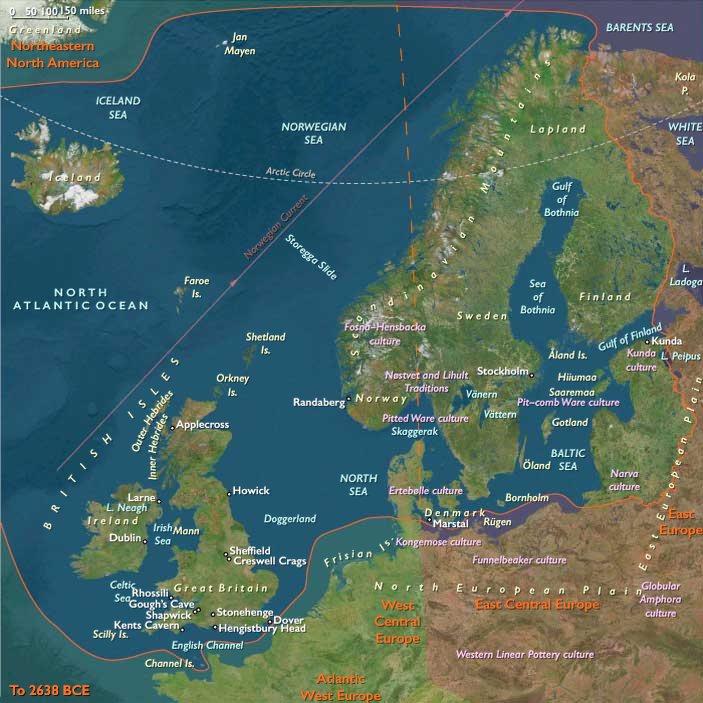
The earliest known remains of Early European Modern Humans (EEMH) have been radiometrically dated to approximately 35,000 years before present.
Related Events
Filter results
Showing 10 events out of 4527 total
The route of the Oregon Trail, one of the main overland migration routes on the North American continent, had begun to be scouted out as early as 1823 by fur traders and explorers.
The trail has begun to be regularly used by fur traders, missionaries, and military expeditions in the 1830s
At the same time, small groups of individuals and the occasional family have attempted to follow the trail, and some have succeeded in arriving at Fort Vancouver in Washington.
On May 1, 1839, a group of men from Peoria, Illinois, sets out with the intention to colonize the Oregon Country on behalf of the United States of America and drive out the British fur trading companies operating there.
The men of the Peoria Party, who are among the first pioneers to blaze the Oregon Trail, are led by Thomas J. Farnham and call themselves the Oregon Dragoons.
They carry a large flag emblazoned with their motto "OREGON OR THE GRAVE.”
Although the group will split up on the trail, several of their members will reach the Oregon Country to become among the prominent early pioneers of this region.
East Micronesia (820–1971 CE): Colonization, Resistance, and Independence
Political and Military Developments
Indigenous Governance and Societal Structures
Between 820 and 1800 CE, indigenous East Micronesian societies, including those in Kosrae, the Marshall Islands, Kiribati, and Nauru, continued developing complex social structures and political systems based on clan leadership, community consensus, and strategic alliances.
European Exploration and Colonization
European exploration significantly impacted East Micronesia beginning in the 16th century, but substantial colonization efforts intensified in the late 19th century. Germany established colonial control over the Marshall Islands and Nauru in 1886 and 1888, respectively. Kiribati fell under British protection in 1892, while Kosrae became part of German Micronesia until it transferred to Japanese administration post-World War I.
Japanese and American Administration
Post-World War I, Japan administered the region under a League of Nations mandate until its defeat in World War II. Afterward, the United States assumed administrative authority over the Marshall Islands and Kosrae under the Trust Territory of the Pacific Islands. Nauru became jointly administered by Australia, New Zealand, and Britain, while Kiribati remained under British colonial rule.
Movement Toward Independence
Throughout the 20th century, nationalist movements and demands for self-governance intensified. By the late 1960s, significant strides toward independence occurred, culminating in eventual sovereignty for many island states in subsequent years.
Economic and Technological Developments
Economic Transformation under Colonial Rule
Colonial rule introduced significant economic transformations, including the commercialization of copra production, phosphate mining in Nauru beginning in 1906, and infrastructure improvements aimed at facilitating resource extraction and colonial governance.
Technological and Infrastructure Advances
Colonial powers introduced modern infrastructure such as transportation networks, telecommunications, and improved maritime facilities. These developments fundamentally reshaped local economies, social structures, and everyday life in East Micronesia.
Cultural and Artistic Developments
Cultural Preservation and Adaptation
Despite colonial pressures, East Micronesian communities preserved many traditional cultural practices, including oral histories, navigational traditions, and communal rituals. Artistic expressions blended indigenous and colonial influences, creating dynamic cultural landscapes.
Revival and Assertion of Indigenous Culture
The 20th century saw concerted efforts to revive and assert indigenous cultural identities, particularly in response to external influences and increasing calls for independence and autonomy.
Social and Religious Developments
Impact of Christianity
Missionaries significantly impacted religious and social structures throughout East Micronesia. Christianity, predominantly Protestantism and Catholicism, became widely adopted, integrating with traditional belief systems and influencing community practices and societal norms.
Social Transformation
Colonial administration introduced Western education, legal frameworks, and governance models, dramatically reshaping local societies. However, traditional kinship systems, clan structures, and communal decision-making practices persisted as core societal foundations.
Long-Term Consequences and Historical Significance
The period from 820 to 1971 CE marked transformative developments in East Micronesia, characterized by colonial encounters, economic changes, cultural adaptation, and the drive toward self-determination. These centuries profoundly influenced regional identities, social structures, and economic foundations, setting the stage for post-colonial nation-building and ongoing regional dynamics.
East Melanesia (820–1971 CE): Interactions, Colonization, and Independence
Political and Military Developments
Chiefdoms and Inter-Island Alliances
From 820 CE onward, East Melanesia experienced significant growth of complex chiefdoms, notably in Fiji, Vanuatu, and the eastern Solomon Islands. These chiefdoms formed intricate networks of alliances and rivalries, reflecting advanced political organization and military strategies.
European Contact and Colonization
European explorers, beginning in the 17th century, profoundly impacted East Melanesia. Initial exploration was followed by colonization, particularly by British and French powers. New Caledonia became a French colony in 1853, while Fiji was ceded to Britain in 1874, and Vanuatu was jointly administered by Britain and France from 1906 as the New Hebrides Condominium.
Road to Independence
During the 20th century, nationalist movements intensified across East Melanesia. Fiji gained independence in 1970, and later Vanuatu in 1980, highlighting significant shifts towards self-governance and regional sovereignty.
Economic and Technological Developments
Agricultural Innovation and Trade
Agricultural techniques continued evolving, with innovations in crop diversification, cultivation methods, and trade expansion. Copra (dried coconut meat), sandalwood, and sugar became significant economic commodities, fostering regional and global trade.
Technological Integration and Modernization
European colonization introduced new technologies, including metal tools, firearms, and improved shipbuilding techniques. These advancements altered economic practices, transportation, and military dynamics within the region.
Cultural and Artistic Developments
Syncretism and Cultural Adaptation
Cultural traditions adapted and syncretized indigenous Melanesian practices with European influences. Artistic expression, including traditional carvings, dances, and music, incorporated external elements, reflecting evolving cultural identities.
Preservation of Indigenous Traditions
Despite colonial pressures, many indigenous cultural traditions were preserved and revitalized. Ceremonial practices, storytelling, and traditional knowledge systems remained critical components of community cohesion and identity.
Social and Religious Developments
Impact of Christianity
Missionary activities beginning in the 19th century profoundly reshaped religious landscapes, introducing Christianity widely throughout East Melanesia. This led to the blending of indigenous religious practices with Christian doctrines.
Social Changes and Community Structures
Colonialism significantly influenced social structures, introducing Western legal systems, education, and governance models. Nevertheless, traditional community organization, chiefly hierarchies, and kinship networks continued playing vital roles.
Long-Term Consequences and Historical Significance
From 820 to 1971 CE, East Melanesia underwent transformative changes through internal dynamics, external influences, and colonization. The resulting synthesis of traditional and introduced elements profoundly shaped contemporary political structures, economic foundations, cultural identities, and social systems, laying critical groundwork for the post-colonial era.
Northern South Asia (820–1971 CE): Empires, Colonialism, and the Birth of Modern Nations
Medieval Empires and Dynastic Rule
From the early medieval period onward, Northern South Asia experiences significant dynastic changes. Islamic empires begin exerting influence from the 11th century with the Ghaznavids and later the Delhi Sultanate, reshaping cultural and political landscapes through trade, conquest, and cultural exchanges. Simultaneously, Afghanistan becomes a crucial frontier region, witnessing invasions and rule by various Turkic and Persian dynasties, including the Timurids and the early Mughals.
Nepal and Bhutan remain largely isolated, developing distinctive Himalayan cultures and systems of governance. In Nepal, the medieval period is characterized by the rule of various dynasties, such as the Mallas, who foster rich cultural and architectural traditions.
Mughal Ascendancy and Cultural Synthesis
The rise of the Mughal Empire in the 16th century under rulers like Babur, Akbar, and Aurangzeb marks a pinnacle of political and cultural achievement. The Mughals integrate diverse traditions, fostering a unique synthesis of Persian, Indian, and Central Asian cultures. Monumental architecture flourishes, exemplified by the Taj Mahal and the Red Fort. Administrative systems established under Akbar provide stability and governance across the empire, extending influence into modern-day Pakistan, Bangladesh, and parts of Afghanistan.
British Colonial Expansion
The weakening Mughal Empire in the 18th century facilitates the expansion of the British East India Company, climaxing with the pivotal Battle of Plassey in 1757. British dominance consolidates rapidly, leading to direct British rule following the Indian Rebellion of 1857–58. Afghanistan, however, remains fiercely independent, becoming a contested region between British India and Imperial Russia, sparking several Anglo-Afghan wars.
Meanwhile, Nepal under the Shah Dynasty and Bhutan under the leadership of the Wangchuck Dynasty maintain autonomy, though both engage diplomatically and militarily with British India. Bhutan eventually signs treaties with Britain, securing internal sovereignty while ceding some frontier territories.
Rise of Nationalist Movements
Nationalist movements emerge by the late 19th century, notably with the establishment of the Indian National Congress in 1885. Parallel to this, Sir Syed Ahmad Khan spearheads educational reforms for Muslims, founding the Muhammadan-Anglo Oriental College in 1875 (later Aligarh Muslim University), laying the foundation for Muslim political activism.
Afghanistan sees modernization and centralization efforts under leaders like Amir Abdur Rahman Khan (1880–1901), who solidifies borders and establishes the Durand Line with British India, a source of enduring tension.
Independence, Partition, and the Emergence of Modern States
Intense nationalist struggles, notably under Mahatma Gandhi and Muhammad Ali Jinnah, culminate in independence and the partition of British India in 1947, creating the independent dominions of India and Pakistan. The partition triggers massive migrations and communal violence, significantly reshaping the region.
Afghanistan navigates neutrality during this period, balancing relations between emerging global powers, while Nepal and Bhutan maintain independent monarchies, cautiously opening diplomatic relations with neighboring nations and beyond.
Post-Independence Challenges and Conflicts
The new states face immediate challenges, including economic stabilization, integration of princely states, and border disputes, notably over Kashmir. Pakistan experiences internal turmoil, leading to the separation of East Pakistan and the birth of Bangladesh in 1971, following a violent liberation struggle. India maintains democratic governance, embarking on industrialization and social reforms.
Afghanistan becomes a focal point of Cold War rivalry, undergoing rapid modernization, yet experiencing deep internal divisions, leading to instability that intensifies in subsequent decades.
Nepal and Bhutan cautiously engage in modernization while striving to preserve traditional identities. Bhutan introduces controlled development policies under the monarchy, and Nepal gradually opens to external influence.
Legacy of the Epoch
The epoch from 820 to 1971 profoundly shapes Northern South Asia, witnessing transitions from medieval empires to colonial subjugation, culminating in complex realities of independent nation-states. Legacies include cultural syncretism, unresolved regional tensions (particularly over Kashmir and the Durand Line), and socio-political structures inherited from colonial rule. These dynamics continue influencing contemporary geopolitics and societal developments across Northern South Asia.
Northern North America (1684–1827 CE); Empires Contested, Nations Born, Frontiers Pushed
Geography & Environmental Context
Northern North America includes the modern United States and Canada, excluding the West Indies. It is divided into three subregions:
-
Northeastern North America: east of 110°W, from New England and the Maritimes through the Great Lakes and Hudson Bay to Virginia, the Carolinas, most of Georgia, and the Mississippi Valley above Little Egypt.
-
Northwestern North America: west of 110°W, from Alaska and the Yukon to the Pacific Northwest and northern California north of the Gulf line.
-
Gulf and Western North America: the wedge south of the Montana diagonal, encompassing the plantation South, the Mississippi Valley below Illinois’ Little Egypt, the Plains, the Southwest, and California south of the Oregon border.
Together, these lands embraced a mosaic of boreal forest, prairie, Appalachian highlands, arid plains, subtropical deltas, and Pacific fjords. Each subregion developed distinct lifeways, but all were drawn into the same imperial rivalries and revolutionary transformations.
Climate & Environmental Shifts
The Little Ice Age persisted into the 18th century, bringing harsh winters to the northeast, erratic salmon and root harvests in the northwest, and drought cycles to the Southwest. Hurricanes battered the Gulf coast, while floods shaped the Mississippi delta. Resource pressures mounted: beaver populations declined from overtrapping, forests receded around port towns and plantations, and horse herds spread across the Plains.
Subsistence & Settlement
-
Indigenous nations maintained diverse economies: maize horticulture in the northeast and southeast, bison hunting on the Plains, salmon fisheries along Pacific rivers, and seal and whale hunting in the Arctic.
-
Colonial settlements took different forms: French Canada and Louisiana, Spanish missions in the Southwest and California, British seaboard colonies, and Russian posts in Alaska.
-
The United States, born of revolution, expanded westward into Kentucky, Tennessee, and the Ohio Valley, while Loyalists and Acadians reshaped Canada’s demography.
Technology & Material Culture
Indigenous technologies — birchbark canoes, snowshoes, horse gear, cedar plankhouses, irrigation systems — persisted alongside European imports: muskets, iron tools, plows, mills, sailing ships, and missions. Hybrid cultures emerged, such as Métis in the fur trade, African-descended Gullah in the Carolinas, and Spanish-Indian ranching lifeways in the Southwest.
Movement & Interaction Corridors
-
Rivers: the St. Lawrence, Great Lakes, Mississippi, and Columbia were arteries of commerce and war.
-
Maritime networks: Atlantic ports linked to Europe, the Caribbean, and Africa; Gulf and Pacific ports tied into global markets.
-
Overland corridors: mission trails, fur brigades, and horse trade networks tied regions together.
-
Migration: enslaved Africans carried to the South, European immigrants to the seaboard and interior, Loyalist refugees to Canada, and Indigenous nations displaced westward.
Cultural & Symbolic Expressions
Indigenous diplomacy — wampum belts, council fires, potlatch ceremonies, and Green Corn rituals — remained central. European religions spread: Catholicism in French and Spanish zones, Protestantism in the British colonies, syncretic traditions among African and Native peoples. Symbols of sovereignty proliferated: forts, flags, treaties, missions, and plantations marked territorial claims.
Environmental Adaptation & Resilience
Indigenous nations diversified subsistence, shifting to fur trapping, mounted bison hunting, or blending ritual with Catholic observance. Colonists adapted to hurricanes, droughts, and floods with new architecture, irrigation, and crop rotations. Food storage, trade alliances, and hybrid practices allowed resilience in a volatile climate.
Political & Military Shocks
-
Imperial wars: Nine Years’ War, Queen Anne’s War, and the Seven Years’ War reshaped borders and alliances.
-
Revolutions: The American Revolution created the United States; the Haitian Revolution reverberated through the Gulf; Indigenous uprisings, from Tecumseh’s confederacy to Pueblo resistance, challenged colonial regimes.
-
Territorial transfers: Louisiana Purchase (1803), Florida cession (1821), Russian America consolidations in Alaska.
-
War of 1812: Britain and the U.S. contested Great Lakes and Gulf coasts, leaving Native confederacies weakened.
Transition
Between 1684 and 1827, Northern North America was transformed from a patchwork of Indigenous nations and rival empires into a continental stage of settler republics, expanding frontiers, and Indigenous dispossession. The fur trade, cod fisheries, plantations, and salmon runs tied its subregions into global markets, while revolution and war redrew its maps. By 1827, the United States was pushing across Appalachia, Canada remained in Britain’s orbit, Russian America and Spanish missions dotted the Pacific, and Native nations, though battered, continued to anchor economies and cultures from the Arctic to the Gulf.
South Polynesia (1684–1827 CE): Māori Intensification, Moriori Resilience, and Early European Intrusions
Geography & Environmental Context
South Polynesia includes New Zealand’s North Island (except its southwestern tip), the Chatham Islands, Norfolk Island, and the Kermadec Islands. Anchors include the Waikato basin, the Bay of Islands, the volcanic spine of the Central Plateau (Tongariro, Taupō, Taranaki), the Northland peninsulas, the Chatham Islands’ cool oceanic plains, Norfolk’s basalt soils and pines, and the volcanic Kermadecs. The subregion spans temperate to subtropical zones, supporting horticulture, rich fisheries, and diverse coastal ecologies.
Climate & Environmental Shifts
The North Island enjoyed reliable rainfall, though droughts periodically afflicted its east coast. Volcanic activity persisted (e.g., Tongariro and White Island eruptions). The Chatham Islands, further east, had cooler, wetter conditions, limiting kūmara cultivation. Norfolk and the Kermadecs were uninhabited but noted by passing Polynesian voyagers and later Europeans. Storms and occasional cyclones swept the coasts, shaping settlement patterns and resource use.
Subsistence & Settlement
-
Māori (North Island): Cultivated kūmara, taro, yams, and gourds; fern root and forest birds supplemented diets. Fishing and shellfish gathering were central. Fortified pā (hilltop strongholds) anchored communities, and large waka (canoes) enabled transport and warfare.
-
Moriori (Chathams): Practiced marine-based subsistence—fishing, birding, root crops, and foraging—with a pacifist ethos that emphasized nonviolence and resource balance.
-
Norfolk & Kermadecs: Uninhabited in this era, but Norfolk’s fertile land and towering pines attracted later European interest; the Kermadecs served as occasional stopovers for voyagers and whalers.
Technology & Material Culture
-
Māori technologies: Double-hulled canoes (waka hourua), intricate wood carving, flax weaving, stone adzes, and greenstone (pounamu) tools and weapons. By the early 19th century, muskets, iron, and European textiles entered Māori material culture.
-
Moriori lifeways: Light canoes adapted to the Chathams’ conditions; plaited mats, wood tools, and fishhooks reflected maritime adaptation.
-
Introductions: European iron nails, axes, and muskets—obtained through trade with whalers and sealers—reshaped Māori society, especially warfare.
Movement & Interaction Corridors
-
Polynesian networks: Inter-iwi exchange flourished across the North Island, while Māori voyagers interacted with the Chathams.
-
European arrival: Abel Tasman (1642) and James Cook (1769) mapped coasts; from the late 18th century, sealers, whalers, and traders frequented the Bay of Islands and Hauraki Gulf.
-
Missionary stations: From 1814, the London Missionary Society established missions in the Bay of Islands, spreading Christianity, literacy, and new crops.
-
Trade: Māori exchanged timber, flax, pork, and food for muskets, iron tools, and cloth.
Cultural & Symbolic Expressions
-
Māori society: Structured by kin groups (iwi, hapū), prestige (mana), and ancestral authority (tapu). Carved meeting houses, oral whakapapa (genealogies), and oratory in marae embodied identity.
-
Moriori ethos: Centered on peace and environmental balance, with communal rituals and oral traditions preserving identity.
-
European influences: Christian teachings and literacy began to take hold, though Māori selectively incorporated them into existing frameworks.
Environmental Adaptation & Resilience
-
Māori: Terracing, kūmara storage pits, and careful microclimate selection expanded horticulture’s reach. Coastal and riverine fisheries buffered against crop failures.
-
Moriori: Relied on fishing and birding to adapt to the Chathams’ cooler climate.
-
Cultural resilience: Kinship and reciprocity stabilized food sharing; oral traditions reinforced stewardship of land and sea.
Political & Military Shocks
-
Māori intertribal conflict: Warfare was endemic but intensified dramatically after the introduction of muskets in the early 19th century, sparking the “Musket Wars” and mass displacements.
-
European incursions: Cook’s voyages (1769–77) opened sustained European contact; whalers and sealers established shore stations, often disrupting local ecologies.
-
Missionaries: Introduced new belief systems and literacy, reshaping cultural landscapes.
-
Norfolk & Kermadecs: Observed by European navigators as potential bases but not yet colonized.
Transition
Between 1684 and 1827, South Polynesia was a dynamic world of Māori horticultural intensification, Moriori maritime resilience, and mounting European contact. The Bay of Islands became a hub of trade and cultural exchange, missions introduced Christianity and literacy, and muskets revolutionized Māori conflict. Norfolk and the Kermadecs remained marginal but strategically noted by explorers. By 1827, the region stood on the threshold of colonization, with Indigenous societies resilient yet deeply altered by global trade, warfare, and missionary influence.
Thai influence grows in the following years until challenged by Western powers.
In 1795 the Thai seize the provinces of Battambang and Siem Reap in Cambodia, where throughout the first half of the next century Chakkri kings will resist Vietnamese incursions.
The conflict between the Thai and the Vietnamese is resolved finally by a compromise providing for the establishment of a joint protectorate over Cambodia.
The Thai also press their claim to suzerainty in the Malay state of Kedah in the face of growing British interest in the peninsula.
As a result of the Anglo- Burmese War (1824-26), Britain annexes territory in the region that had been contested by the Thai and the Burmese for centuries.
This move leads to the signing of the Burney Treaty in 1826, an Anglo-Thai agreement that allows British merchants modest trade concessions in the kingdom.
In 1833 the Thai will reach a similar understanding with the United States.
Maritime East Asia (1684–1827 CE): Imperial Order, Maritime Gateways, and Cultural Flowerings
Geography & Environmental Context
Maritime East Asia encompasses southern and eastern China (Yunnan, Guangxi, Guizhou, the Sichuan Basin, Chongqing, Hunan, Hubei, Henan, Shanxi, Hebei, Beijing, Guangdong, Fujian, Zhejiang, Jiangsu, Shandong, Liaoning, Jilin, and southern Heilongjiang), Taiwan, the Korean Peninsula, southern Primorsky Krai, the Japanese islands of Kyushu, Shikoku, Honshu, and southwestern Hokkaidō, and the Ryukyu and Izu island chains. Anchors include the Yangtze and Yellow River valleys, the Sichuan Basin, the Pearl River Delta, the rugged coasts of Fujian and Zhejiang, the Taiwan Strait, the mountainous spine of Korea, and Japan’s great urban and agricultural heartlands from Kantō to Kansai. The region combines vast agrarian river basins, fertile plains, strategic straits, and densely settled coastal archipelagos.
Climate & Environmental Shifts
The subtropical–temperate monsoon shaped agriculture, with wet summers and drier winters. The waning Little Ice Age brought occasional severe winters (notably in North China and Korea) and episodes of drought that stressed rice harvests in Hunan, Jiangxi, and the Korean Peninsula. Typhoons battered the coasts of Fujian, Taiwan, and the Ryukyus. In Japan, volcanic eruptions (such as Mount Asama in 1783) caused famines and hardship, while floods along the Yellow and Yangtze Rivers periodically displaced entire communities.
Subsistence & Settlement
-
China: Wet-rice agriculture dominated in the Yangtze basin and south, supplemented by millet, wheat, and sorghum in the north. Tea, mulberries (for silk), and cotton became vital cash crops. The Sichuan Basin supported immense populations with rice and maize. Urban centers such as Beijing, Nanjing, Hangzhou, Suzhou, Guangzhou (Canton), and Chongqing flourished as administrative, commercial, and cultural hubs.
-
Taiwan: Han settlers expanded irrigated rice and sugarcane fields, pressing Indigenous Austronesian groups into the interior highlands.
-
Korea: Rice paddies dominated southern valleys, while barley, millet, and dry-field crops supplemented diets further north. Villages clustered around Confucian schools and market towns.
-
Japan: The Tokugawa regime stabilized settlement; rice yields increased through new irrigation and fertilization, while cash crops like cotton, indigo, and tobacco gained importance. Cities like Edo (Tokyo), Osaka, and Kyoto grew into some of the world’s largest.
-
Ryukyu Kingdom: Dependent on rice imports from Japan, it thrived on inter-island trade, serving as a conduit between China and Japan under Satsuma domain oversight.
Technology & Material Culture
-
Agriculture: Advanced irrigation, terracing, and the widespread use of organic fertilizers (night soil, compost) sustained high yields.
-
Manufacturing: China’s silk and porcelain industries dominated exports; Japan’s kilns (Arita ware) and cotton weaving became major domestic and export commodities.
-
Shipbuilding: Chinese junks, Korean panokseon warships, and Japanese coastal vessels were crucial for regional commerce. European ship designs were selectively adopted in Japan.
-
Architecture: Confucian academies, Buddhist temples, and Edo-period castles marked landscapes, alongside urban palaces and gardens in China.
-
Printing and literacy: Woodblock and movable type printing flourished—Confucian texts, Buddhist sutras, vernacular novels, and practical handbooks circulated widely.
Movement & Interaction Corridors
-
China: After 1684, the Qing legalized overseas trade, but restricted it under the Canton System (1757), making Guangzhou the sole port for Western commerce. American silver flowed into China in exchange for tea, silk, and porcelain.
-
Taiwan: Exported sugar and rice to Fujian and Guangdong; served as a frontier zone of Han migration.
-
Korea: Maintained tributary ties with Qing China, cautiously limited external contact, but cultivated a rich scholarly and Confucian culture.
-
Japan: Under the sakoku system, Japan restricted European contact to the Dutch at Dejima (Nagasaki), while maintaining tributary relations with Korea and the Ryukyu Kingdom.
-
Ryukyus: Functioned as diplomatic and commercial intermediaries, carrying goods and rituals between Okinawa, Japan, and China.
-
Global circuits: The Manila Galleon funneled New World silver into Asian markets, while the VOC and EIC pressed for greater access, focusing on China’s southern ports.
Cultural & Symbolic Expressions
-
China: The Qing dynasty reinforced Neo-Confucian orthodoxy through the civil service exams, while popular religion blended Daoism, Buddhism, and local cults (notably Mazu, goddess of the sea). Literati culture produced calligraphy, painting, and novels such as Dream of the Red Chamber.
-
Taiwan: Coastal temples honored Chinese deities, while Indigenous peoples retained ancestral rituals tied to hunting, fishing, and agriculture.
-
Korea: The yangban elite upheld Confucian values through schools and shrines; popular culture thrived in mask dramas and pansori storytelling.
-
Japan: Tokugawa ideology emphasized Neo-Confucian order, while Shinto shrines and Buddhist temples framed spiritual life. The Edo period produced a cultural efflorescence—kabuki theater, ukiyo-e prints, haiku poetry, and vibrant urban popular culture.
-
Ryukyus: Ritual specialists (noro) maintained ancestral rites; Chinese Confucian influences blended with indigenous traditions.
Environmental Adaptation & Resilience
-
Flood control and granaries: Hydraulic works in the Yangtze and Yellow River valleys, and state granaries, mitigated famine risks (though corruption undermined relief in some crises).
-
Agricultural diversification: Widespread adoption of maize, sweet potatoes, and peanuts (American introductions) strengthened resilience against rice failures.
-
Fisheries and forestry: Coastal communities balanced rice dependence with fishing and salt production; Japan regulated forests under Tokugawa edicts to prevent deforestation.
-
Trade buffering: Korean, Ryukyuan, and Japanese polities balanced restricted external contacts with strong internal redistribution systems.
Transition
Between 1684 and 1827, Maritime East Asia embodied both stability and global entanglement. The Qing dynasty consolidated rule over vast agrarian systems while restricting trade to Canton. Korea remained the “Hermit Kingdom,” committed to Confucian orthodoxy. Japan’s Tokugawa shogunate enforced sakoku, but nurtured a thriving domestic economy and Edo’s cultural efflorescence. Taiwan transformed into a frontier of Han settlement, and the Ryukyus remained intermediaries between larger powers. By the early 19th century, Lower East Asia stood as one of the most populous, literate, and economically dynamic regions of the world—yet pressures from European trade and demographic strain hinted at the upheavals soon to come.
Indian opium has become a major global commodity under the British, who dominate the trade.
Opium's peculiar properties make it the ideal trade good during this age, combining the reliable demand of a basic food with the logistics of a luxury good.
As an addictive drug, opium requires a daily dose, giving it the inelastic demand of a basic foodstuff.
Long distance sea-trade in bulk foods is beyond the capacity of current maritime technology, but opium has the low weight and high markup of a luxury good like cloves or pepper.
Compounding its extraordinary profitability, China's Yongzheng emperor reacts to the rise of mass addiction by banning opium in 1729 and thus denying China the opportunity to produce opium locally to undercut the high price of Indian imports.
A syndicate of Indian merchants up the Ganges River at Patna holds a monopoly over the Bengal opium trade, making cash advances to peasant farmers and selling the processed opium to Dutch, British and French merchants.
Forces of the British East India Company in 1764 march inland from their port at Calcutta to conquer Bengal.
They soon discover the financial potential of India's richest opium zone.
The Company assumes control of a well-established opium industry involving peasant producers, merchants, and long-distance traders.
British exports of Indian opium to China increase from fifteen tons in 1720 to seventy-five tons in 1773, in which year the British governor-general of Bengal abolishes the Indian opium syndicate at Patna and establishes a colonial monopoly on the sale of opium.
Opium not only solves the fiscal crisis that accompanied the British conquest of Bengal; it remains a staple of colonial finances, providing from six to fifteen percent of British India's tax revenues throughout the nineteenth Century.
More important, opium exports are an essential component of a triangular trade that is the foundation of Britain's status as a world power.
Smoking of opium in China had come on the heels of tobacco smoking and may have been encouraged by a brief ban on the smoking of tobacco by the Ming emperor, ending in 1644 with the Qing dynasty, which had encouraged smokers to mix in increasing amounts of opium.
The smoking of opium soon becomes popular throughout China.
Opium addiction increases, and opium importations from India grow rapidly.
Britain and other European nations undertake the opium trade because of their chronic trade imbalance with China during the eighteenth century.
There is tremendous demand in Europe for Chinese tea, silks, and porcelain, but there is correspondingly little demand in China for Europe's manufactured goods and other trade items.
Consequently, Europeans must pay for Chinese products with gold or silver.
The opium trade, which creates a steady demand among Chinese addicts for opium imported by the West, solves this chronic trade imbalance.
Years: 37197BCE - 35470BCE
Topics
Subjects
Regions
Subregions
- East Europe
- East Central Europe
- Eastern Southeast Europe
- South Central Europe
- Mediterranean West Europe
- Mediterranean Southwest Europe
- Atlantic Southwest Europe
- West Central Europe