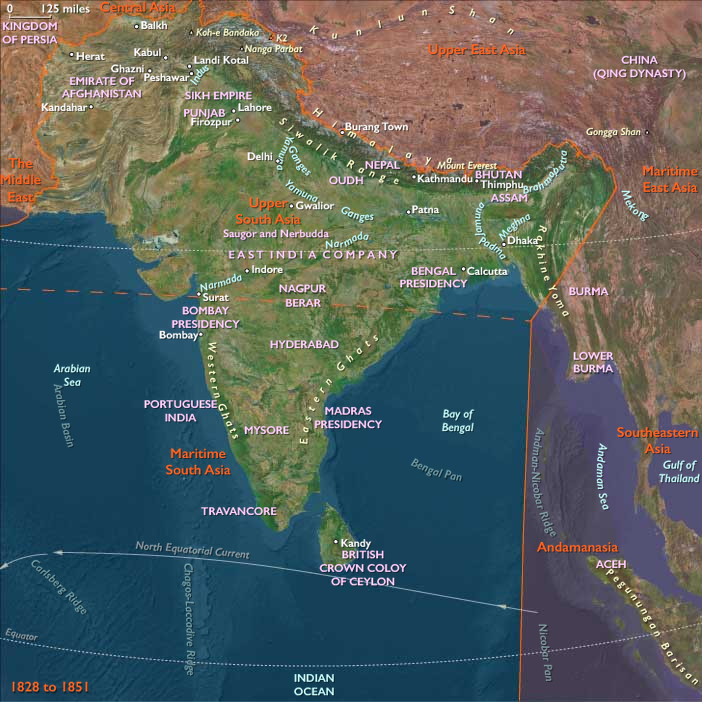
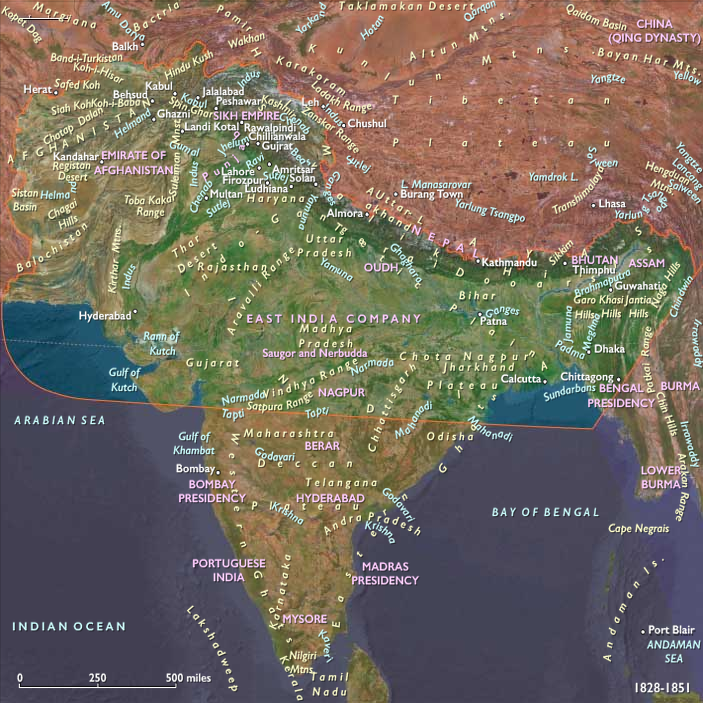
European traders set up the first tea …
Years: 1840 - 1840
Locations
Groups
- East India Company, British (United Company of Merchants of England Trading to the East Indies)
- India, East India Company rule in
Commodoties
Subjects
Regions
Subregions
Related Events
Filter results
Showing 10 events out of 18028 total
This paves the way for British colonies on Vancouver Island (1849) and in British Columbia (1858).
The process will finally end around 1890–1912 as the last major farmlands and ranch lands are settled.
Native tribes in some places resist militarily, but they had been overwhelmed by settlers and the army and after 1830 had been relocated to reservations in the west.
The highly influential "Frontier Thesis" of Wisconsin historian Frederick Jackson Turner argues that the frontier shaped the national character, with its boldness, violence, innovation, individualism, and democracy.
The '49ers (in the California Gold Rush), ranchers, farmers, and entrepreneurs and their families head to California, Oregon, and other points in the far west.
Wagon-trains take five or six months on foot; after 1869, the trip will take six days by rail.
North Polynesia (1840–1851 CE)
Consolidation and Constitutional Reform under Kamehameha III
The reign of Kamehameha III (Kauikeaouli) saw crucial developments in the political and social landscape of the Hawaiian Islands. Having assumed full royal authority following the deaths of his influential advisors—Kaʻahumanu in 1832 and Kinaʻu shortly thereafter—Kamehameha III sought stability through the establishment of a more formalized system of governance.
In 1840, Kamehameha III promulgated Hawaii’s first written constitution, fundamentally transforming the kingdom into a constitutional monarchy. This document, influenced significantly by Western legal principles, outlined a government structure comprising executive, legislative, and judicial branches, thereby strengthening central authority and clearly defining the king’s powers.
The Paulet Affair and International Diplomacy
In 1843, tensions escalated with the arrival of British naval officer Lord George Paulet, who claimed Hawaii for Britain after disputes involving the property rights of British subjects. Paulet's temporary occupation prompted Kamehameha III to dispatch diplomatic representatives to London. The crisis was resolved through diplomatic channels, and British Rear Admiral Richard Thomas restored Hawaiian sovereignty later that same year. This restoration led Kamehameha III to famously proclaim, Ua Mau ke Ea o ka ʻĀina i ka Pono—"The life of the land is perpetuated in righteousness"—a phrase which became Hawaii’s official motto.
Land Tenure and the Great Mahele
In an effort to modernize land management and ownership, the landmark Great Mahele (land division) commenced in 1848. This extensive land redistribution dramatically altered traditional landholding practices, transitioning from communal systems to individual ownership under Western property laws. However, the Mahele inadvertently favored foreign settlers and Hawaiian elites, resulting in widespread dispossession and marginalization of many native Hawaiians who lacked familiarity with private land ownership concepts.
Economic and Social Changes
During this period, Hawaii's economy continued to thrive due to increased trade and agricultural exports, especially sugar. The cultivation of sugarcane expanded substantially, spurred by Western technological advancements and rising international demand. Honolulu’s prominence as a trade hub continued to grow, solidifying its role as the economic and political center of the kingdom.
The rapid economic expansion brought an influx of foreign workers and settlers, intensifying Hawaii's transformation into a multicultural society. Despite economic gains, the native Hawaiian population continued to decline, ravaged by diseases such as measles and influenza introduced through increased international contact.
Educational and Religious Developments
Missionary influence persisted throughout Kamehameha III's reign, significantly shaping education and religious life. Protestant and Catholic missions competed for influence, establishing schools, churches, and seminaries across the islands. Education became more accessible, particularly in English, which increasingly became the language of commerce and government.
These developments between 1840 and 1851 further solidified the Kingdom of Hawaii’s integration into the global economic system, formalized its governmental structures, and marked a pivotal transition toward modernity and Western influence, albeit with profound consequences for native Hawaiian society and culture.

Only a few sporadic contacts with the New Caledonian archipelago are recorded from 1796 until 1840.
About fifty American whalers (identified by Robert Langsom from their log books) are recorded in the region (Grande Terre, Loyalty Is., Walpole and Hunter) between 1793 and 1887.
Contacts become more frequent after 1840, because of the interest in sandalwood.
As trade in sandalwood declines, it is replaced by a new business enterprise, "blackbirding", a euphemism for taking Melanesian or Western Pacific Islanders from New Caledonia, the Loyalty Islands, New Hebrides, New Guinea, and the Solomon Islands into indentured or forced labor in the sugar cane plantations in Fiji and Queensland by various methods of trickery and deception.
In the early years of the trade, coercion is used to lure Melanesian islanders onto ships.
In later years indenture systems will be developed; however, when it comes to the French slave trade, which takes place between its Melanesian colonies of the New Hebrides and New Caledonia, very few regulations are implemented.
This represented a departure from the British experience, since increased regulations will be developed to mitigate the abuses of blackbirding and 'recruitment' strategies on the coastlines.
The first missionaries from the London Missionary Society and the Marist Brothers arrive in the 1840s.
In 1849, the crew of the American ship Cutter is killed and eaten by the Pouma clan.
Cannibalism is widespread throughout New Caledonia.
New Zealand, still part of the colony of New South Wales, becomes a separate Colony of New Zealand on July 1, 1841.
Armed conflict begins between the Colonial government and Māori in 1843 with the Wairau Affray over land and disagreements over sovereignty.
These conflicts, mainly in the North Island, see thousands of imperial troops and the Royal Navy come to New Zealand and became known as the New Zealand Wars.
Following these armed conflicts, large amounts of Māori land is confiscated by the government to meet settler demands.
The Victorian Gold Rush leads to a period of extreme prosperity for the Australian colony, and an influx of population growth and financial capital for Melbourne, which will be dubbed "Marvelous Melbourne" as a result of the procurement of wealth.
Armed conflict begins between the Colonial government and Māori in 1843 with the Wairau Affray over land and disagreements over sovereignty.
These conflicts, mainly in the North Island, see thousands of Imperial troops and the Royal Navy come to New Zealand and become known as the New Zealand Wars.
Following these armed conflicts, large amounts of Māori land are confiscated by the government to meet settler demands.
In response to the New Zealand Company's attempts to establish an independent settlement in Wellington and French settlers purchasing land in Akaroa, William Hobson declares British sovereignty over all of New Zealand on May 21, 1840, even though copies of the Treaty are still circulating throughout the country for Māori to sign.
With the signing of the Treaty and declaration of sovereignty the number of immigrants, particularly from the United Kingdom, begins to increase.
Years: 1840 - 1840
Locations
Groups
- East India Company, British (United Company of Merchants of England Trading to the East Indies)
- India, East India Company rule in