
The earliest dated remains of domesticated dogs, …
Years: 11277BCE - 9550BCE
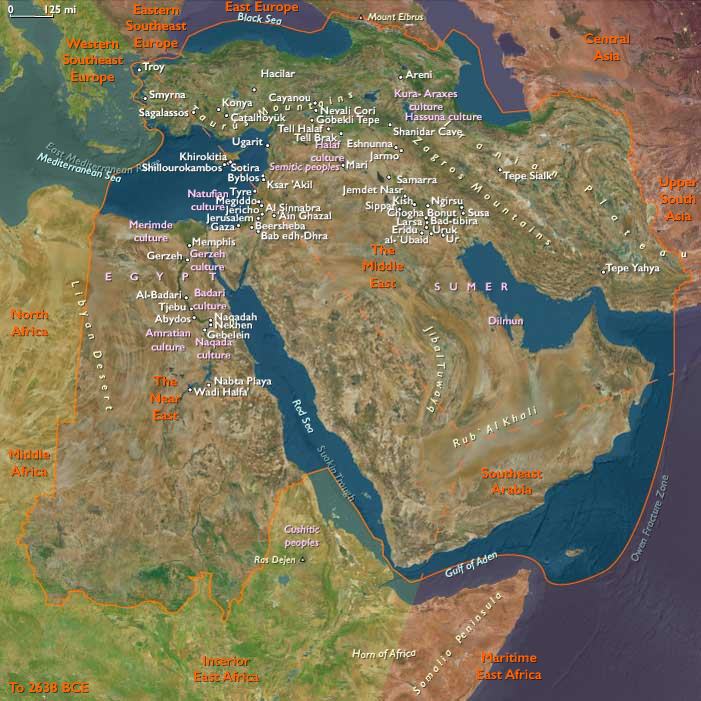
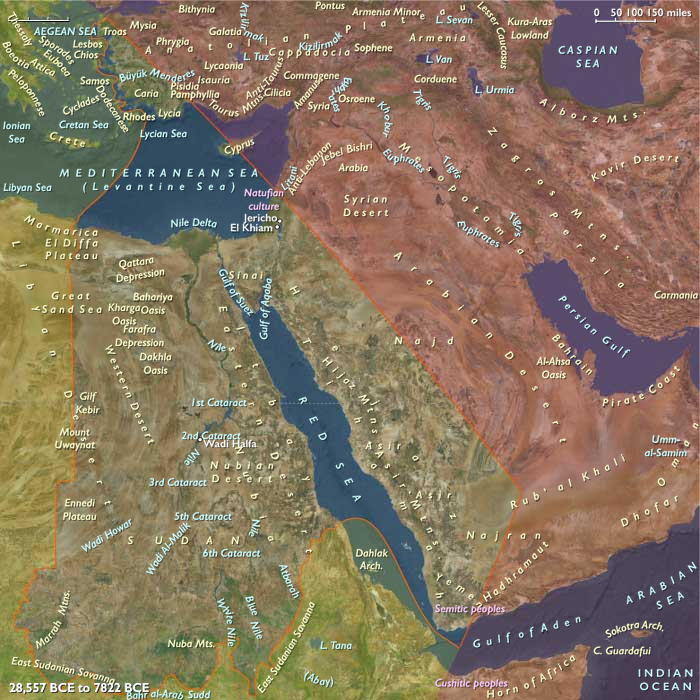
The earliest dated remains of domesticated dogs, dated to around 10,500 BCE, are coeval with the emergence of the Natufian culture of the Levant following the close of the Pleistocene Epoch. (First identified in 1928 in the valley of Wadi en Natuf in Israel, major sites have since been found in many parts of Israel and Jordan and in Syria.)
The Natufian culture differs markedly from Late Paleolithic cultures following the close of the Pleistocene Epoch.
The Natufians, although still concerned with hunting, exhibit evidence of a more sedentary life, including the introduction of a new economy preoccupied with intensive collecting of wild seed plants.
Natufians produce microlithic stone reaping tools, stone mortars and pestles, bone sculptures, and luxury goods, such as shell and bone jewelry.
Trade is important to the Natufians, whose economic relations apparently extend from the Mediterranean to the Zagros Mountains.
Like us, the Natufians are artistic, lavishly carving the bone-handled hafts of their flint-bladed sickles, and like us, they honor their dead, burying them with personal ornaments in cemeteries.
They live in caves, as did their Paleolithic predecessors, or occupy incipient villages.
One of these, the first known organized community in the Fertile Crescent, forms at the oasis of Jericho, on the plain on the west bank of the River Jordan.
The earliest occupation of the site consists of remains of the Natufian culture and includes what may have been a shrine.
The site is watered, as it is today, by the copious spring 'as-Sul'n.
Locations
Groups
Topics
- The Upper Paleolithic
- Allerød Oscillation
- Late Glacial Maximum
- Younger Dryas
- Neolithic Revolution
- Preboreal Period
Commodoties
Subjects
- Commerce
- Sculpture
- Environment
- Labor and Service
- Decorative arts
- Conflict
- Faith
- Government
- Custom and Law
- Technology
- Archaeology
- Anthropology
Regions
Subregions
Related Events
Showing 10 events out of 69399 total
Years: 11277BCE - 9550BCE
Locations
Groups
Topics
- The Upper Paleolithic
- Allerød Oscillation
- Late Glacial Maximum
- Younger Dryas
- Neolithic Revolution
- Preboreal Period
Commodoties
Subjects
- Commerce
- Sculpture
- Environment
- Labor and Service
- Decorative arts
- Conflict
- Faith
- Government
- Custom and Law
- Technology
- Archaeology
- Anthropology
Regions
Subregions