
Dawachi and the Khoit-Oirat prince Amursana had …
Years: 1755 - 1755
Dawachi and the Khoit-Oirat prince Amursana had competed in 1752 for the title of Khan of the Dzungars, a confederation of several Tibetan Buddhist Oirat tribes that had emerged suddenly in the early seventeenth century.
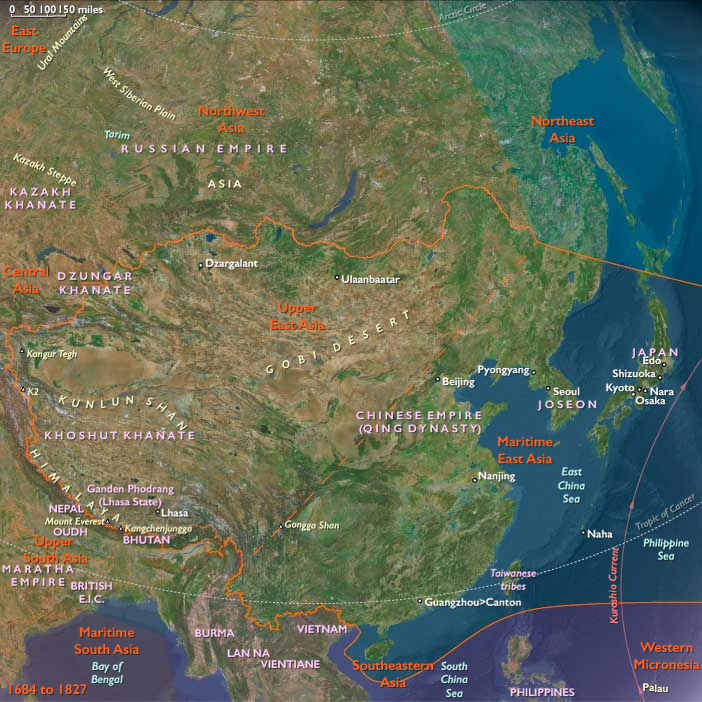
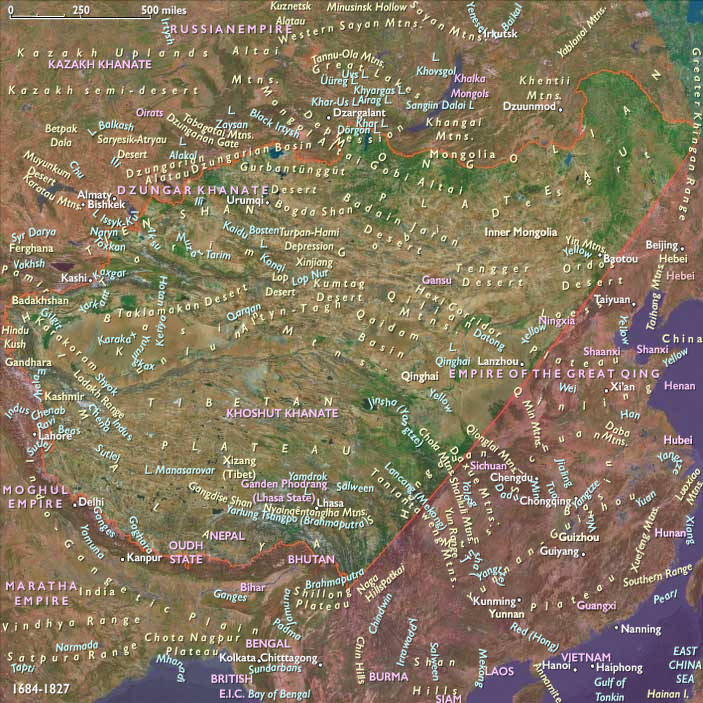
The Qing dynasty has gone to war against the Dzungars, who live in the area stretching from the west end of the Great Wall of China to present-day eastern Kazakhstan and from present-day northern Kyrgyzstan to southern Siberia (most of which is located in present-day Xinjiang).
They are the last nomadic empire to threaten China, which they have done from the early seventeenth century.
Amursana had suffered several defeats at the hands of Dawachi and was thus forced to flee with his small army to the protection of the Qing imperial court.
The Yongzheng Emperor's successor, the Qianlong Emperor, has pledged his to support Amursana, who recognizes Qing authority; among those who support Amursana and the Chinese are the Khoja brothers Burhān al-Dīn and Khwāja-i Jahān.
Khan Khoja is kept as hostage whereas Burhan-ud-din is sent with Oirat, Chinese and Turks to re-conquer the Altishah, the six oasis towns along the rim of the Tarim Basin.
Qianlong in 1755 sends the Manchu general Zhaohui, who is aided by Amursana, Burhān al-Dīn and Khwāja-i Jahān, to lead a campaign against the Dzungars.
After several skirmishes and small scale battles along the Ili River, the Qing army led by Zhaohui approaches Ili (Gulja; modern Yining City) and forces Dawachi to surrender.
Qianlong appoints Amursana as the Khan of Khoid and one of four equal khans—much to the displeasure of Amursana, who had wanted to be the Khan of the Dzungars.
The Qing dynasty has gone to war against the Dzungars, who live in the area stretching from the west end of the Great Wall of China to present-day eastern Kazakhstan and from present-day northern Kyrgyzstan to southern Siberia (most of which is located in present-day Xinjiang).
They are the last nomadic empire to threaten China, which they have done from the early seventeenth century.
Amursana had suffered several defeats at the hands of Dawachi and was thus forced to flee with his small army to the protection of the Qing imperial court.
The Yongzheng Emperor's successor, the Qianlong Emperor, has pledged his to support Amursana, who recognizes Qing authority; among those who support Amursana and the Chinese are the Khoja brothers Burhān al-Dīn and Khwāja-i Jahān.
Khan Khoja is kept as hostage whereas Burhan-ud-din is sent with Oirat, Chinese and Turks to re-conquer the Altishah, the six oasis towns along the rim of the Tarim Basin.
Qianlong in 1755 sends the Manchu general Zhaohui, who is aided by Amursana, Burhān al-Dīn and Khwāja-i Jahān, to lead a campaign against the Dzungars.
After several skirmishes and small scale battles along the Ili River, the Qing army led by Zhaohui approaches Ili (Gulja; modern Yining City) and forces Dawachi to surrender.
Qianlong appoints Amursana as the Khan of Khoid and one of four equal khans—much to the displeasure of Amursana, who had wanted to be the Khan of the Dzungars.
Locations
People
Groups
Topics
Commodoties
Subjects
Regions
Subregions
Related Events
Showing 10 events out of 26883 total
Years: 1755 - 1755
Locations
People
Groups
Topics
Commodoties
Subjects
Regions
Subregions