
Gold prospectors, following the discovery of gold …
Years: 1886 - 1886
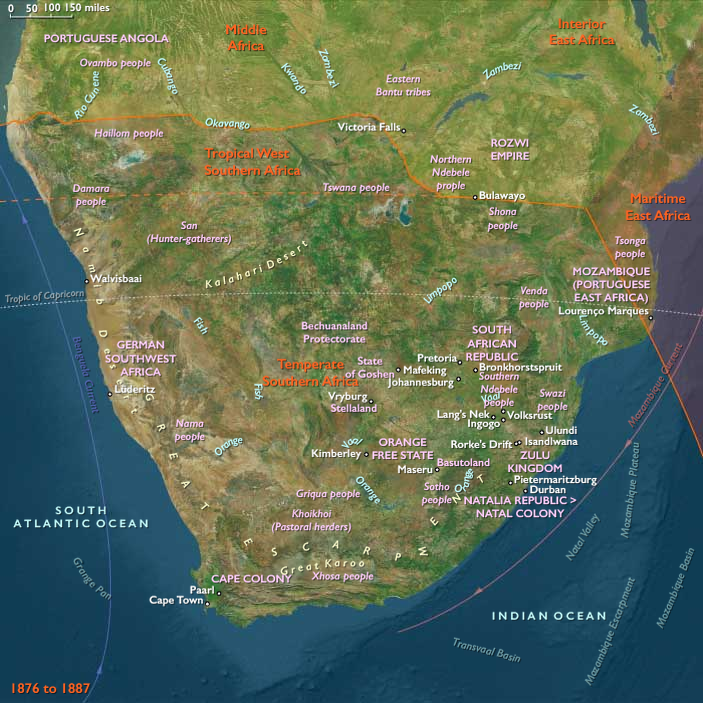
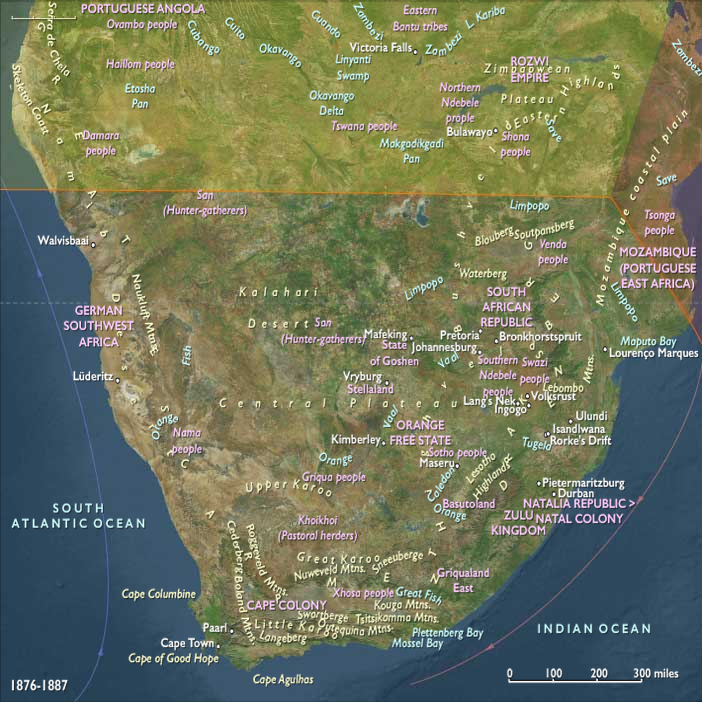
Gold prospectors, following the discovery of gold at Langlaagte, Johannesburg in 1886, soon discover that there are even richer gold reefs in the Witwatersrand (literally "white water ridge"—a watershed) near Johannesburg.
Johannesburg is a dusty settlement some fifty-five kilometers from the Zuid-Afrikaansche Republiek (ZAR) capital, Pretoria, but as word spreads, people flock to the area from all other regions of the country, as well as many foreigners (uitlanders) from North America, the United Kingdom and Europe.
The economy of the Transvaal soon booms, the massive deposits of gold-bearing ore skewing the economic balance between Boers, tribal peoples and British capitalists even more dramatically.
The Dutch speaking Voortrekkers had arrived in Johannesburg in the early nineteenth century, driving away the Matebele with the help of Sotho–Tswana allies, establishing settlements around Rustenburg and Pretoria in the early 1830s, and claiming sovereignty over what would become Johannesburg as part of the Transvaal Republic.
Gold was initially discovered some four hundred kilometers to the east of present-day Johannesburg, in Barberton.
Locations
Groups
- Sotho (Basotho or Basuto) people
- Zulu people
- Xhosa people
- Tswana people
- Britain (United Kingdom of Great Britain and Ireland)
- Cape Colony, British
- Zululand
- Matabele Kingdom
- South African Republic (the Transvaal) (restored)
Topics
Commodoties
Subjects
Regions
Subregions
Related Events
Showing 10 events out of 10921 total
Years: 1886 - 1886
Locations
Groups
- Sotho (Basotho or Basuto) people
- Zulu people
- Xhosa people
- Tswana people
- Britain (United Kingdom of Great Britain and Ireland)
- Cape Colony, British
- Zululand
- Matabele Kingdom
- South African Republic (the Transvaal) (restored)
Topics
Commodoties
Subjects
Regions
Subregions