Dutch traders import eighty-seven tons of Indian …
Years: 1696 - 1707
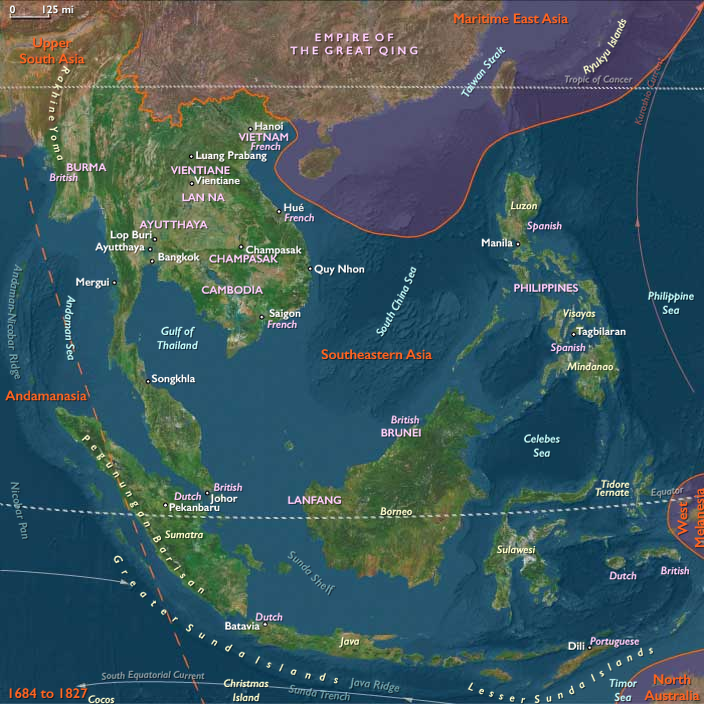
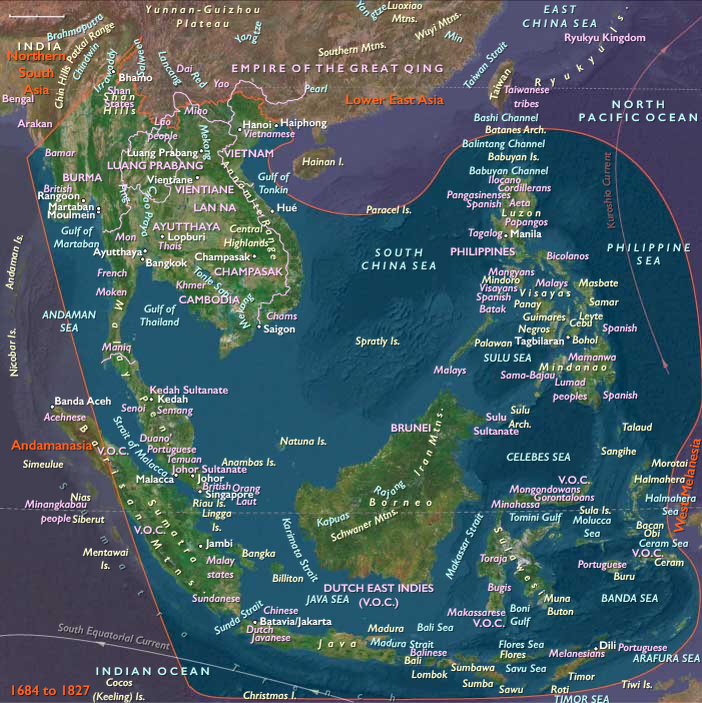
Dutch traders import eighty-seven tons of Indian opium for distribution to Java and the Indies in 1699.
Locations
Groups
- Netherlands, United Provinces of the (Dutch Republic)
- Dutch East India Company in Indonesia
- Dutch East India Company (Vereenigde Oostindische Compagnie or VOC in Dutch, literally "United East Indies Company")
Topics
Commodoties
Subjects
Regions
Subregions
Related Events
Filter results
Showing 10 events out of 29101 total
Northeast Asia (1696–1707 CE)
Russian Maritime Endeavors and Indigenous Interactions
Between 1696 and 1707, Northeast Asia—a region encompassing eastern Siberia east of 130°E, northeastern Heilongjiang province, the northern half of Primorsky Krai, and most of Hokkaido (excluding its southwestern portion)—experienced continued expansion of Russian exploration, intensified maritime activities, and evolving interactions with indigenous peoples.
Russian promyshlenniki (fur traders) advanced further into the region, seeking valuable pelts, particularly sable, sea otter, and fox, driven by strong demand from Chinese markets. During these expeditions, indigenous communities, notably the maritime Chukchi, engaged cautiously with the Russians, trading furs, ivory, and marine products for metal goods, beads, tobacco, and firearms. Despite profitable exchanges, Chukchi groups remained vigilant against Russian attempts to exert control, safeguarding their autonomy through strategic alliances and occasional armed resistance.
On the Kamchatka Peninsula, semi-nomadic peoples such as the Koryaks and Alyutors faced mounting pressures as Russian traders expanded settlements and competed for local resources, especially reindeer herds and fishing territories. Relations between Russians and these indigenous groups were characterized by a complex mix of cooperation, cultural exchange, tension, and intermittent conflict.
Further south on Kamchatka, the river-dwelling Itelmens found Russian settlers increasingly establishing outposts along critical waterways, which led to a gradual shift in their traditional economic practices. Russians depended heavily on Itelmen knowledge for navigating the peninsula’s challenging terrain and waterways but frequently disrupted indigenous ways of life through exploitation and forced tribute (yasak).
Recognizing the necessity of a more efficient maritime connection to support its distant outposts, Russia intensified efforts to enhance maritime infrastructure. Tsar Peter the Great had dispatched shipbuilders to the harsh and remote coastal site of Okhotsk in 1714 to create a crucial Pacific seaport. Despite poor harbor conditions and challenging logistics, in 1715 shipbuilders constructed the vessel Vostok, which was successfully sailed by Kozma Sokolov to Kamchatka in 1716–1717, significantly strengthening Russia's strategic reach and logistical capabilities in Northeast Asia.
This era thus represented a pivotal phase, establishing enduring frameworks for Russian-indigenous relations, maritime expansion, and regional economic integration, shaping the cultural and geopolitical contours of Northeast Asia for decades to follow.
Tobacco is frequently mixed with other herbs at this time (this practice will continue with clove cigarettes to the modern day), and opium is one component in the mixture.
Tobacco mixed with opium is called madak (or madat) and had become popular throughout China and its seafaring trade partners (such as Taiwan, Java and the Philippines) in the seventeenth century.
China under the Qing Dynasty has opened herself to foreign trade under the Canton System through the port of Guangzhou (Canton), and traders from the British East India Company begin visiting the port by the 1690s.
Due to the growing English demand for Indian tea and the Chinese Emperor's prohibition of English commodities other than silver, English traders resort to trade in opium as a high-value commodity for which China is not self-sufficient.
The British traders have been purchasing small amounts of opium from India for trade since Ralph Fitch first visited in the mid-sixteenth century.
Trade in opium is standardized, with production of balls of raw opium, 1.1 to 1.6 kilograms, thirty percent water content, wrapped in poppy leaves and petals, and shipped in chests of sixty to sixty-five kilograms (one picul).
Chests of opium are sold in auctions in Calcutta with the understanding that the independent purchasers will then smuggle it into China.
Peter, as a child of the second marriage of Tsar Aleksey, was at first relegated to the background of Russian politics as various court factions struggled to control the throne.
Aleksey was succeeded by his son from his first marriage, Feodor III, a sickly boy who died in 1682.
Peter then was made co-tsar with his half brother, Ivan V, but Peter's half sister, Sofia, holds the real power.
She rules as regent while the young Peter is allowed to play war games with his friends and to roam in Moscow's foreign quarters.
These early experiences instill in him an abiding interest in Western military practice and technology, particularly in military engineering, artillery, navigation, and shipbuilding.
In 1689, using troops that he had drilled during childhood games, Peter foils a plot to have Sofia crowned.
When Ivan V dies in 1696, Peter becomes the sole tsar of Muscovy.
East Europe (1696–1707 CE): Consolidation of Reforms and Territorial Expansion
Political and Military Developments
Continued Leadership of Peter the Great
From 1696 to 1707 CE, Peter the Great solidified his leadership, implementing profound political, military, and social reforms designed to modernize Russia. His centralization efforts strengthened administrative control and further reinforced state authority.
The Great Northern War and Territorial Gains
During this period, Russia became actively involved in the early phases of the Great Northern War against Sweden (1700–1721). Initial victories and strategic maneuvers significantly expanded Russia’s influence and territorial holdings in the Baltic region.
Diplomatic Realignment and International Alliances
Peter maintained strategic alliances, particularly with Denmark and Poland-Lithuania, against Sweden. His diplomatic skills advanced Russia’s status on the European stage, positioning it as an emerging power.
Economic and Technological Developments
Economic Reforms and Expansion
Peter further advanced economic modernization, promoting industrial growth, enhanced trade networks, and introducing progressive economic policies. These reforms facilitated greater integration with Western European economies.
Military and Technological Innovations
Significant developments continued in military organization, naval expansion, and fortifications. Technological advancements included improved weaponry, shipbuilding techniques, and fortification strategies, essential for military successes.
Cultural and Artistic Developments
Westernization of Russian Culture
Peter’s era saw deeper integration of Western European influences into Russian cultural life. New architectural styles flourished, and European artistic and educational trends were actively promoted, significantly reshaping cultural norms.
Intellectual Expansion and Literary Activity
The period witnessed growing intellectual vibrancy, with an increased flow of ideas from Europe. Literary production expanded, incorporating new Western-inspired themes and formats, enriching Russia’s intellectual landscape.
Settlement Patterns and Urban Development
Rapid Urban Growth and Modernization
Cities, particularly Saint Petersburg, newly established in 1703, underwent rapid growth and modernization, reflecting Peter’s strategic vision. Moscow and other urban centers similarly expanded, benefiting from improved infrastructure and planning.
Strategic Fortification Enhancements
Urban and territorial fortifications were continually improved, ensuring robust defensive capabilities and providing security against external threats during ongoing military campaigns.
Social and Religious Developments
Social Reforms and Integration
Social structures continued evolving under Peter’s reforms, increasingly influenced by Western European models. Efforts toward integration and administrative inclusion of diverse ethnic groups persisted, promoting societal harmony and cohesion.
Orthodox Church under State Control
The relationship between the Orthodox Church and state continued shifting towards greater state oversight. Peter’s reforms sought to align religious institutions with state goals, altering the Church’s traditional role significantly.
Long-Term Consequences and Historical Significance
The period from 1696 to 1707 CE marked further consolidation of Peter the Great’s transformative reforms and substantial territorial expansion. These developments solidified Russia’s emergence as a significant European power, profoundly impacting its future political, economic, and cultural trajectory.den

The tsar's court also feels the impact of Ukraine and the West.
Kiev is a major transmitter of new ideas and insight through the famed scholarly academy that Metropolitan Mogila (Mohyla) founded there in 1631.
Among the results of this infusion of ideas into Muscovy are baroque architecture, literature, and icon painting.
Other more direct channels to the West open as international trade increases and more foreigners come to Muscovy.
The tsar's court is interested in the West's more advanced technology, particularly when military applications are involved.
By the end of the seventeenth century, Ukrainian, Polish, and West European penetration have undermined the Muscovite cultural synthesis—at least among the elite—and have prepared the way for an even more radical transformation.
Peter triples the revenues of the state treasury through a variety of taxes.
He levies a capitation, or poll tax, on all males except clergy and nobles and imposes a myriad of indirect taxes on alcohol, salt, and even beards.
To provide uniforms and weapons for the military, Peter develops metallurgical and textile industries using serf labor.
Peter's reorganization of the government structure is no less thorough.
He replaces the prikazy with colleges or boards and creates a senate to coordinate government policy.
Peter's reform of local government is less successful, but his changes enable local governments to collect taxes and maintain order.
As part of the government reform, the Orthodox Church is partially incorporated into the country's administrative structure.
Peter abolishes the patriarchate and replaces it with a collective body, the Holy Synod, led by a lay government official.
Peter wants to equip Russia with modern technology, institutions, and ideas.
He requires Western-style education for all male nobles, introduces so-called cipher schools to teach the alphabet and basic arithmetic, establishes a printing house, and funds the Academy of Sciences, which is established just before his death in 1725 and becomes one of Russia's most important cultural institutions.
He demands that aristocrats acquire the dress, tastes, and social customs of the West.
The result is a deepening of the cultural rift between the nobility and the mass of Russian people.
The best illustration of Peter's drive for Westernization, his break with traditions, and his coercive methods is his construction in 1703 of a new, architecturally Western capital, St. Petersburg, situated on land newly conquered from Sweden on the Gulf of Finland.
Although St. Petersburg faces westward, its Westernization is by coercion, and it cannot arouse the individualistic spirit that is an important element in the Western ways Peter so admires.
War dominates much of Peter's reign.
At first Peter attempts to secure the principality's southern borders against the Tatars and the Ottoman Turks.
His campaign against a fort on the Sea of Azov fails initially, but after he creates Russia's first navy, Peter is able to take the port of Azov in 1696.
To continue the war with the Ottoman Empire, Peter travels to Europe to seek allies.
The first tsar to make such a trip, Peter visits Brandenburg, Holland, England, and the Holy Roman Empire during his so-called Grand Embassy.
Peter learns a great deal and enlists into his service hundreds of West European technical specialists.
The embassy is cut short by the attempt to place Sofia on the throne instead of Peter, a revolt that is crushed by Peter's followers.
As a result, Peter has hundreds of the participants tortured and killed, and he publicly displays their bodies as a warning to others.
Years: 1696 - 1707
Locations
Groups
- Netherlands, United Provinces of the (Dutch Republic)
- Dutch East India Company in Indonesia
- Dutch East India Company (Vereenigde Oostindische Compagnie or VOC in Dutch, literally "United East Indies Company")