The Dutch have begun to replace the …
Years: 1617 - 1617
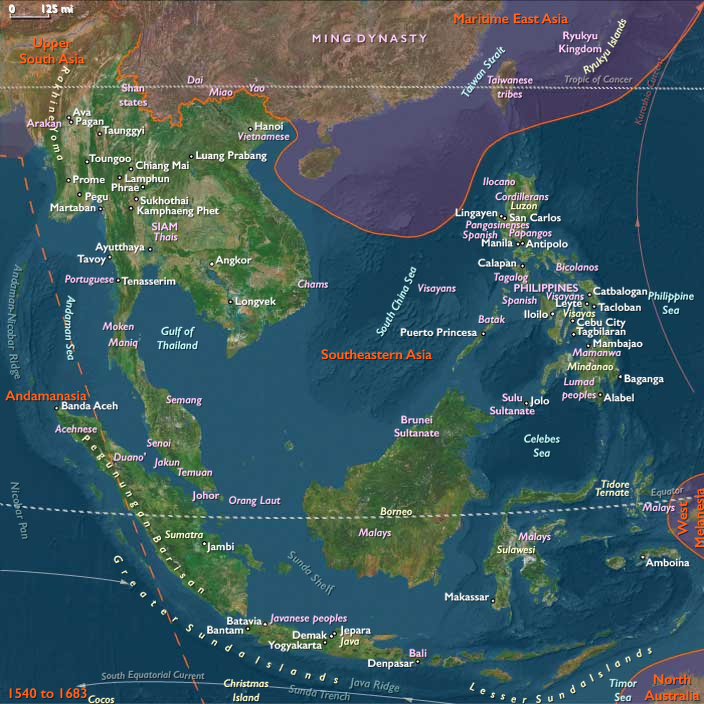
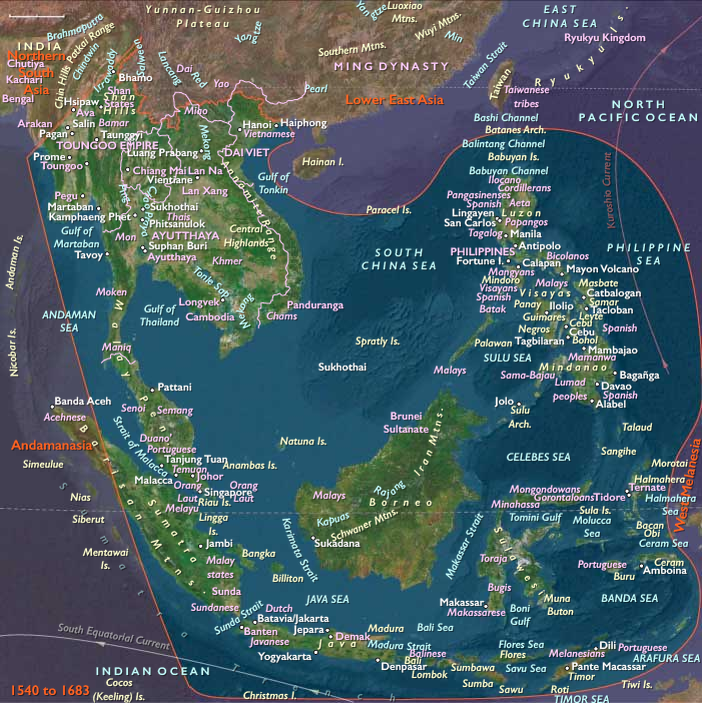
The Dutch have begun to replace the diminished Portuguese presence in Indonesia in the early seventeenth century, but both countries continue to trade with Japan and China.
Locations
Groups
- Chinese Empire, Ming Dynasty
- Portugal, Habsburg (Philippine) Kingdom of
- Netherlands, United Provinces of the (Dutch Republic)
- Dutch East India Company (Vereenigde Oostindische Compagnie or VOC in Dutch, literally "United East Indies Company")
- Japan, Tokugawa, or Edo, Period
Topics
Commodoties
Subjects
Regions
Subregions
Related Events
Filter results
Showing 10 events out of 33109 total
The Dutch, as a result of the 1608 Siamese mission to the Hague, sign their first treaty with Siam, which guarantees terms for the purchase of deer hides, in 1617.
The Reformation has transformed the Holy Roman Empire into a patchwork of Catholic and Protestant states.
Emperor Matthias, without heirs, seek to assure an orderly transition during his lifetime by having his dynastic heir (the fiercely Catholic Ferdinand of Habsburg, Archduke of Styria) elected to the separate royal thrones of Bohemia and Hungary.
Some of the Protestant leaders of Bohemia fear they will be losing the religious rights granted to them by Emperor Rudolf II in his letter of majesty.
They prefer the Protestant Frederick V, elector of the Palatinate (successor of Frederick IV, the creator of the League of Evangelical Union).
However, other Protestants support the stance taken by the Catholics, and in 1617, Ferdinand is duly elected by the Bohemian estates to become the Crown Prince, and automatically upon the death of Matthias, the next King of Bohemia.
As Ferdinand II, the Jesuit-educated ruler continues the absolutist and devoutly Catholic policies he had pursued while archduke (having, for, example, banished the Protestant leaders of the Styrian estates.
The Sultan, after yet another wave of Cossack raids in 1617, sends a powerful force under Iskander Pasha to the Commonwealth borders.
The army consists of janissaries, Tatars and vassal troops from Transylvania, Moldavia and Wallachia (numbering up to forty thousand).
Żółkiewski meets them near Busza (on the Jaruga River), but neither side can decide to attack, and letters between leaders have been exchanged since the start of Iskander’s march.
Żółkiewski has mostly magnate troops and no Cossack troops, as the Commonwealth is simultaneously waging war with Muscovy and with the latest Swedish aggression against Livonia, while the Ottomans are at war with Persia.
Żółkiewski is forced to renounce all Polish claims to Moldavia through the Treaty of Busza (also known as the "Treaty of Jaruga") signed with Iskander Pasha.
The treaty states that Poland will not meddle in the internal affairs of Ottoman vassals in Transylvania, Moldavia, and Wallachia, and that the Commonwealth is to prevent Cossacks from raiding lands in the Ottoman Empire, while ceding Khotyn.
The Turks promise in return to stop Tatar raids.
Abbas has subjected Kakheti to repeated invasions from 1614 to 1617.
Sixty to seventy thousand people have been killed in a series of Georgian insurrections and Iranian reprisals, and more than one hundred thousand Kakhetian peasants have been forcibly deported into Iran.
The population of Kakheti has dropped by two-thirds; once flourishing towns, like Gremi and Zagemi, have shrunk to insignificant villages; agriculture has declined and commerce has come to a standstill.
The Duke of Osuna, viceroy of Naples, and ...
...the Marquess of Villafranca, the Governor of Milan, direct the Spanish policy in Italy, which has encountered resistance from the Kingdom of Savoy and the Republic of Venice.
Inigo Jones is the architect for the Queen's House, Greenwich, a royal residence built for Anne of Denmark, the queen of King James I of England, between 1614-1617 in Greenwich, a few miles downriver from London.
One of the most important buildings in British architectural history, being the first consciously classical building to have been constructed in Britain, it is Jones's first major commission after returning from his 1613-1615 grand tour of Roman, Renaissance and Palladian architecture in Italy.
Some earlier English buildings, such as Longleat, had made borrowings from the classical style; but these were restricted to small details and were not applied in a systematic way.
Nor was the form of these buildings informed by an understanding of classical precedents.
The Queen's House would have appeared revolutionary to English eyes in its day.
Jones is credited with the introduction of Palladianism with the construction of the Queen's House.
Although it diverges from the mathematical constraints of Palladio and it is likely that the immediate precedent for the H-shaped plan, straddling a road, is the Villa Medici at Poggio a Caiano by Giuliano da Sangallo.
An epidemic sweeps New England in 1617, devastating many of the native tribes but not the Naragansetts.
Michael begins to reestablish domestic order in Russia and seeks peace with Sweden.
After nearly two months of negotiations, representatives from Sweden and Russia meet on February 27, 1617, at the village of Stolbovo (now derelict), south of Lake Ladoga.
Sweden had from the outset entered into negotiations with very high ambitions, with the hopes of fulfilling the old dream of making all Russian trade pass through Swedish territory.
As a consequence of this ambition, the Swedes had originally demanded far-reaching territorial gains into western Russia, including the important northern port of Arkhangelsk.
At this point, however, James I of England had sent a delegation to mediate, as did the Dutch, mostly to make sure Arkhangelsk does not fall into Swedish hands, which would make the extensive trade between Western Europe and Russia far more difficult.
Arkhangelsk does not change hands in the resulting treaty, partly because of the Dutch and English efforts, but mostly because Russia finally has managed to unite under one tsar.
As word reaches Russia that the Swedish war against Poland might soon be over, the Russians are quick to get negotiations going for real —knowing that they cannot afford Sweden's renewal of the war effort on just one front.
In the resulting peace treaty, the Russian tsar and the Swedish king agree to the following terms:
• Sweden gains the province and fortress of Kexholm (Käkisalmi) (now Priozersk) and the province of Ingria
—including the fortress of Nöteborg, known as "the key to Finland" (now Shlisselburg, Russia)
• Members of the upper classes in these conquered areas are allowed to migrate within fourteen days, if they wish to, a right not granted to regular priests and farmers
• Russia renounces all claims to Estonia and Livonia
• Russia will pay Sweden war indemnities of twenty thousand rubles
• Novgorod and other Swedish territorial gains during the war will be returned to Russia
• Sweden has the right to keep all spoils of war collected before November 20, 1616
• The Russian city of Gdov is to remain in Swedish hands until the peace has been confirmed and the borders fully established
• Sweden recognizes Michael Romanov as the rightful tsar of Russia, putting an end to further Swedish claims in Russia
• Russia is allowed free trade at normal trade tariffs, making sure Sweden cannot cripple Russia completely
• Russia is allowed to establish merchant houses in Stockholm, Reval (Tallinn) and Vyborg in exchange for Sweden being allowed to establish merchant houses in Novgorod, Pskov, and Moscow.
Gustavus Adolphus is known to have said about this treaty, which granted Sweden natural borders to Russia, partly in the form of Lake Ladoga and Lake Peipus: jag hoppas att det skall bliva svårt för ryssen att hoppa över den bäcken — "I hope it will be hard for the Russians to jump across that creek".
England is officially credited with brokering this peace, through their mediator John Mericke, though the Dutch efforts are also of great importance.
After the war, the leader of the Dutch delegation, Reinoud van Brederode, is granted the title Baron and given the barony of Wesenberg (Rakvere) in Estonia by Gustavus Adolphus.
Russia will manage to gain back the lost territories as well as to acquire further Swedish lands in the Great Northern War of 1700-1721, putting an end to the Swedish status of a great regional power.

Anne of Austria, born at Benavente Palace in Valladolid, Spain, and baptized Ana María Mauricia, is the daughter of Habsburg parents, Philip III of Spain and Margaret of Austria.
She holds the titles of Infanta of Spain and of Portugal and Archduchess of Austria.
Anne had been betrothed at age 11 to Louis XIII.
Her father, Philip, had given her a dowry of five hundred thousand crowns and many beautiful jewels.
For fear that Louis XIII would die early, they said that if this was the case, she would return to Spain with her dowry, jewels, and wardrobe.
The pecuniary arrangements being thus satisfied, Anne had been saluted as the Queen of France.
Following the tradition of cementing military and political alliances between France and Spain that had begun with the marriage of Philip II of Spain to Elisabeth of Valois in 1559 as part of the Peace of Cateau-Cambrésis, Louis and Anne had been married by proxy in Burgos on November 24, 1615, while Louis's sister, Elizabeth, and Anne's brother, Philip IV of Spain, were married by proxy in Bordeaux.
Anne and Elisabeth had both been exchanged on the Isle of Pheasants, between Hendaye and Fuenterrabía.
Anne and Louis, both fourteen years old, had been pressured to consummate the marriage in order to forestall any possibility of future annulment, but Louis has ignored his bride.
Louis's mother, Marie de' Medici, continues to conduct herself as Queen of France, without any deference to her daughter-in-law.
Anne, surrounded by her entourage of highborn Spanish ladies-in-waiting, continues to live according to Spanish etiquette and failed to improve her French.
Years: 1617 - 1617
Locations
Groups
- Chinese Empire, Ming Dynasty
- Portugal, Habsburg (Philippine) Kingdom of
- Netherlands, United Provinces of the (Dutch Republic)
- Dutch East India Company (Vereenigde Oostindische Compagnie or VOC in Dutch, literally "United East Indies Company")
- Japan, Tokugawa, or Edo, Period