
The Strengthening of the Duchy of Burgundy …
Years: 1262 - 1262
The Strengthening of the Duchy of Burgundy Under Capetian Rule
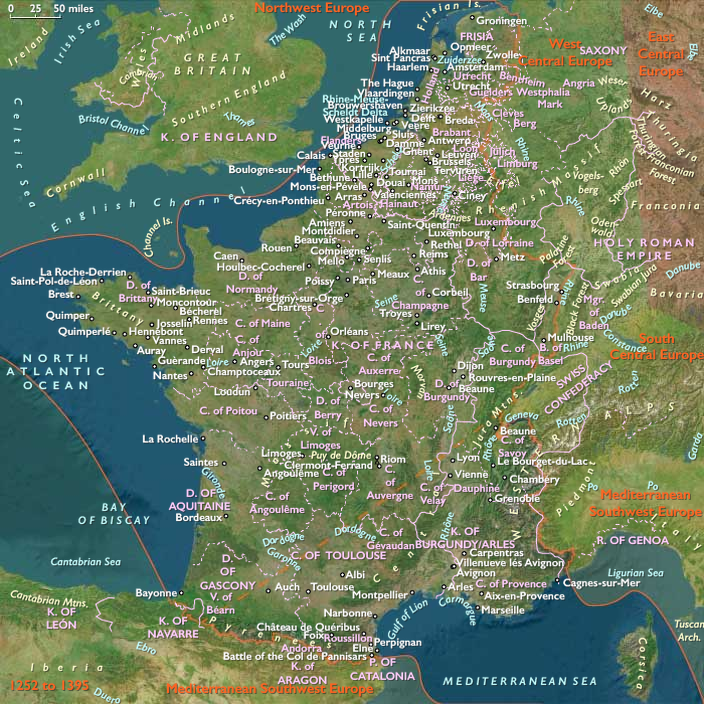
The Duchy of Burgundy flourished under Capetian rule, benefiting from a well-organized administrative system that mirrored the royal court of Paris. Over time, the dukes of Burgundy consolidated their power, fostering institutional stability and expanding their territories.
Burgundy’s Administrative Development
- A ducal court, modeled after the royal court in Paris, emerged as the center of political authority.
- The Jours Généraux, sitting at Beaune, functioned as a regional counterpart to the Parliament of Paris, reinforcing the duchy’s legal autonomy.
- Local government was strengthened by the imposition of bailiffs (baillis) over provosts and lords of the manor, ensuring greater ducal control.
- The duchy was divided into five Bailiages, further centralizing administration and justice.
The Expansion of Burgundy Under Hugh IV
Under Duke Hugh IV (r. 1218–1272), the Duchy of Burgundy expanded significantly, acquiring the Counties of Chalon and Auxonne, which further solidified Burgundian influence in eastern France.
Hugh IV and the Crusades
- Hugh IV participated in the Crusade of 1239–1241, organized by Emperor Frederick II and King Theobald I of Navarre.
- He allied his Burgundian troops with those led by Richard of Cornwall, a key leader of the campaign.
- This coalition successfully retook Ascalon, a strategic city in the Holy Land, and negotiated a peace settlement with the Mamluk rulers of Egypt in 1241.
Claim to the Kingdom of Thessalonica
Hugh IV also laid claim to the Kingdom of Thessalonica, a crusader state founded after the Fourth Crusade (1204). However, by the time of his claim, Thessalonica had already been recaptured by the Byzantine Greeks of the Empire of Nicaea, making his title purely nominal.
Legacy of Hugh IV’s Rule
Hugh IV’s reign strengthened the Duchy of Burgundy, transforming it into a politically stable and administratively advanced territory. His expansionist policies and participation in crusading efforts elevated Burgundy’s prestige but also reflected the waning influence of Crusader ambitions in the Eastern Mediterranean.
Over the following centuries, Burgundy would grow into a powerful and semi-independent state, playing a crucial role in late medieval European politics.
Locations
People
Groups
Topics
Commodoties
Subjects
Regions
Subregions
Related Events
Showing 10 events out of 45968 total
Years: 1262 - 1262
Locations
People
Groups
Topics
Commodoties
Subjects
Regions
Subregions