
The Duchers is the Russian name for …
Years: 1654 - 1654
The Duchers is the Russian name for the people populating the shores of the middle course of the Amur River, approximately from the mouth of the Zeya down to the mouth of the Ussury, and possibly even somewhat further downstream.
Their ethnic identity is not known with certainty, but it is usually assumed that they were a Tungusic people, related to the Jurchens and/or the Nanais.
The total number of Duchers (including other related Manchu groups, but not the Daurs or Evens) of the Amur Valley at the time of the appearance of the Russian explorers in the region around 1650 has been estimated by modern scholars at fourteen thousand.
According to the Russian explorers of the time, the Duchers, as well as the related groups, the Goguls, and their northwestern neighbors, the Daurs, are agriculturalists.
They grow rye, wheat, barley, millet, oats, peas, and hemp, as well as a number of vegetables.
The Duchers have horses and cattle; pigs ware a particularly important source of meat.
They do some hunting and fishing as well.
According to the seventeenth-century Cossacks' reports, the Duchers live in fortified villages with sixty and more houses in each.
The predecessor of the Qing fortress Aigun (which was originally located on the left—now Russian—bank of the Amur, opposite to its later location) is a Ducher town, currently known to the archaeologists as the Grodekovo site, after the nearby village of Grodekovo.
It is located south of the city of Blagoveshchensk and the fall of the Zeya into the Amur.
Yerofey Khabarov had reported the existence of this town (which he calls Aytyun) to the Yakutsk voivode D. Frantsbekov in 1652.
According to archaeologists, this fortress was first built around the end of the first or beginning of the second millennium CE.
The "tribute" of furs, grain, and livestock, collected (or looted, as the case may be) by the Cossacks from the Daurs and the Duchers is the main economic benefit derived by the Russians from their expansion in the region in the early 1650s, and, in order to deny it to them, the Qing government, starting in 1654, resettles the Ducher farmers from the Amur valley to the Sungari and Hurka Rivers further south.
The Daurs are resettled (to the Nenjiang River Valley) as well.
Locations
People
Groups
- Duchers
- Russians (East Slavs)
- Cossacks
- Daur people
- Russia, Tsardom of
- Manchus
- Chinese Empire, Qing (Manchu) Dynasty
Topics
Commodoties
Subjects
Regions
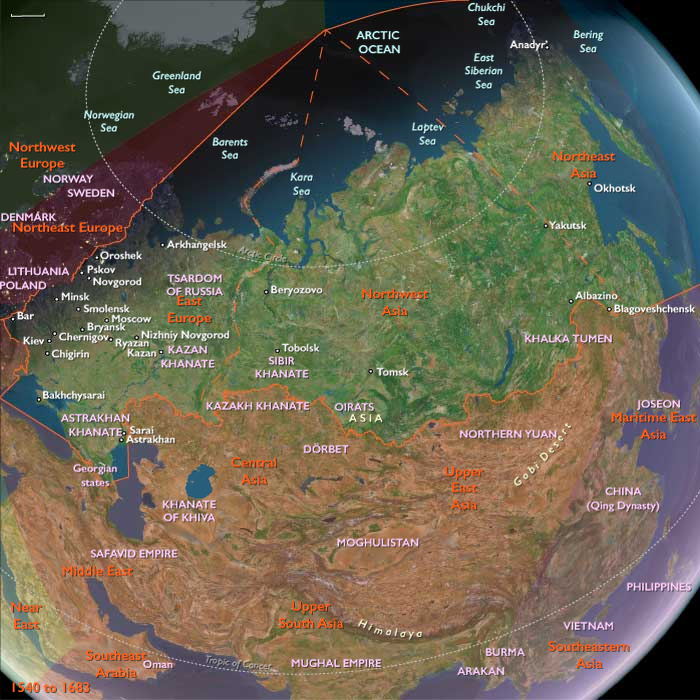
Subregions
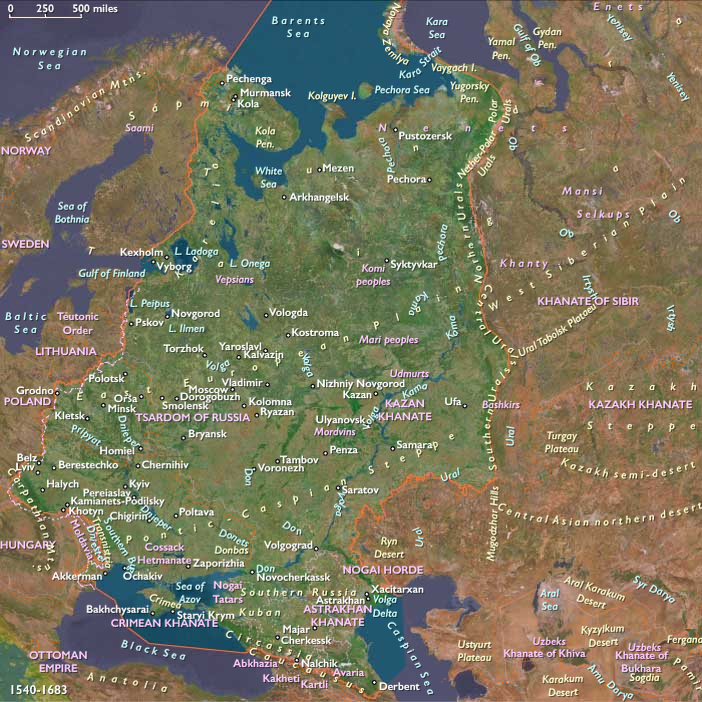
Related Events
Showing 10 events out of 31628 total
Years: 1654 - 1654
Locations
People
Groups
- Duchers
- Russians (East Slavs)
- Cossacks
- Daur people
- Russia, Tsardom of
- Manchus
- Chinese Empire, Qing (Manchu) Dynasty
Topics
Commodoties
Subjects
Regions
Subregions