
The Drukpa and the Lhapa sects of …
Years: 1577 - 1577
The Drukpa and the Lhapa sects of the persecuted Kagyupa branch of Tibetan Buddhism have been struggling for control of western Bhutan since the twelfth century.
The Lhapa order has built the original dzongs, a distinctive type of fortress architecture, in Bhutan, including that of Punakha, established in 1577 on a relatively flat spit of land at the confluence of the Mo Chhu and Pho Chhu rivers.
The rivers surround the dzong on three sides, providing protection from attack.
By tradition, dzongs are constructed without the use of architectural plans.
Instead construction proceeds under the direction of a high lama who establishes each dimension by means of spiritual inspiration.
The the dzongs are built using corvée labor which is applied as a tax against each household in the district.
Under this obligation each family is to provision a decreed number of workers to work for several months at a time in the construction of the dzong.
Recent research by the prominent Bhutanese scholar C.T. Dorji suggests that the original 'model dzong' may not be Simtokha Dzong as commonly believed, but Dobji Dzong, built in 1531 at an altitude of sixty-six hundred meters on a cliff facing the gorge of the Wangchhu River.
Unlike the dzongs built in the seventeenth century under the direction of the Shabdrung for defensive purposes, Dobji dzong had been constructed to serve a religious purpose, marking the spot where Ngawang Chogyel "...followed a spring water which originated from beneath the throne of Jetsun Milarepa in Druk Ralung to find a suitable site for establishing a center to propagate drukpa kagyu teachings in Bhutan".
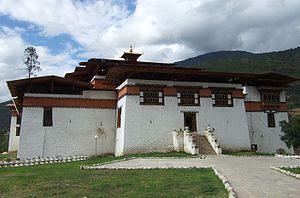
Simtoka Dzong near Thimphu (Cfynn, 2008)
Locations
Groups
Topics
Subjects
Regions
Subregions
Related Events
Showing 10 events out of 35098 total
Years: 1577 - 1577
Simtoka Dzong near Thimphu (Cfynn, 2008)
Locations
Groups
Topics
Subjects
Regions
Subregions