
Broad Overview of High Medieval Atlantic West …
Years: 1108 - 1251
Broad Overview of High Medieval Atlantic West Europe (1108–1251 CE): Northern & Western France and the Low Countries
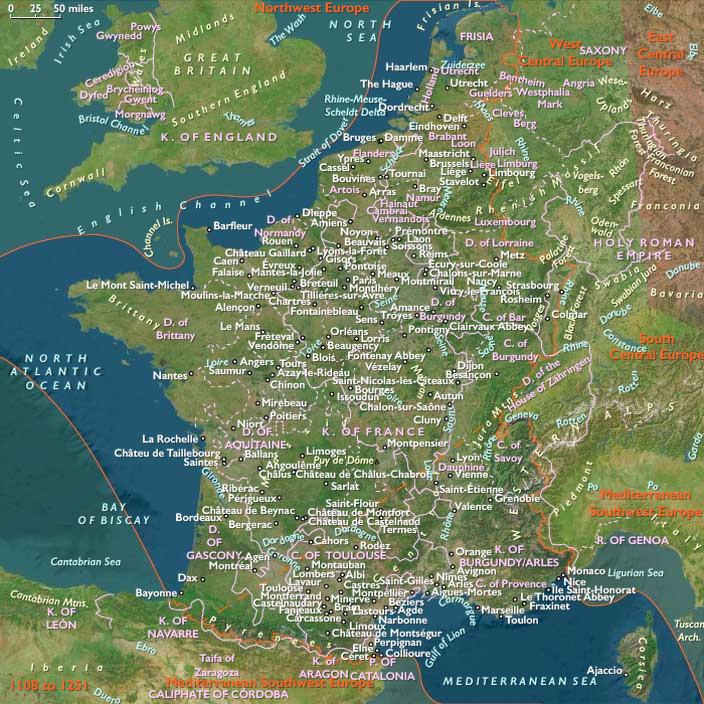
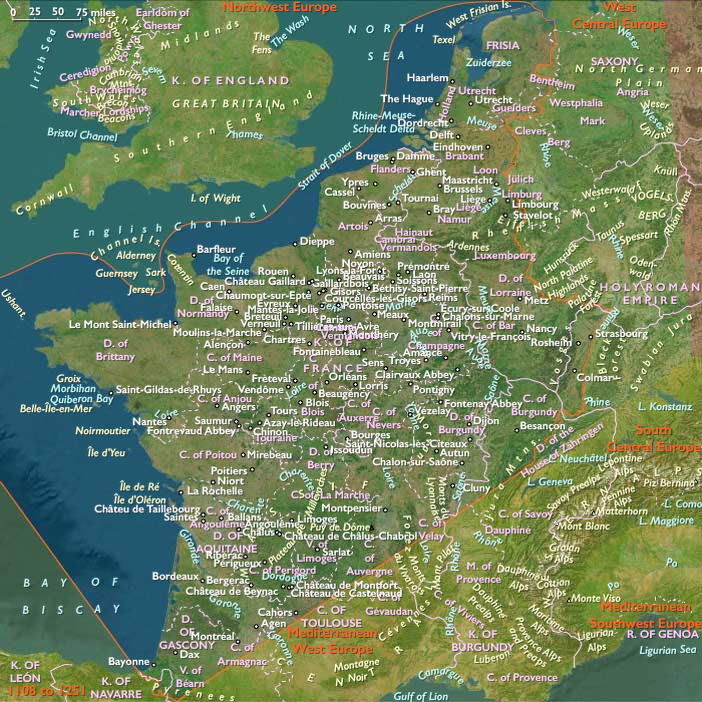
From 1108 to 1251, Atlantic West Europe—which includes northern and western France as well as the Low Countries (modern Netherlands, Belgium, and Luxembourg)—underwent profound transformations in political power, economic expansion, military conflicts, and cultural development.
This period saw:
- The consolidation of Capetian power in France, particularly under Philip II Augustus (r. 1180–1223) and Louis IX (r. 1226–1270).
- The decline of Plantagenet (Angevin) control in western France, culminating in the loss of Normandy, Anjou, and Poitou to the French Crown (1204–1259).
- The economic rise of the Low Countries, especially in Flanders, Brabant, and Holland, as centers of textile production and trade.
- The growing power of Burgundy, Champagne, and Lorraine, balancing between French royal authority and the Holy Roman Empire.
1. Political and Military Developments
The Capetian Expansion and the Decline of the Angevin Empire
- Philip II Augustus (r. 1180–1223) decisively defeated John of England, reclaiming Normandy, Anjou, Maine, and Poitou (1204).
- The Battle of Bouvines (1214), where Philip defeated an English-Flemish-Imperial coalition, solidified French dominance in the north.
- The Battle of Taillebourg (1242) further weakened English influence in Gascony and Poitou.
- Despite these victories, Gascony remained under English control, leading to ongoing Franco-English tensions.
The Low Countries: A Political and Economic Powerhouse
- Flanders and Brabant became crucial economic hubs, balancing alliances between France, England, and the Holy Roman Empire.
- The War of the Succession of Flanders (1185–1206) saw French intervention, culminating in Philip II’s victory over Count Baldwin IX of Flanders.
- Burgundy, Champagne, and Lorraine remained contested borderlands between France and the Empire, with frequent feudal conflicts.
- The Stedinger Crusade (1232–1234) in northwestern Germany saw the suppression of Frisian settlers resisting noble authority.
2. Economic and Urban Expansion
The Low Countries: The Rise of a Commercial Power
- Flanders, Brabant, and Holland became leading trade and textile centers, with major cities such as:
- Bruges and Ghent (Flanders) – Textile production and trade hubs.
- Brussels and Antwerp (Brabant) – Growing financial centers.
- Dordrecht and Haarlem (Holland) – Maritime and fishing economies.
- The Hanseatic League began expanding into Dutch and Flemish waters, increasing Baltic-North Sea trade links.
France: Regional Economic Growth
- Champagne Fairs (held in cities like Troyes and Provins) became key international trade markets, connecting merchants from Italy, Spain, and the Low Countries.
- Bordeaux and La Rochelle emerged as maritime trade centers, linking France to England and the Mediterranean.
- Wine production flourished in Gascony and Burgundy, fueling export economies.
3. Religious and Cultural Developments
Gothic Architecture and the High Middle Ages Cultural Boom
- Major cathedrals were constructed across the region, marking the height of French High Gothic and Rayonnant styles:
- Notre-Dame de Paris (begun 1163, completed c. 1240s)
- Reims Cathedral (begun 1211) – Coronation site of French kings.
- Amiens Cathedral (begun 1220) – Tallest of the High Gothic cathedrals.
- Sainte-Chapelle (1246–1248) – Built by Louis IX to house relics from Constantinople, showcasing the height of Rayonnant Gothic.
The Inquisition and Religious Tensions
- The Albigensian Crusade (1209–1229) led to the fall of the Cathar heresy in Languedoc, strengthening Capetian control over southern France.
- Pope Gregory IX formally established the Papal Inquisition in 1231, appointing Robert le Bougre ("Hammer of Heretics") as an inquisitor in Burgundy.
- In 1242, Christian zealots burned 24 cartloads of Talmud manuscripts in Paris, marking a period of increasing institutionalized anti-Jewish policies.
The Rise of Universities and Intellectual Thought
- The University of Paris became a leading center of Scholasticism, with thinkers like:
- Alexander of Hales, who introduced Aristotelian logic into theology.
- William of Auvergne, who worked to reconcile Augustine with Aristotle.
- The University of Orléans emerged around 1230, as a center of legal studies, focusing on Roman and canon law.
- Johannes de Sacrobosco’s Tractatus de Sphaera (c. 1230) became the leading astronomical text of the era.
4. The Strengthening of Monarchical Authority
France: The Rise of a Centralized State
- Philip II Augustus expanded royal justice, limiting noble autonomy.
- Louis IX (Saint Louis) sent enquêteurs (royal commissioners) in 1247 to investigate local governance, ensuring administrative accountability.
- The French monarchy increased control over taxation and trade, strengthening its financial power.
Burgundy, Champagne, and Lorraine: Balancing Between France and the Empire
- Burgundy remained a semi-independent duchy, balancing feudal allegiances between France and the Holy Roman Empire.
- The War of the Succession of Champagne (1216–1222) highlighted tensions between French royal influence and regional autonomy.
- In Lorraine, Theobald I’s rebellion against Frederick II (1218) led to a brief imperial occupation and restructuring of local power.
The Low Countries: Increasing Autonomy
- The Counts of Flanders and Holland navigated a delicate balance between England and France, using their economic power to resist complete subjugation.
- Haarlem (1245) and Delft (1246) received city rights, reflecting the increasing urban autonomy and self-governance of Dutch cities.
Conclusion: The Transformation of Atlantic West Europe by 1251
By 1251, northern and western France and the Low Countries had undergone profound transformations:
- Capetian France had become the dominant power, solidifying control over Normandy, Anjou, and Poitou while increasing royal administration.
- England had lost most of its continental holdings, retaining only Gascony, leading to a shift in its focus toward maritime power and internal governance.
- The Low Countries had risen as economic centers, with cities like Bruges, Ghent, and Antwerp becoming major trading hubs.
- Burgundy, Champagne, and Lorraine remained contested border regions, balancing imperial and French influences.
- Religious, architectural, and intellectual advancements flourished, positioning the region at the heart of medieval European culture and governance.
These changes set the stage for the Late Middle Ages, shaping the Hundred Years’ War, the continued growth of urban economies, and the increasing centralization of power in France and the Low Countries.
People
- Alexander of Hales
- Henry II of England
- Infante Ferdinand of Portugal
- Johannes de Sacrobosco
- John of England
- Louis IX of France
- Louis VI of France
- Louis VII of France
- Philip II of France
- Pope Gregory X
- William of Auvergne
Groups
- Jews
- Flanders, County of
- Anjou, County of
- Normandy, Duchy of
- Brittanny, Duchy of
- Champagne, County of
- Holy Roman Empire
- Burgundy, County of
- France, (Capetian) Kingdom of
- Utrecht, Bishopric of
- Burgundy, Duchy of
- Lorraine (Lothier), Lower, (second) Duchy of
- Christians, Roman Catholic
- England, (Norman) Kingdom of
- Holland, County of
- England, (Plantagenet, Angevin) Kingdom of
- Brabant, Duchy of
- Lorraine, (second) Duchy of
Topics
- Albigensian Crusade
- Bouvines, Battle of
- Stedinger Revolt
- Taillebourg, Battle of
- Flemish Succession, War of the
Commodoties
Subjects
Regions
Subregions
Related Events
Showing 10 events out of 49873 total
Years: 1108 - 1251
People
- Alexander of Hales
- Henry II of England
- Infante Ferdinand of Portugal
- Johannes de Sacrobosco
- John of England
- Louis IX of France
- Louis VI of France
- Louis VII of France
- Philip II of France
- Pope Gregory X
- William of Auvergne
Groups
- Jews
- Flanders, County of
- Anjou, County of
- Normandy, Duchy of
- Brittanny, Duchy of
- Champagne, County of
- Holy Roman Empire
- Burgundy, County of
- France, (Capetian) Kingdom of
- Utrecht, Bishopric of
- Burgundy, Duchy of
- Lorraine (Lothier), Lower, (second) Duchy of
- Christians, Roman Catholic
- England, (Norman) Kingdom of
- Holland, County of
- England, (Plantagenet, Angevin) Kingdom of
- Brabant, Duchy of
- Lorraine, (second) Duchy of
Topics
- Albigensian Crusade
- Bouvines, Battle of
- Stedinger Revolt
- Taillebourg, Battle of
- Flemish Succession, War of the
Commodoties
Subjects
Regions
Subregions