
The downfall of the Oyo Empire had …
Years: 1836 - 1836
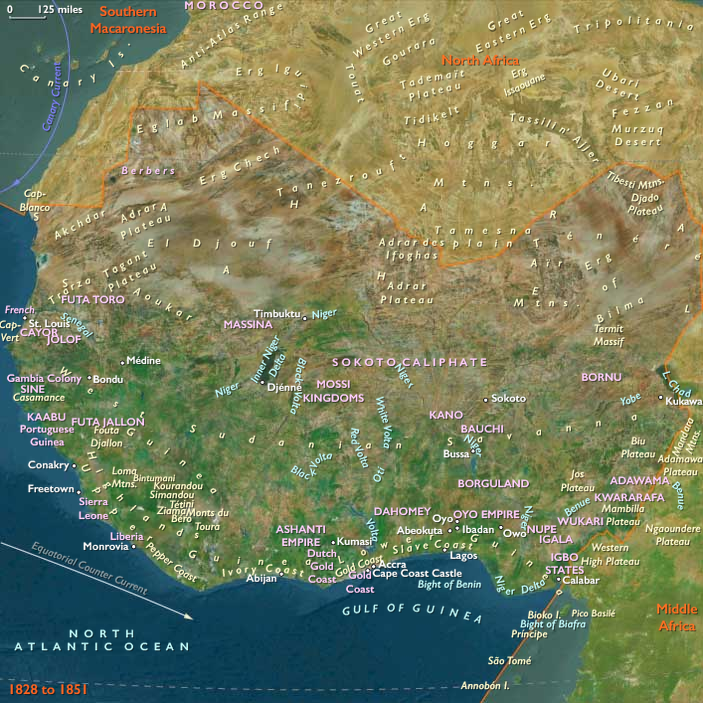
The downfall of the Oyo Empire had begun in around 1789, when Alaafin Abiodun had been killed; his son and successor, Awole, was the suspected murdered.
A series of constitutional upheavals, dynastic intrigues, and local particularism had followed, weakening the empire.
In an Illorin-centered revolt initiated by Afonja, the Are Ona Kakanfo, the government had in 1796 ousted Alaafin Awole.
At his rejection by the council, Awole said to have cursed the empire as he prepared to commit suicide.
The revolt had led to the secession of Ilorin, a Yoruba state that is to play a crucial role in the destruction of Oyo.
When Dahomey's King Gezo had ascended the throne in 1818, he had offered only a tiny piece of cloth and 2 bags of cowries to the Oyo tax collector, saying that anything else would be disproportionate to Dahomey's wealth.
When four more envoys were sent from Oyo, Gezo had had them beheaded.
An Oyo army had been deployed and decisively defeated, ending Oyo's hegemony over Dahomey.
After gaining its independence, Dahomey had begun raiding the Egbado Corridor southwest of Yorubaland.
After Awole's rejection, Afonja, now master of Illorin, had invited an itinerant Fulani scholar of Islam called Alim al-Salih into his ranks.
By doing this, he hoped to secure the support of Yoruba Muslims (mainly slaves taking care of the Empire's horses) and volunteers from the Hausa-Fulani north in keeping Ilorin independent.
Torn by internal struggle, Oyo could not defend itself against the Fulani Empire, which had razed oyo-Ile.
After the Fulani kill Afonja, the Oyo empire collapses in 1836. (Up to this day, the Illorin traditional ruler is an emir, whereas in the rest of Yoruba towns the kings are called oba or baale; Baale or Baba Onile meaning "father of the land" or "lord of the land".)
Locations
Groups
Topics
Commodoties
Subjects
Regions
Subregions
Related Events
Showing 3 events out of 3 total
Years: 1836 - 1836
Locations
Groups
Topics
Commodoties
Subjects
Regions
Subregions