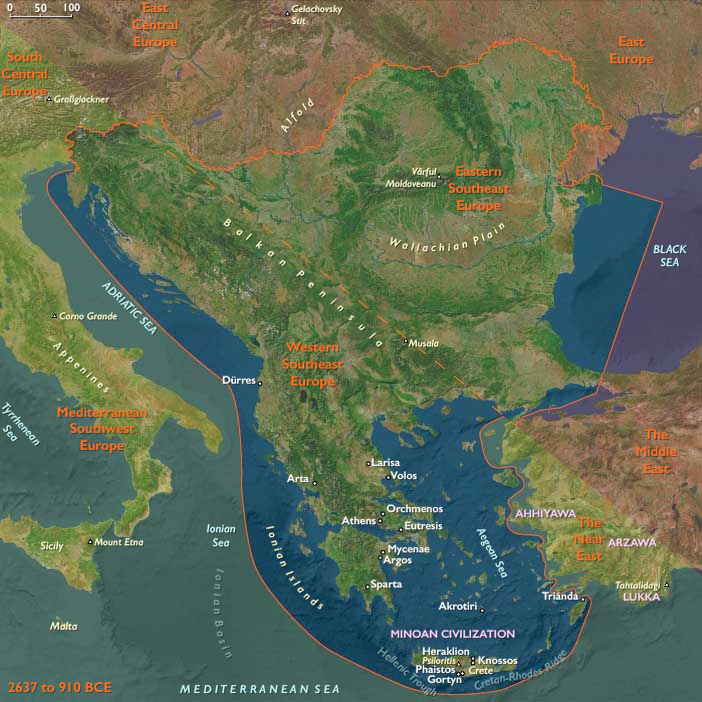
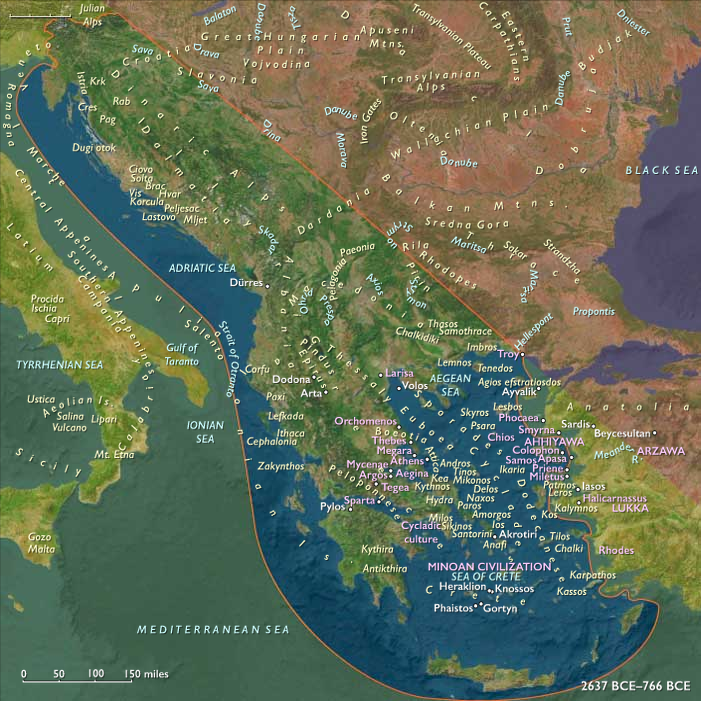
The Dorians, having also conquered Messenia, …
Years: 1053BCE - 910BCE
The Dorians, having also conquered Messenia, …
Locations
Groups
Topics
Subjects
Regions
Subregions
Related Events
Filter results
Showing 8 events out of 8 total
Saladin leaves part of his army to besiege Gaza and a smaller force at Ascalon and marches northward with the rest.
Accompanying Baldwin is Raynald of Châtillon, newly created lord of Oultrejordain, the name used during the Crusades for an extensive and partly undefined region to the east of the Jordan River.
A fierce enemy of Saladin, Raynald is the effective commander of the army, with King Baldwin too ill with leprosy to command it personally.
Also with the army are Baldwin of Ibelin, his brother Balian, Reginald of Sidon, and Joscelin III of Edessa.
Odo de St Amand, Master of the Knights Templar, comes with eighty-four Templar knights.
Another Templar force attempts to meet Baldwin at Ascalon, but they remain besieged at Gaza.
Saladin continues his march towards Jerusalem, thinking that Baldwin will not dare to follow him with so few men.
He attacks Ramla, …
…Lydda and …
…Arsuf, but because Baldwin is supposedly not a danger, he has allowed his army to be spread out over a large area, pillaging and foraging.
However, unknown to Saladin, the forces he had left to subdue the King had been insufficient and now both Baldwin and the Templars are marching to intercept him before he reaches Jerusalem.
The Christians, led by the King, pursue the Muslims along the coast, finally catching their enemies at Mons Gisardi, near Ramla.
The location is disputed, as Ramla is a large region that includes the town under the same name.
Malcolm Barber equates Mons Gisardi with the mound of al-Safiya.
Saladin's chronicler Imad ad-Din al-Isfahani refers to the battle taking place by the mound of Al-Safiya, potentially modern Tell es-Safi near the village of Menehem, not far from Ashkelon, and within the contemporary Ramla province.
Al-Safiya means white and, indeed, the Es-Safi hill is white with the foundations of a Crusader castle recently found at the top, called Blanchegarde.
Ibn Al-Athīr, one of the Arab chroniclers, mentions that Saladin intended to lay siege to a Crusader castle in the area, but Saladin's baggage train had been apparently mired.
There is a small stream north of Tell es-Safi bordering farmland that in November might have been plowed up and muddy enough to hinder the passage of the baggage train.
The Egyptian chroniclers agree that the baggage had been delayed at a river crossing.
Saladin is taken completely by surprise.
His army is in disarray, part has been held up by the mired baggage train while another part of his force has scattered into raiding parties across the countryside.
The horses are tired from the long march.
Some men have to hurry to collect their weapons from the baggage train.
Saladin's army, in a state of panic, scrambles to make battle lines against the enemy.
King Baldwin orders the relic of the True Cross to be raised in front of the troops.
The King, whose teenage body is already ravaged by aggressive leprosy, is helped from his horse and drops to his knees before the cross.
He prays to God for victory and rises to his feet to cheers from his army.
The Jerusalem army attack the hurriedly arranged Muslims, inflicting heavy casualties.
The King, fighting with bandaged hands to cover his terrible wounds and sores, is in the thick of the fighting.
Egyptian effective command is under Saladin's nephew Taqi ad-Din.
Taqi ad-Din apparently attacks while Saladin is putting his Mamluk guard together.
Taqi’s son Ahmad dies in the early fighting.
Saladin's men are quickly overwhelmed.
Saladin himself only avoids capture by escaping, as Ralph de Diceto claims, on a racing camel.
By nightfall, those Egyptians that are with the Sultan have reached Caunetum Esturnellorum near the mound of Tell el Hessy (or Hessi).
This is about twenty-five miles from Ramla.
It is only about seven kilometers from Tell es-Safi (al-Safiya).
King Baldwin's victory is total.
He has utterly destroyed the invasion force and has captured Saladin's baggage train.
Baldwin pursues Saladin until nightfall, and then retires to Ascalon.
Deluged by ten days of heavy rains and suffering the loss of roughly ninety percent of his army, including his personal bodyguard of Mamluks, Saladin flees back to Egypt, harassed by Bedouins along the way.
Only one tenth of his army makes it back to Egypt with him.
Saladin again invades the Crusader states in 1179, from the direction of Damascus.
He bases his army at Banias and sends raiding forces to despoil villages and crops near Sidon and the coastal areas.
Farmers and townspeople impoverished by Saracen raiders will be unable to pay rent to their Frankish overlords.
Saladin's destructive policy will weaken the Crusader kingdom unless stopped.
In response, Baldwin moves his army to Tiberias on the Sea of Galilee.
From there he marches north-northwest to the stronghold of Safed.
Continuing in the same direction, he reaches Toron castle (Tebnine), about thirteen miles (twenty-one kilometers) east-southeast of Tyre.
Together with the Knights Templar led by Odo of St Amand and a force from the County of Tripoli led by Count Raymond III, Baldwin moves northeast.
From the eastern side of the coastal range, the Crusaders see Saladin's tents in the distance.
Baldwin and his nobles decide to descend to the plain and attack at once.
As the Frankish army moves downhill, the mounted troops soon outstrip the foot soldiers.
After a few hours' delay, the Crusader army reassembles, then encounters and easily defeats the Saracen raiding forces, who are returning from their forays.
The Franks, believing the battle won, let their guard down.
Raymond's knights and Odo of St Amand's Templars move onto some high ground between the Marj Ayyun and the Litani River.
The Crusader infantry rests from their hurried march earlier in the day.
Suddenly, Saladin's main army attacks the unprepared Crusaders, defeating them badly.
Observers of the time blame the defeat on Odo of St Amand, who is captured in the battle.
King Baldwin barely escapes capture; unable to mount a horse because of his crippling disease, he is carried to safety by a knight as his bodyguard cuts a path through the Saracens.
Many Frankish survivors of the struggle flee to shelter at Beaufort Castle (Qala'at ash-Shaqif Arnoun) about five miles (eight kilometers) southwest of the battlefield.
Baldwin, making a bold strategic move as a result of his military victory at Mont Gisard, decides to march to Jacob’s Ford, one of the safest crossings of the Jordan River, and build a defensive fortress on its territory.
Christian Palestine and Muslim Syria utlize this key river crossing, approximately one hundred miles north of Jerusalem on one of the main roads between Acre, Israel and Damascus, as a major intersection between the two civilizations.
The king and his Crusaders theorize that such a fortification could protect Jerusalem from a northern invasion and put pressure on Saladin’s stronghold at Damascus.
Between October 1178 and April 1179, Baldwin had begun the first stages of constructing his new line of defense, a fortification called Chastellet, at Jacob’s Ford.
Saladin is unable to stop the erection of Chastellet by military force because a large portion of his troops is stationed in northern Syria, suppressing Muslim rebellions.
Consequently, the sultan offers Baldwin sixty thousand dinars to halt construction.
Baldwin declines, and Saladin increases the offer to one hundred thousand dinars.
The Christian king again refuses and continues to build Chastellet.
By the summer of 1179, Baldwin’s forces have constructed a stone wall of massive proportions.
Saladin, fully aware that any further bargaining or negotiations would only be in vain and that the more time he wastes, the more time Baldwin will have to complete his massive fortification, summons a large Muslim army to march southeast towards Jacob’s Ford.
On August 23, 1179, Saladin arrives at Jacob’s Ford and initiates a siege of the castle.
While his archers distract the men inside the fortification, miners dig a tunnel to breach the stone and iron walls at the northeast corner of Chastellet.
Once the tunnel is dug, Saladin’s forces place large pieces of wood into the tunnel and set them alight.
This process, called sapping, is a method by which the tunnel's supports are burnt away forcing the walls to eventually collapse under their own weight.
Sapping initially fails for Saladin and his troops, and, the troops are forced to put out the fire with buckets of water, being paid one gold piece per bucket to do so.
After the fire is extinguished, the miners are instructed to relight the fire.
At the same time, Baldwin, having learned of this attack, calls for reinforcements from Jerusalem.
However, communications between Baldwin, who is in Tiberias, and Chastellet are slow and, by this time, the siege has been underway for several days.
Baldwin’s forces inside the castle begin to reinforce the main gates around the castle.
Shortly after, the Muslims again light a fire in the tunnel under the castle, and the walls collapse.
Approximately six days after the siege began, Saladin and his troops enter Chastellet.
By August 30, the Muslim invaders have pillaged the castle and killed most of its residents.
On the same day, less than one week after reinforcements had been called, Baldwin and his supporting army set out from Tiberias, only to discover smoke permeating the horizon directly above Chastellet.
They are too late to save the seven hundred knights, architects, and construction workers who have been killed and the other eight hundred who have been taken captive.
Baldwin and his reinforcements turn back towards Tiberias and Saladin orders the remains of the fortification to be torn down.

Saladin indeed arrives to besiege Jerusalem in September, after he has conquered almost all of the rest of the kingdom, including Ibelin, Nablus, Ramla, and Ascalon.
The sultan feels no ill will to Balian for breaking his oath, and arranges for an escort to accompany Maria and their children to Tripoli.
As the highest ranking lord remaining in Jerusalem, Balian, as Ibn al-Athir wrote, is seen by the Muslims as holding a rank "more or less equal to that of a king."