
The dome of the Hagia Sophia collapses …
Years: 558 - 558
April
The dome of the Hagia Sophia collapses on May 7, 558, due to an earthquake.
Justinian orders the dome to be rebuilt.
Locations
People
Groups
- East, or Oriens, Praetorian prefecture of
- Christianity, Chalcedonian
- Roman Empire, Eastern: Justinian dynasty
Subjects
Regions
Subregions
Related Events
Filter results
Showing 10 events out of 57532 total
The Dedication of the Abbey of Saint-Germain-des-Prés (558 CE)
The original Abbey of Saint-Germain-des-Prés, founded by Childebert I, King of Paris, is formally dedicated on December 23, 558 CE, by Germain, Bishop of Paris.
1. The Abbey’s Foundation and Purpose
- The monastery was originally named Abbey of St. Vincent, in honor of St. Vincent of Saragossa, whose tunic Childebert had taken from Spain during his campaign against the Visigoths.
- It was intended as a major religious institution at the gates of Paris, reinforcing the city's growing importance as a spiritual and political center.
2. The Role of Bishop Germain of Paris
- Bishop Germain of Paris plays a crucial role in the dedication ceremony, officially consecrating the abbey for Christian worship.
- He later becomes so closely associated with the monastery that, after his canonization, the abbey is renamed in his honor, becoming Saint-Germain-des-Prés.
3. A Lasting Religious and Cultural Center
- The Abbey of Saint-Germain-des-Prés becomes one of the most important monastic institutions in Frankish Gaul.
- Over time, it serves as a royal burial site, a center of Christian learning, and an influential monastic community.
- Its dedication in 558 CE marks the continued expansion of Christian monasticism under the Merovingians, strengthening the connection between Frankish royalty and the Catholic Church.
Conclusion
The dedication of Saint-Germain-des-Prés by Bishop Germain of Paris in 558 CE symbolizes the deepening ties between the Frankish monarchy and the Church. The abbey remains a major religious landmark, shaping the spiritual and cultural identity of medieval Paris and beyond.
Yuan Huangtou of Ye, the son of the deposed Yuan Lang, the briefly reigning Emperor of Northern Wei, has been permitted to inherit his father’s title of Prince of Anding.
Northern Wei's branch successor state Eastern Wei having ended in 550 and been replaced by Northern Qi, its first emperor, Emperor Wenxuan of Northern Qi, carries out a major slaughter of Northern Wei's imperial Yuan clan in 559.
Several prisoners of Emperor Wenxuan, including Yuan Huangtou, are forced to launch themselves from a tower attached to a kite, as an experiment.
Yuan Huangtou is the sole survivor, successfully gliding over the city walls.
One Yuan Huangtou is imprisoned and starves to death, but it is not known for sure whether that Yuan Huangtou was Yuan Lang's son.
The Liang Dynasty ends in 557 as Chen Baxian, a distinguished general, becomes, as Emperor Wu, the first emperor of Southern China’s Chen Dynasty.
Chen Qian, age thirty-seven, succeeds his uncle Emperor Wu of Chen.
During his reign, he will consolidate the state against the rebellious warlords.
The Gaya confederacy cannot risk the hostility of either Baekje or Silla (two of the Three Kingdoms of Korea that dominated the peninsula, the third being Goguryeo).
By the sixth century, Ara Gaya has put a great deal of effort into pursuing a diplomatic solution for maintaining its independence, including hosting summits between Baekje, Silla and Yamato-Wa.
The Gaya confederacy had been greatly weakened as northwestern Gaya states fell under the influence of Baekje and southeastern states fell under Silla's influence.
Ara Gaya had sought to maintain its independence by allying itself with Goguryeo, and then asked Goguryeo to invade Baekje in 548.
This attempt to weaken Baekje's sphere of influence failed with Goguryeo’s unsuccessful campaign.
Silla had defeated Baekje in war in 553 and occupied the Gyeonggi area (the Han River basin), breaking its hundred and twenty-year alliance with Baekje.
Having started incorporating the parts of Gaya already under its sphere of influence, Silla also invades the rest of Gaya to eliminate Baekje's sphere of influence there.
Ara Gaya capitulates to Silla in 559.
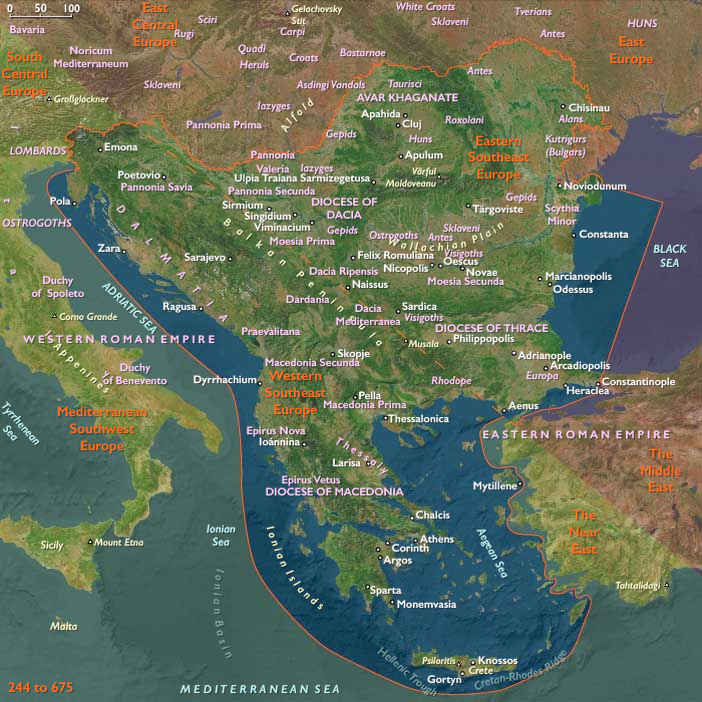
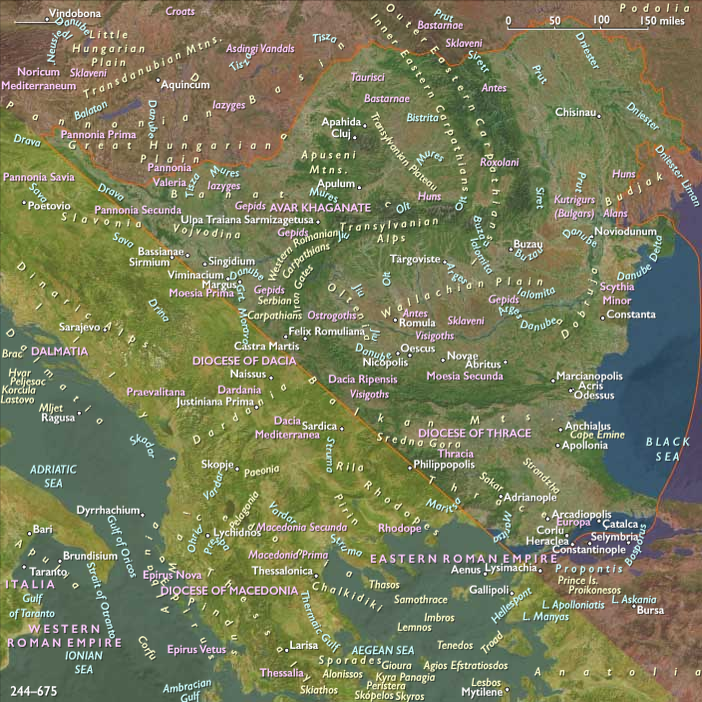
The Kutrigurs and Huns under Zabergan, accompanied by Sclaveni, cross the Danube in 559 and divide their force into three columns.
One column reaches Thermopylae; the second, moving eastward through Thrace, gains a foothold on the Gallipoli Peninsula near Constantinople.
The third column advances as far as the suburbs of the city itself, which the aged Belisarius has to defend with an unlikely muster of civilians, demesmen, and a few veterans.
Worried by Roman naval action on the Danube, which seems to menace the escape route home, the Kutrigurs break off the attack, …
…return north, and find themselves under attack from the Utigur Bulgars, a people whose support Justinian's agents had earlier connived at and won by suitable bribes.
The two closely related peoples weaken each other in warfare, of which the episode of 559 is not the first instance, and this is precisely the result at which Roman diplomacy is aimed.
Chlothar I Suppresses a Revolt in Saxony and Imposes Tribute (559 CE)
In 559 CE, Chlothar I, King of the Franks, successfully suppresses a revolt by the Saxons and Thuringii in the region of Saxony (modern-day Germany). Following his victory, he imposes an annual tribute on the defeated Saxons, requiring them to deliver 500 cows per year as a symbol of Frankish dominance.
1. The Saxon and Thuringian Revolt
- The Saxons and Thuringii, located in the northeastern frontier of the Frankish kingdom, frequently resisted Frankish control.
- Their rebellion in 559 CE likely stemmed from:
- Resentment toward Frankish expansion into their lands.
- A desire to assert independence from Frankish overlordship.
- Ongoing conflict over territorial and economic control.
- Chlothar leads a military campaign into Saxony, defeating the rebels and reestablishing Frankish authority in the region.
2. The Imposition of Tribute
- As a means of ensuring continued submission, Chlothar demands an annual tribute of 500 cows from the Saxons.
- This tribute serves multiple purposes:
- Economic gain, enriching Frankish nobility and the royal treasury.
- Symbolic subjugation, reinforcing Saxon dependence on the Franks.
- Deterring further revolts, as the tribute system forces the Saxons to maintain ties with the Franks.
3. The Legacy of Frankish-Saxon Conflict
- Although Chlothar enforces Frankish dominance, Saxon resistance will continue for centuries, culminating in the Saxon Wars under Charlemagne (late 8th century).
- The tribute of 500 cows annually represents an early example of Frankish tributary rule, a strategy used in later conquests.
- The event demonstrates Chlothar's ability to maintain control over the eastern frontier, securing his status as the most powerful Merovingian ruler of his time.
Conclusion
By 559 CE, Chlothar I effectively consolidates his rule over Frankish and non-Frankish territories, imposing his authority through military suppression and economic tribute. His success in Saxony marks one of the final conquests of his reign, solidifying Frankish influence over Germanic lands well into the medieval period.
The Avars have moved westward from south Russia, subjugating Utigurs, Kutrigurs, and Slavic peoples to the profit of the empire.
By 560, the Avars, who enslave Slavs (hence the name), have apparently conquered all the territory occupied by Eastern Slavs, or Antes.
The Avars destroy one Bulgar tribe, but the rest save themselves by submitting to another horde of Turkic newcomers.
The Avars are familiar with the stirrup, and they may have introduced it into Europe.
(Some of the earliest unequivocal evidence of the use of the stirrup comes from Avar graves.)
The First Council of Braga, convened in 561 CE, formally condemns Priscillianism, a heretical movement that had persisted in Hispania since the fourth century. This council, held in the Suebi Kingdom of Galicia, reinforces the region’s alignment with Chalcedonian Christianity, further distancing it from Arian and Priscillianist influences.
Years: 558 - 558
April
Locations
People
Groups
- East, or Oriens, Praetorian prefecture of
- Christianity, Chalcedonian
- Roman Empire, Eastern: Justinian dynasty
