The doctrine of transmigration of souls, the …
Years: 609BCE - 598BCE
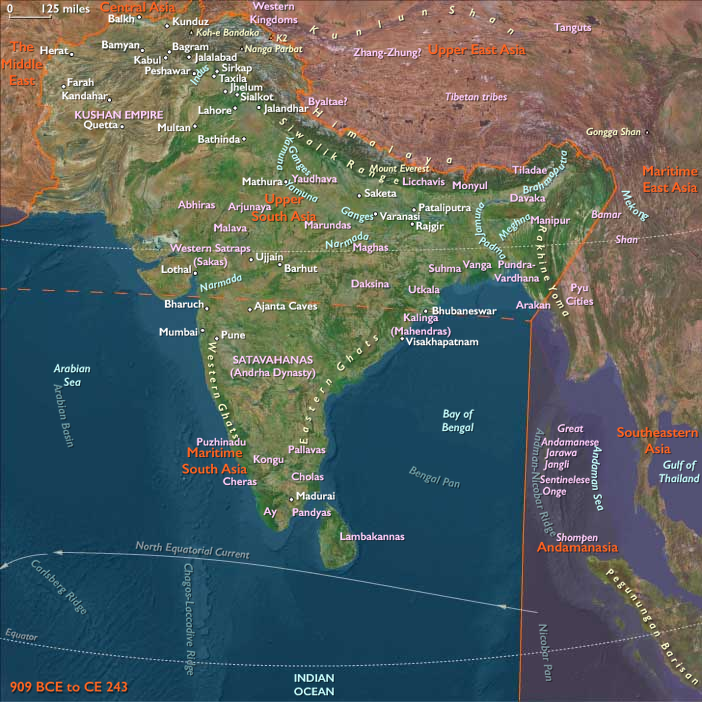
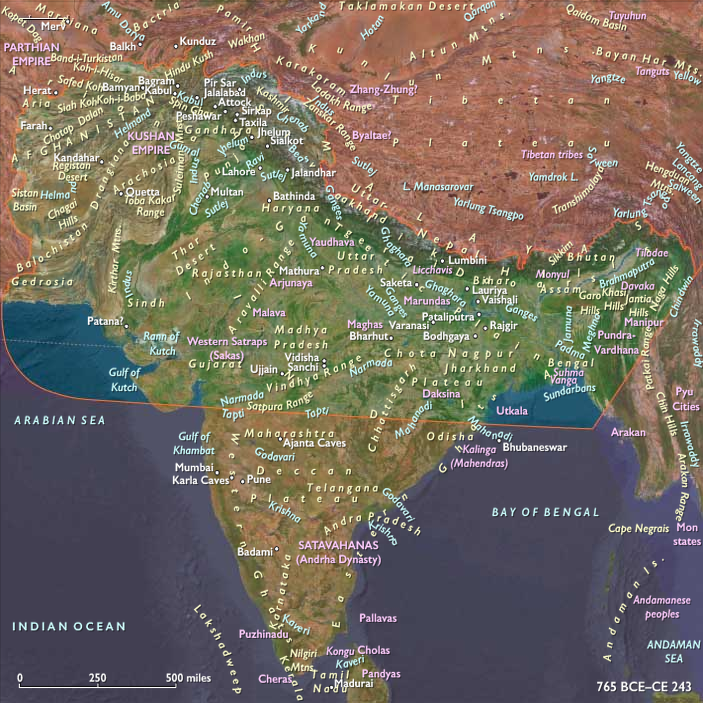
The doctrine of transmigration of souls, the belief that human beings are born and die many times and that their souls born are emanations of the divine spirit, is developed in the Upanishads around 600, interwoven with the concept of karma (action), which involves the inevitable working out, for good or ill, of all action in a future existence, the soul’s condition in each existence being determined by its actions in previous births; the soul’s ultimate goal being the reabsorption of the soul into the ocean of divinity whence it came.
Groups
Topics
Subjects
Regions
Subregions
Related Events
Filter results
Showing 10 events out of 65979 total
Milesian Greeks establish Panticapaeum (present-day Kerch) in southern Ukraine, on the western shore of the Strait of Kerch at the head of a small bay, in the late seventh–early sixth century BCE; it flourishes as a trading center with the Scythians.
Wheel-formed pottery begins replacing crude hand-modeled ware in the coastal region of Thrace toward the end of the seventh century BCE.
The Thracians, who are of Indo-European stock and language, are superior fighters; only their constant political fragmentation prevents their overrunning the lands around the northeastern Mediterranean.
Although Greek and Roman historians characterize the Thracian tribes as primitive partly because they live in simple, open villages, the Thracians in fact have an advanced culture that is especially noted for its poetry and music.
The use of Greek and Macedonian coins spreads through the area, and the Thracians exchange grain, cattle, fish, honey, and slaves with the Greeks for oils, wines, precious materials, jewelry, and high-quality pottery.
By the sixth century BCE, this trade is affording the Thracian ruling class many luxuries.
The Middle East: 609–598 BCE
Babylonian Ascendancy and the Final Defeat of Assyria
Following the dramatic collapse of Assyria in 610 BCE, the remnants of the Assyrian forces rally under their final ruler, Ashur-uballit II, in the city of Carchemish. In a desperate attempt to preserve Assyrian power, Ashur-uballit allies himself with the Egyptian pharaoh, Necho II, whose forces had previously secured a quick victory over the Kingdom of Judah at Megiddo. After capturing Kadesh on the Orontes, the Egyptians move northward to join their Assyrian allies.
Together, the Egyptian and Assyrian armies cross the Euphrates and besiege Harran, Ashur-uballit’s recently lost stronghold. The siege fails disastrously, forcing Necho’s army to retreat toward northern Syria. With this failure, Ashur-uballit disappears from historical records, marking the definitive end of the Assyrian Empire.
Nebuchadnezzar II and the Neo-Babylonian Empire
With Assyria's downfall imminent, the Babylonian king, Nabopolassar, delegates military command to his capable son, Nebuchadnezzar II (Nabu-kudur-usur). Nebuchadnezzar decisively engages the combined Egyptian-Assyrian forces at the Battle of Carchemish in 605 BCE, decisively defeating them and scattering their remnants. The Babylonians pursue the fleeing Egyptians, inflicting further losses at Hamath and decisively driving them out of Syria. This battle extinguishes the last significant Assyrian resistance, consolidating Babylonia’s dominance over the entire region.
Poised to extend his conquest into Egypt itself, Nebuchadnezzar halts abruptly upon learning of his father’s death, returning swiftly to Babylon to secure the throne. His accession initiates the height of the Neo-Babylonian Empire, characterized by extensive urban renewal, monumental architecture, and significant cultural advancements.
Cultural and Technological Developments
During this era, the Babylonians refine their scientific and mathematical knowledge, as evidenced by sophisticated cuneiform tablets from around 600 BCE. These tablets include complex multiplication, reciprocals, square roots, and algebraic tables, demonstrating advanced mathematical techniques. This expertise notably informs Babylonian astronomy, underscoring the deep integration of mathematics and science in Babylonian culture.
With Assyrian dominance gone, the language of the region also shifts. The Hieroglyphic Luwian script, previously recorded on official seals and monuments, disappears from the historical record, marking a significant linguistic and cultural transition.
Decline of Urartu and Emergence of Armenia
To the north, the powerful kingdom of Urartu, centered around Lake Van and the highlands of what is now eastern Turkey and Armenia, abruptly vanishes around 600 BCE. Historical records suggest that Urartu, significantly weakened by earlier Scythian and Median incursions, is either conquered or peacefully transformed by an emerging local Armenian dynasty, likely the early Orontid Dynasty. Greek and Armenian sources confirm that Armenian prince Paruyr Skayordi, allied with the Medes, plays a critical role in dismantling Assyrian power. These events ultimately give rise to an independent Armenian political identity that fills the vacuum left by Urartu’s disappearance.
Thus, the period from 609 to 598 BCE marks a decisive transition in Middle Eastern history, as the Neo-Babylonian Empire rises to prominence, Egyptian ambitions falter, Assyrian power fades completely, and new cultural identities begin to solidify.

Babylonian cuneiform tablets from 600 BCE facilitate complicated computations with tables for multiplication, reciprocals, and square roots, as well as tables for solving certain basic forms of equations.
The Neo-Babylonians, strong in algebraic arithmetic, apply their mathematics to astronomy.
The Pharaoh, following the easy Egyptian victory over Judah in the Battle of Megiddo, soon captures Kadesh on the Orontes, then moves forward to join forces with the Assyrian ruler Ashur-uballit II.
The Egyptian and Assyrian armies cross the Euphrates together and lay siege to Harran, Ashur-uballit’s former stronghold.
The combined forces fail to recapture the city, and Necho retreats back to northern Syria.
At this point, Ashur-uballit vanishes from history, and the Assyrian Empire is soon conquered by the Babylonians.
Nabopolassar, after driving the remnants of the Assyrian resistance to Carchemish in 605 BCE, leaves military operations in the hands of his son, Nabu-kudur-usur (called Nebuchadnezzar in the Old Testament, modern historians often refer to him as Nebuchadrezzar).
At Carchemish, Nebuchadrezzar disperses the Assyrians and their leader Ashur-uballit II, then battles Necho’s Egyptian army that, delayed at Megiddo and then at Riblah, has come to aid their beleaguered Assyrian allies.
Defeating the Egyptians, he chases the survivors to …
…Hamath and kills more of them there, forcing the Egyptian allies out of Syria and thus completing the destruction of the Assyrian state.
With the Assyrian collapse, Hieroglyphic Luwian, a variant of the Luwian language, recorded in official and royal seals and a small number of monumental inscriptions, ceases to be recorded.
Nabopolassar’s son is poised to invade Egypt itself when he receives news of his father's death.
He returns to Babylon to take the throne as Nebuchadnezzar II.
The Urartians, centered around eastern Anatolia around Lake Van and in the region of present Armenia, in the environs of Yerevan, suddenly disappear from history around 600, to be replaced almost immediately, in the same area of eastern Anatolia, by the Armenians.
According to Urartian epigraphy, Sarduri III (645–635 BCE) was followed by three kings—Erimena (635–620 BCE), his son Rusa III (620–609 BCE), and the latter's son Rusa IV (609–590 or 585 BCE).
Late during the 600s BCE (during or after Sardur III's reign), Urartu was invaded by Scythians and their allies—the Medes.
In 612 BCE, the Median king Cyaxares, together with Nabopolassar of Babylon and the Scythians, conquered Assyria after it had been badly weakened by civil war.
Many Urartian ruins of the period show evidence of destruction by fire.
This would indicate two scenarios—either Media subsequently conquered Urartu, bringing about its subsequent demise, or Urartu maintained its independence and power, going through a mere dynastic change, as a local Armenian dynasty (later to be called the Orontids) overthrew the ruling family with the help of the Median army.
Ancient sources support the latter version: Xenophon, for example, states that Armenia, ruled by an Orontid king, was not conquered until the reign of Median king Astyages (585– 550 BCE) – long after Median invasion of the late seventh century BCE.
Similarly, Strabo (first century BCE to first century CE) wrote that "[i]n ancient times Greater Armenia ruled the whole of Asia, after it broke up the empire of the Syrians, but later, in the time of Astyages, it was deprived of that great authority ..."
Medieval Armenian chronicles corroborate the Greek and Hebrew sources.
In particular, Movses Khorenatsi writes that Armenian prince Paruyr Skayordi helped the Median king Cyaxares and his allies conquer Assyria, for which Cyaxares recognized him as the king of Armenia, while Media conquered Armenia only much later—under Astyages.