
The Dobruja comes under the domination of …
Years: 1417 - 1417
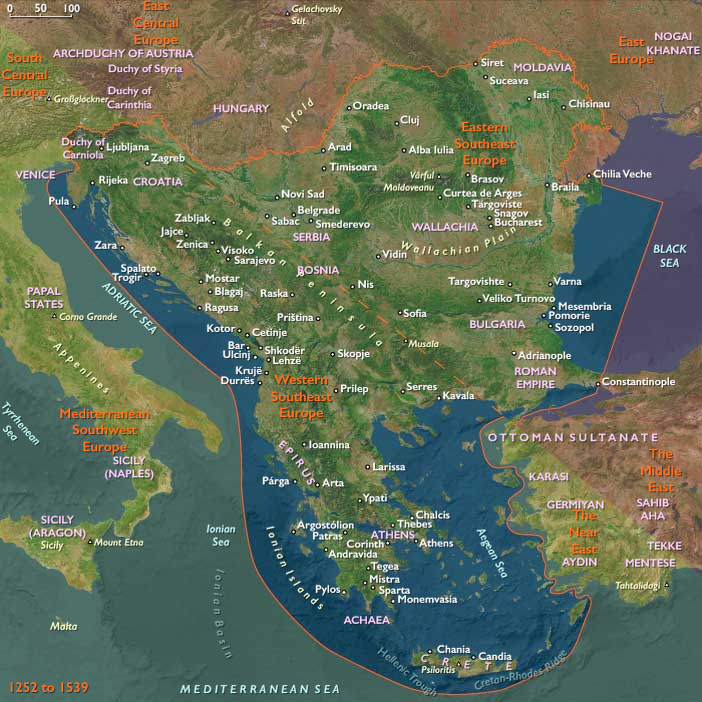
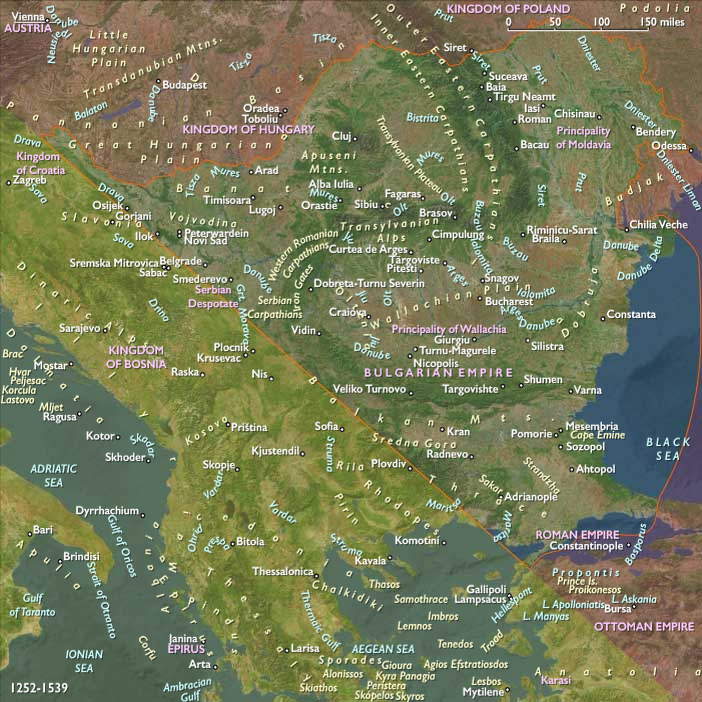
The Dobruja comes under the domination of the Ottoman Turks, who in 1417 attach directly to their empire the regions of …
Locations
People
Groups
Subjects
Regions
Subregions
Related Events
Filter results
Showing 10 events out of 42306 total
Mehmet conducts raids into Hungary in 1417.
Frederick Hohenzollern, by his many services as Burggraf (count) of Nuremberg, has earned the gratitude of the German king Sigismund of Luxembourg, who had rewarded in 1411 him with the office of administrator of Brandenburg, then in 1417 makes him hereditary elector of Brandenburg.
Ruling from Berlin, his primary tasks are to curb the fractious nobility, restore order, repel external foes, and recover alienated properties.
Mehmet, pursuing a policy of relative restraint in the Balkans, restores the vassal system in Bulgaria and Serbia, promising that he will not undertake new European adventures.
However, the fertile lands of the principality of Wallachia attract the Ottoman Turks, who …
…reduce Wallachia to vassal status in 1417, when Mircea capitulates to Sultan Mehmed and agrees to pay an annual tribute and surrender territory; in return, the sultan allows Wallachia to remain a principality and to retain the Eastern Orthodox faith.
…Turnu Măgurele and …
…Giurgiu, which afford them permanent fortifications north of the Danube River.
Sultan Mehmed also makes territorial gains in Albania in 1417.
Donatello completes the Saint George for the Confraternity of the Cuirass-makers in 1417.
The sculptor has slightly twisted the saint's body and intensified the face to present a proud, youthful, self-confident hero.
In the elegant relief at the base, “St. George and the Dragon,” he displays his virtuosity by the “rilievo schiacciato” ("crushed" or "flattened" relief), in which the field of action appears deep but the sculptural plane is actually quite shallow.
It is one of the first examples of central-point perspective in sculpture.
Henry V and the Restoration of English as an Official Language (1415–1417)
During his military campaigns in France, King Henry V of England (r. 1413–1422) began using English in official correspondence—a significant linguistic shift that marked the revival of English as an official language for the first time since the Norman Conquest (1066), over 350 years earlier.
I. The Use of English in Henry V’s Correspondence
- While on campaign in France (1415–1420), Henry wrote letters back to England in English, rather than in Latin or Anglo-Norman French, which had been the dominant languages of government and administration.
- This was a deliberate political and cultural statement, emphasizing national unity and reinforcing the legitimacy of the English monarchy.
- His use of English signified a turning point in the gradual decline of French as the language of English governance.
II. The Long Decline of French in England (1066–1415)
- After the Norman Conquest (1066), Anglo-Norman French became the dominant language of the English court, law, and government.
- Latin remained the language of the Church and formal records, while English was largely confined to the lower classes.
- By the 14th century, English was slowly re-emerging:
- The Statute of Pleading (1362) allowed English to be spoken in courts, though legal documents remained in French or Latin.
- Geoffrey Chaucer (c. 1343–1400) had popularized Middle English in literature, demonstrating its richness and adaptability.
III. The Lasting Impact of Henry V’s Use of English
- By the end of Henry V’s reign, English had become the primary language of administration and government, replacing French in royal and official documents.
- This shift laid the foundation for:
- The first official use of English in Parliament.
- The transition to Middle English as the standard written language.
- The eventual translation of legal and governmental records into English.
IV. Conclusion: The Restoration of English in Official Use
Henry V’s use of English in correspondence marked a major turning point in England’s linguistic history, restoring English as the primary language of governance for the first time since 1066. His efforts helped solidify English national identity, ensuring its permanent place in royal administration, law, and diplomacy.
The English Capture of Caen (1417)
In 1417, during the second phase of Henry V's campaign in France, Caen, one of the largest and most strategically important cities in Normandy, fell to English forces, marking a major expansion of English rule in northern France.
I. The Context: Henry V’s Renewed Offensive in France
- Following his victory at Agincourt (1415) and the subsequent consolidation of English control over Calais and Harfleur, Henry V launched a full-scale invasion of Normandy in 1417.
- This campaign was part of his broader strategy to conquer northern France, undermine the weakened French monarchy, and press his claim to the French throne.
- By mid-1417, English forces landed in Normandy, methodically capturing towns and fortresses along the Norman coast and interior.
II. The Siege and Capture of Caen (August–September 1417)
- In August 1417, Henry V laid siege to Caen, a major stronghold in western Normandy and a center of political, military, and economic activity.
- The city was well-defended by French forces, but its defenses were weakened by internal divisions stemming from the Armagnac-Burgundian civil war.
- After weeks of intense fighting, Caen fell to the English in September 1417.
III. The Aftermath: English Rule Over Normandy
- The fall of Caen secured a critical foothold for England in Normandy, paving the way for the further conquest of northern France.
- The English continued their Norman campaign, capturing Alençon, Argentan, and Falaise in the following months.
- By 1419, the English had completed their conquest of Normandy, leading to Henry V’s recognition as heir to the French throne in the Treaty of Troyes (1420).
IV. Impact and Legacy
- The capture of Caen was a significant victory that cemented English power in northern France, leading to the occupation of Normandy until 1450.
- The city became a key English administrative center, used to govern occupied French territories.
- The English conquest of Normandy strengthened Henry V’s claim to the French crown, further destabilizing the already weakened French monarchy.
The fall of Caen in 1417 was a major turning point in Henry V’s conquest of Normandy, marking the expansion of English control in France and paving the way for the Treaty of Troyes and the height of English power in the Hundred Years’ War
