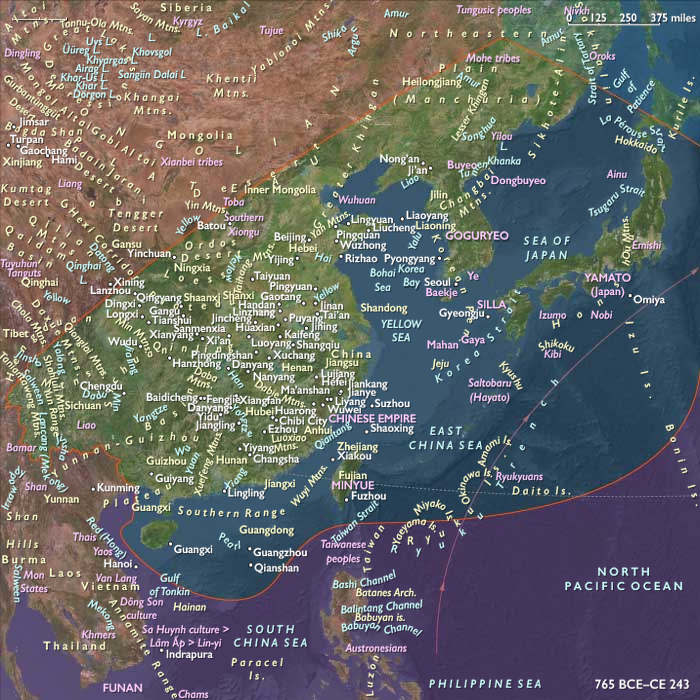
The division of the Han empire into …
Years: 225 - 225
The division of the Han empire into three states has become firmly established, particularly after Liu Bei's death in 223.
Liu Bei's prime minister Zhuge Liang, serving as regent for Liu Shan, has reestablished the alliance with Sun, causing Cao Wei to have to defend itself on two fronts and unable to conquer either.
Exasperated, Cao makes a famous comment in 225 that "Heaven created the Yangtze to divide the north and the south."
Locations
People
Groups
- Nanman
- Chinese (Han) people
- Cao Wei, (Chinese) kingdom of
- Shu Han (minor Han), (Chinese) kingdom of
- Wu, Eastern, (Chinese) kingdom of
Topics
Commodoties
Subjects
Regions
Subregions
Related Events
Filter results
Showing 10 events out of 60628 total
The Wu administration is known for its efficiency early in the reign of Sun Quan, who displays a knack for listening to correct advice and for delegating authorities to the proper individuals.
For example, he correctly trusts the faithful Lu Xun and Zhuge Jin, so much so that he makes a duplicate imperial seal and leaves it with Lu Xun; whenever he corresponds with Shu's emperor Liu Shan or regent Zhuge Liang, he delivers the letter to Lu Xun first (as Lu's post is near the Shu border), and then if, in Lu's opinion, changes are needed, Lu revises the letter and then restamps it with Sun's imperial seal.
Further, Lu Xun and Zhuge Jin are authorized to coordinate their actions with Shu without prior imperial approval.
Sun Quan treats his high level officials as friends and addresses them accordingly (with style names), and in accordance they dedicate all effort to Wu's preservation.
He also knows the proper roles for officials that he trusts; for example, in 225, when selecting a chancellor, while the key officials all respect Zhang Zhao greatly and want him to be chancellor, Sun Quan declines, reasoning that while he respects Zhang greatly, a chancellor needs to handle all affairs of state, and Zhang, while capable, has such strong opinions that he will surely be in conflict with Sun Quan and other officials at all times.
He also repeatedly promotes his official Lü Fan even though, while he was young, Lü Fan had informed on Quan to his father Sun Ce about his improper spending habits, understanding that Lü did so only out of loyalty to Sun Ce.
In 224 and 225, Cao Pi again makes attacks on Wu, but each time the Wu forces are able to repel Wei's with relative ease—so easily that Cao Pi makes the comment, "Heaven created the Yangtze to divide the north and south."
Palmyra, an important city located in an oasis two hundred and fifteen kilometers northeast of Damascus and one hundred and eighty kilometers southwest of the Euphrates at Deir ez-Zor, has long been a vital caravan stop for travelers crossing the Syrian desert and is known as the Bride of the Desert.
The earliest documented reference to the city by its Semitic name Tadmor, Tadmur or Tudmur (which means "the town that repels" in Amorite and "the indomitable town" in Aramaic) is recorded in Babylonian tablets found in Mari.
Having been made part of the Roman province of Syria during the reign of Tiberius (14–37 CE), Palmyra has steadily grown in importance as a trade route linking Persia, India, China, and the Roman Empire.
In 129, Hadrian had visited the city and was so enthralled by it that he had proclaimed it a free city and renamed it Palmyra Hadriana.
Beginning in 224, Palmyra's trade diminishes as the Sassanids occupy the mouth of the Tigris and the Euphrates.
Sun Quan is able to increase his effective control over Jiao Province (present-day northern Vietnam) when, in late 226, his general Lü Dai is able to defeat the warlord Shi Hui and end the effective independence that the Shi clan had.
In addition, the several independent kingdoms in modern Cambodia, Laos, and southern Vietnam all became Wu vassals as well.
The choice of empress had been an immediate issue after Cao Pi became emperor in 220.
Lady Zhen was his wife, but by this point had long lost favor due to a variety of reasons including the struggle she had with a favorite concubine of Cao's, Guo Nüwang.
Lady Guo used the unlikely possibility that Zhen's son Cao Rui might be biologically Yuan Xi's son to full advantage in creating conflicts between Cao Pi and Lady Zhen.
Cao therefore had refused to summon Lady Zhen to Luoyang after he ascended the throne but instead ordered her to remain at Yecheng, which caused Lady Zhen to be resentful.
When words of her resentment reached Cao, he became angry and forced her to commit suicide.
In 222, Cao had created Consort Guo empress.
Empress Guo, however, is without make issue.
Lady Zhen's son Cao Rui is the oldest of Cao Pi's sons, but because she had been put to death and because of Cao Pi's lingering doubt as to his paternity, has not been created crown prince.
but instead had been made only the Prince of Pingyuan following Cao Pi's ascension.
Cao Pi, however, does not appear to have seriously considered any other son as heir.
(It might have been because the other sons were all significantly younger, although their ages were not recorded in history.)
In the summer of 226, when Cao Pi is seriously ill, he finally creates Prince Rui crown prince.
On his deathbed, he entrusts his successor to the care of Cao Zhen, Chen Qun, and Sima Yi.
Following Cao Pi's death, Prince Rui ascends the throne at the young age of twenty-one.
Sun Quan himself is, however, equally unsuccessful in efforts to make major attacks on Wei.
After Cao Pi's death in 226, for example, Sun Quan launches an attack on Wei's Jiangxia prefecture (in present-day Xiaogan, Hubei) but is forced to withdraw as soon as Wei reinforcements arrive.
Alexander’s reign contains some of the last major building works constructed in Rome before the reign of Diocletian.
He builds the last of the eleven ancient aqueducts of Rome, the twenty-two kilometer long Aqua Alexandrina, to supply his enlargement of the Thermae of Nero, which have been renamed after the emperor (Thermae Alexandrinae).
It had been commonly expected when Cao Rui became emperor that his wife, Princess Yu, would be created empress, but she was not.
Rather, he creates a favorite concubine, Consort Mao, empress in 227.
Princess Yu is exiled back to their original palace.
He loves Empress Mao dearly, and a number of her relatives, including her father and brother, become honored officials (but without actual powers).
Bardaisan shows great literary activity against Marcion and Valentinus, the Gnostics of the day.
Bardaisan mixes his Babylonian pseudo-astronomy with Christian dogma and originates a Christian sect, which is vigorously combated by St. Ephrem.
Various opinions have been formed as to the real doctrine of Bardesanes.
As early as Hippolytus (Philosoph., VI, 50) his doctrine was described as a variety of Valentinianism, the most popular form of Gnosticism.
Adolf Hilgenfeld in 1864 defended this view, based mainly on extracts from St. Ephrem, who devoted his life to combating Bardaisanism in Edessa.
The strong and fervent expressions of St. Ephrem against the Bardaisanites of his day are not a fair criterion of the doctrine of their master.
The extraordinary veneration of his own countrymen, the very reserved and half-respectful allusion to him in the early Church Fathers, and above all the "Book of the Laws of the Countries", suggest a milder view of Bardaisan's aberrations.
He cannot be called a Gnostic in the proper sense of the word.
Like the Early Christians, he believes in an Almighty God, Creator of heaven and earth, whose will is absolute, and to whom all things are subject.
God endowed man with freedom of will to work out his salvation and allowed the world to be a mixture of good and evil, light and darkness.
All things, even those we now consider inanimate, have a measure of liberty.
In all of them the light has to overcome the darkness.
After six thousand years this earth shall have an end, and a world without evil shall take its place.
However, Bardaisan also thinks the sun, moon and planets are living beings, to whom, under God, the government of this world is largely entrusted; and though man is free, he is strongly influenced for good or for evil by the constellations.
Bardaisan's catechism must have been a strange mixture of Christian doctrine and references to the signs of the Zodiac.
Led by the fact that "spirit" is feminine in Syriac, he seems to have held unorthodox views on the Trinity.
He apparently denies the Resurrection of the Body, but thinks Christ's body was endowed with incorruptibility as with a special gift.
The Romans under Caracalla, taking advantage of the anti-Christian faction in Edessa, capture Abgar IX and send him in chains to Rome.
Thus the Osrhoenic kingdom, after 353 years' existence, comes to an end.
Though he is urged by a friend of Caracalla to apostatize, Bardaisan stands firm, saying that he fears not death, as he would in any event have to undergo it, even though he should now submit to the emperor.

Bardaisan is forced at the age of sixty-three to take refuge in the fortress of Ani in Armenia, where he tries to spread the Gospel, but with little success.
He will die five years later, either at Ani or at Edessa.
Bardaisan apparently was a voluminous author, and though nearly all his works have perished, we find notices of the following: • Dialogues against Marcion and Valentinus.
• Dialogue "Against Fate" addressed to an Antoninus.
Whether this Antoninus is merely a friend of Bardaisan or a Roman emperor and, in the latter case, which of the Antonini is meant, is matter of controversy.
It is also uncertain whether this dialogue is identical with "The Book of the Laws of the Countries".
• A "Book of Psalms", one hundred and fifty in number, in imitation of David's Psalter.
These psalms will become famous in the history of Edessa, their words and melodies living for generations on the lips of the people.
Only when St. Ephrem composes hymns in the same pentasyllabic meter and has them sung to the same tunes as the psalms of Bardaisan, will the latter gradually lose favor.
• Astrologico-theological treatises, in which his peculiar tenets were expounded.
• A "History of Armenia", a history of the Armenian kings.
• "An Account of India".
Bardaisan obtained his information from the Indian Sramana (wandering monks) ambassadors to the Roman Emperor Heliogabalus.
A few extracts are preserved by Porphyry and Stobaeus.
• "Book of the Laws of the Countries".
Against a questioning disciple called Abida, Bardaisan seeks to show that man's actions are not entirely necessitated by Fate, as the outcome of stellar combinations.
From the fact that the same laws, customs and manners often prevail among all persons living in a certain district, or though locally scattered living under the same traditions, Bardaisan endeavors to show that the position of the stars at the birth of individuals can have but little to do with their subsequent conduct, hence the title "Book of the Laws of the Countries."
Alexander, under the influence of his mother, has done much to improve the morals and condition of the people, and to enhance the dignity of the state.
His advisers are men like the famous jurist Ulpian, the historian Cassius Dio and a select board of sixteen senators; a municipal council of fourteen assists the urban prefect in administering the affairs of the fourteen districts of Rome.
Julia Mamaea calls on Origen, the Alexandrian Christian leader, to provide her with instruction in Christian doctrine.
Julia has watched over the development of her son's character and improved the tone of the administration.
On the other hand, she is inordinately jealous.
In 225, she had arranged for Alexander to marry Sallustia Barbia Orbiana, the daughter of a noble Patrician family, whose father had been made Caesar or co-ruler.
After Orbiana was given the title of Augusta, Mamaea, due to her desire for complete ownership of all feminine imperial titles, grew jealous of the strong bond that developed between Orbiana and Severus.
She treats Orbiana cruelly, forcing her to seek refuge with her father, Sallustius, who is believed to have been appointed as a Caesar.
Sallustius consults with the Praetorian Guard for protection of Orbiana, but the act is determined to be treasonous.
In August 227, Sallustius is executed, and Orbiana is stripped of her title, divorced and exiled to the province of Libya in North Africa.
Severus Alexander has the power to intervene, but chooses not to.
Years: 225 - 225
Locations
People
Groups
- Nanman
- Chinese (Han) people
- Cao Wei, (Chinese) kingdom of
- Shu Han (minor Han), (Chinese) kingdom of
- Wu, Eastern, (Chinese) kingdom of