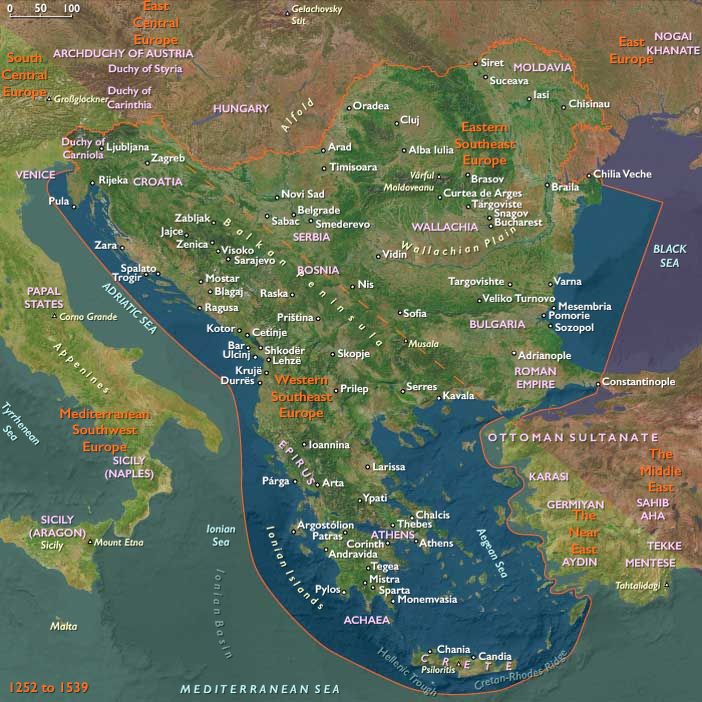
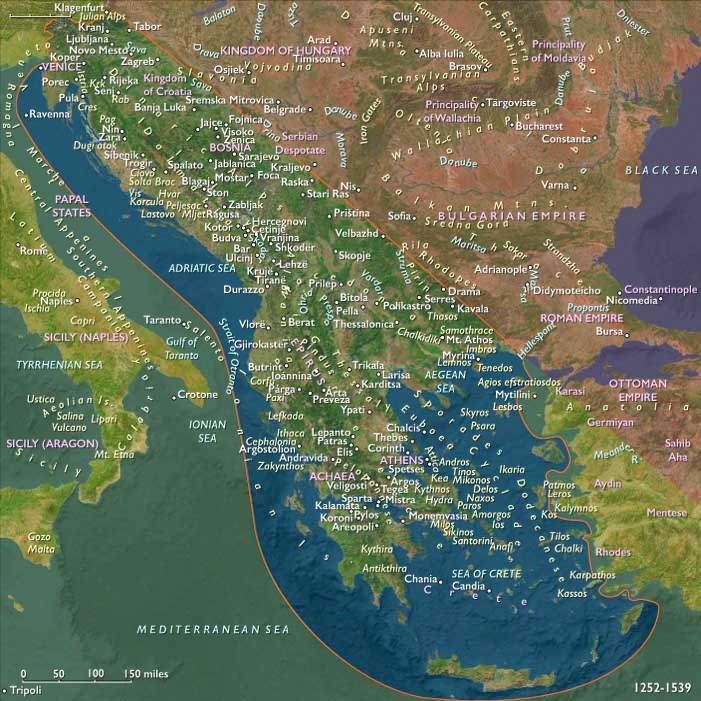
The division of the Albanian-populated lands into …
Years: 1385 - 1385
The division of the Albanian-populated lands into small, quarreling fiefdoms ruled by independent feudal lords and tribal chiefs makes them easy prey for the Ottoman armies.
The Albanian ruler of Durrës, Karl Thopia, appeals in 1385 to Ottoman sultan Murad for support against his rivals, the Balsha family.
An Ottoman force quickly marches into Albania along the Via Egnatia and routs the Balshas.
The principal Albanian clans soon swear fealty to the Turks.
Locations
People
Groups
Topics
Commodoties
Subjects
Regions
Subregions
Related Events
Filter results
Showing 10 events out of 43584 total
The painter Wang Meng is considered one of the Four Masters of the Yuan Dynasty, along with Huang Gongwang, Wu Zhen, and Ni Zan.
They had famously refused to serve the Mongolian rulers of their country.
In contrast to many renowned painters in previous history, these artists mostly work on paper instead of silk, an indication of the importance they give to the calligraphic touch of the brush on paper.
They exclusively paint landscapes, which they believe to be the visible key to the invisible reality.
They restrict their acquaintanceship to each other, and like-minded "wen ren" (gentleman-scholars) Wang Meng, unlike the other three Yüan Masters, who were hermit painters, leads a politically active life that ultimately results in his death in prison on October 14, 1385, at about the age of seventy-seven.
Tokhtamysh, rapidly forgetting his obligations and gratitude to his mentor Timur, who had taken over the former Golden Horde territory of Urganj in his efforts to aid his protégé’s enthronement, vows to reincorporate the territory.
Upon hearing that Timur is campaigning in the Caucasus, Tokhtamysh decides upon a furtive conquest of Timur’s capital, Samarkand.
Tokhtamysh advances his forces into Transoxiania in 1385, but Timur, learning of his intentions, races back to Samarkand and, arriving earlier Tokhtamysh, then attacks him.
Regarding Timur’s army as the vanguard of a larger force, Tokhtamysh withdraws.
The nations of Lithuania and Poland—the former recently recovering from a civil war, and the latter from a succession crisis—sign a treaty at Krewo in 1385, according to which the Lithuanian grand duke Jogaila becomes Wladyslaw II Jagiello, king of Poland, in return for his conversion of the still pagan Lithuanians to Roman Catholicism and the eventual union of the two states.
As a result of the agreement, Lithuania’s rulers and the ethnic Lithuanian population living in non-Rus’ territories become Catholic, but the grand duchy continues to function as an independent state.
Attempts by Habsburg duke Leopold III of Austria to gain territory in Swabia in southern Germany spill over into Swiss Confederation territory.
By the end of 1385, Lucerne’s forces occupy the Habsburg-controlled towns of Rothenburg and …
Timur had helped Tokhtamysh to assume supreme power in the White Horde against Tokhtamysh's uncle Urus Khan in the late 1370s and early 1380s.
After this, Tokhtamysh had united the White and Blue Hordes, forming the Golden Horde, and launched a massive military punitive campaign against the Russian principalities between 1381 and 1382, restoring the Turko (tartar)-Mongol power in Russia after the defeat in the Battle of Kulikovo.
The Golden Horde, after a period of anarchy between the early 1360s and late 1370s, had thus been briefly reestablished as a dominant regional power, defeating Lithuania in Poltava around 1383.
But Tokhtamysh had territorial ambitions in Persia and Central Asia, and on account of this he turndagainst his old ally, Timur.
After the death of Abu Sa'id in 1335, the last ruler of the Ilkhanid Dynasty, a power vacuum had emerged in Persia, and Persia's vulnerability had led to military incursions from its neighbors.
In 1383 Timur started his military conquest of that country, capturing Herat, Khorasan and all of eastern Persia by 1385.
In the same year, Tokhtamysh raids Azerbaijan and northwestern Iran.
The city of Tabriz is plundered and Tokhtamysh retires with a rich booty.
Timur has spent the past fifteen years in various wars and expeditions.
He has not only consolidated his rule at home by the subjugation of his foes, but seeks extension of territory by encroachments upon the lands of foreign potentates.
His conquests to the west and northwest have led him to the lands near the Caspian Sea and to the banks of the Ural and the Volga.
Conquests in the south and southwest encompass almost every province in Persia, including Baghdad, Karbala and Northern Iraq.
One of the most formidable of Timur's opponents is another Mongol ruler, a descendant of Genghis Khan named Tokhtamysh.
After having been a refugee in Timur's court, Tokhtamysh had become ruler both of the eastern Kipchak and the Golden Horde.
After his accession, he had quarreled with Timur over the possession of Khwarizm and Azerbaijan.
However, Timur still supported him against the Russians and in 1382 Tokhtamysh had invaded the Muscovite dominion and burned Moscow.
Taking advantage of the power vacuum in Persia after the death of Abu Sa'id, ruler of the Ilkhanate, in 1335, Timur had initiated the military conquest of Persia in 1383.
He has captured Herat, Khorasan and all eastern Persia by 1385.
...Sempach.
The War of the Eight Saints, carried on with spates of unprecedented cruelty to civilians, had drained the resources of Florence, though the city had ignored the interdict placed upon it by Pope Gregory, declared its churches open, and sold ecclesiastical property for one hundred thousand florins to finance the war.
Bologna had submitted to the Church in August 1377, and Florence had signed a treaty at Tivoli on July 28, 1378 at a cost of two hundred thousand florins indemnity extorted by Pope Urban VI for the restitution of church properties, receiving in return the papal favor and the lifting of the disregarded interdict.
Urban's erstwhile patroness, Queen Joan I of Naples, had deserted him in the late summer of 1378, in part because her former archbishop had become her feudal suzerain.
Urban had then lost sight of the larger issues and began to commit a series of errors.
Turning upon his powerful neighbor Joan, he had excommunicated her as an obstinate partisan of Antipope Clement, and had permitted a crusade to be preached against her.
Soon her enemy and cousin Charles of Durazzo, representing the Sicilian Angevin line, had been made sovereign over the Kingdom of Naples on June 1, 1381), and was crowned by Urban.
Joan's authority was declared forfeit, and Charles had murdered her in 1382.
In return, Charles had had to promise to hand over Capua, Caserta, Aversa, Nocera, and Amalfi to the pope's nephew.
Once ensconced at Naples, Charles had found his new kingdom invaded by Louis of Anjou and Amadeus VI of Savoy; hard-pressed, he had reneged on his promises.
In Rome, the Castel Sant'Angelo was besieged and taken, and Urban was forced to flee.
In the fall of 1383 he determined to Charles in person and go to Naples, where he had found himself virtually a prisoner.
After a first reconciliation, with the death of Louis (September 20, 1384), Charles had found himself freer to resist Urban's feudal pretensions, and relations had taken a turn for the worse.
Urban had been shut up in Nocera, from the walls of which he daily fulminates his anathemas against his besiegers, with bell, book and candle; a price is set on his head.
Rescued by two Neapolitan barons who had sided with Louis, Raimondello Orsini and Tommaso di Sanseverino, after six months of siege Urban succeeds in making his escape to Genoa with six galleys sent him by doge Antoniotto Adorno.
Several among his cardinals who had been shut up in Nocera with him and had followed him in Genoa determined to make a stand: they determine that a Pope, who by his incapacity or blind obstinacy, might be put in the charge of one of the cardinals.
Urban has them seized, tortured and put to death.

Gian Galeazzo Visconti’s first marriage was to Isabelle of Valois, who brought him the title of comte de Vertus in Champagne, rendered in Italian as Conte di Virtù, the title by which he was known in his early career.
A devoted father to his daughter Valentina (wife of Louis, Duke of Orleans and mother of the famous poet, Charles of Orleans), Gian Galeazzo had reacted to gossip about Valentina at the French Court by threatening to declare war on France.
The wife of King Charles VI of France iss Isabeau of Bavaria, the granddaughter of Bernabò Visconti, and, thus, a bitter rival of Valentina and her father Gian Galeazzo Visconti.
After Galeazzo's wife Isabelle died in childbirth in 1373, he married secondly, on October 2, 1380, his first cousin Caterina Visconti, daughter of Bernabò; with her he will have two sons, Gian Maria and Filippo Maria.
Although most famous as Signore of Milan, Gian Galeazzo is the son of Galeazzo II Visconti, who possessed the signoria of the city of Pavia.
In 1385, Gian Galeazzo gains control of Milan by overthrowing his uncle Bernabò through treacherous means.
He imprisons his uncle, who soon dies, supposedly poisoned on his orders.
The Battle of Aljubarrota and the Securing of Portuguese Independence (1385)
Following the retreat of Castilian forces, João of Avis seized the opportunity to legitimize his claim to the Portuguese throne. In March 1385, he convened a cortes to resolve the succession crisis.
João I Proclaimed King (April 6, 1385)
- João das Regras, a skilled jurist and political strategist, presented João’s case before the cortes, systematically dismissing the claims of rival pretenders to the throne, including Beatriz of Portugal, wife of Juan I of Castile.
- On April 6, 1385, João was officially proclaimed King João I of Portugal, securing the legitimacy of the House of Avis.
- As a key military decision, João appointed Nuno Álvares Pereira as Constable of Portugal, placing him in charge of the kingdom’s defense.
- At the same time, English longbowmen began arriving in Portugal, reinforcing the Anglo-Portuguese alliance, which had been formalized in the Treaty of Windsor (1386).
Military Campaigns Leading to Aljubarrota
- Nuno Álvares Pereira marched north, securing the submission of Braga, Guimarães, and other strongholds loyal to Castile.
- In response, Juan I of Castile sent an army to attack Viseu, but his forces were routed at Rancoso, where the Portuguese used the same defensive tactics that had won them victory at Atoleiros.
- Despite these setbacks, Juan I remained determined to capture Lisbon and marched south with a massive Castilian force.
The Battle of Aljubarrota (August 14, 1385)
João I and Nuno Álvares Pereira, recognizing the danger of a prolonged siege of Lisbon, chose to engage the Castilian army before it reached the capital. The two armies met on the plain of Aljubarrota, about 60 km north of Lisbon, on August 14, 1385.
Portuguese Strategy and the Devastation of Castile
- The Portuguese army, numbering 7,000 men, faced a Castilian force of 32,000.
- Nuno Álvares Pereira deployed his troops in defensive squares of dismounted cavalry, a tactic inspired by English longbowmen tactics used at Crécy and Poitiers.
- The Portuguese forces built field fortifications and wooden stakes to disrupt Castilian cavalry charges.
- When the Castilian army attacked, the Portuguese held firm, forcing the enemy into disorder and confusion.
- Within thirty minutes, the Castilian army collapsed in complete disarray, suffering enormous casualties, while João I’s forces emerged victorious.
The Aftermath: The Securing of Portuguese Independence
- Although further battles followed, Aljubarrota was decisive, marking the beginning of the end of Castile’s attempt to dominate Portugal.
- Final peace with Castile was not signed until October 1411, but Portugal’s independence had been secured for almost two centuries.
- This victory solidified João I’s rule, ensured the survival of the House of Avis, and paved the way for Portugal’s Age of Exploration and maritime expansion.
The Battle of Aljubarrota remains one of the most significant military victories in Portuguese history, not only securing the kingdom’s sovereignty but also shaping its political and strategic future.