The cathedral of Modena, the city’s single …
Years: 1099 - 1099
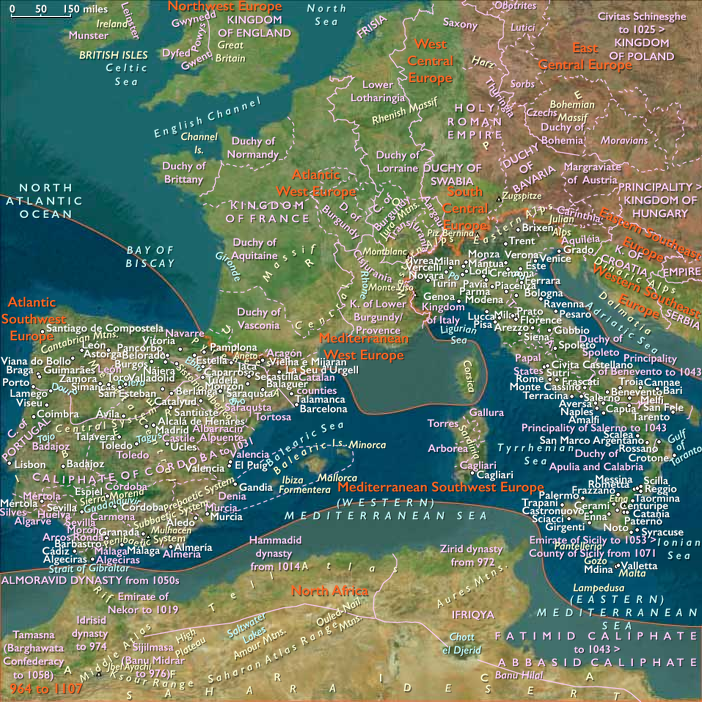
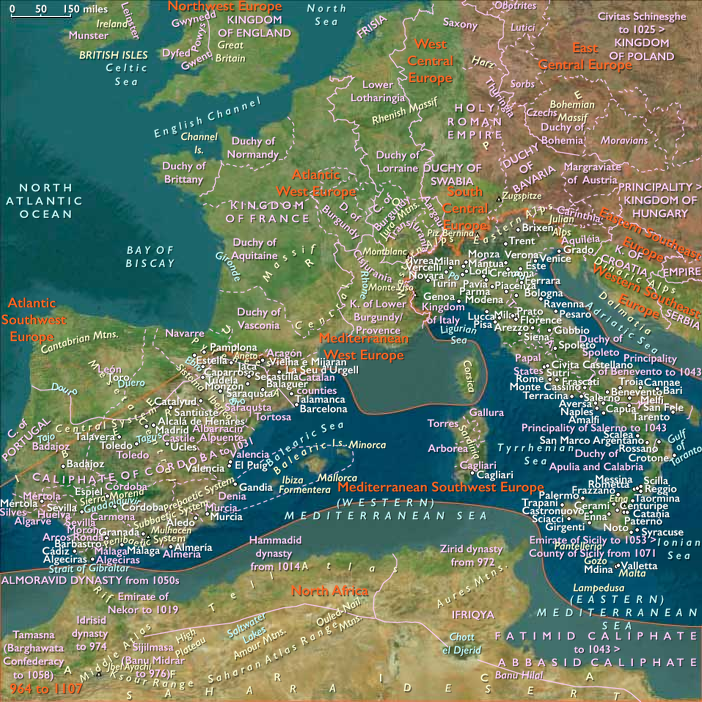
The cathedral of Modena, the city’s single great structure, had been sparked by the discovery of the burial site of Saint Geminianus, the patron saint of Modena..
Under the direction of the Countess Matilda of Tuscany, its first stone is laid June 6, 1099 and its crypt ready for the saint’s remains.
The initial design and direction is provided by an architect known as Lanfranco, about whom little else is known.
The Saint's remains are still exhibited in the cathedral's crypt.
Locations
People
Groups
- Papal States (Republic of St. Peter)
- Italy, Kingdom of (Holy Roman Empire)
- Christians, Roman Catholic
Topics
Subjects
Regions
Subregions
Related Events
Filter results
Showing 10 events out of 50098 total
Grand Prince Svyatopolk II of Kiev sends his son Yaroslav—who is the husband of one of Coloman's nieces—to Hungary to seek assistance from Coloman against the princes of the westernmost regions of Rus' in 1099.
Yaroslav convinces Coloman to intervene in the conflict.
The king and his army cross the Carpathian Mountains and lay siege to Peremyshl (Przemyśl, Poland), the seat of Volodar Rostislavich, one of the rebellious princes.
David Igorevich, one of Volodar Rostislavich's allies, persuades the Cumans to attack the Hungarians.
In the ensuing battle, the Hungarian army is soundly defeated.
Zbigniew, in view of his father’s disapproval, and after discovering the plans of Sieciech and Duchess Judith-Sophia to take over Poland, gains an ally in the young prince Boleslaw.
Both brothers demand that the reins of government should be handed over to them.
It is difficult to believe, however, that Boleslaw is making independent decisions at this point as he was only twelve years of age.
It is postulated that at this stage he is merely a pawn of the Baron’s power struggle.
Wladyslaw I Herman, however, agrees to divide the realm between the brothers, each to be granted his own province while the Prince—Wladyslaw I himself—retains control of Mazovia and its capital at Plock.
Wladylaw also retains control of the most important cities, i.e., Wroclaw, Krakow and Sandomierz.
Zbigniew’s province encompasses Greater Poland, including Gniezno, Kuyavia, Leczyca Land and Sieradz Land.
Boleslaw’s territory includes Lesser Poland, Silesia and Lubusz Land.
The division of the country and the permission for Boleslaw and Zbigniew to co-rule greatly alarms Sieciech, who now begins preparing to dispose of the brothers altogether.
Sieciech understands that the division of the country will undermine his position.
He initiates a military settlement of the issue and he gains the Prince’s support for it.
The position of Herman is seen as ambiguous as he chooses to support Sieciech’s cause instead of his sons'.
In response to Sieciech’s preparations, Boleslaw and Zbigniew enter into an alliance.
This takes place at a popular assembly or Wiec organized in Wroclaw by a magnate named Skarbmir.
Here it is decided to remove the current guardian of Boleslaw, a noble named Wojslaw who is a relative of Sieciech, and arrange for an expedition against the Palatine.
Subsequently, in 1099, the armies of Count Palatine and Prince Herman encounter the forces of Zbigniew and Boleslaw near Zarnowiec by the river Pilica.
Here the rebel forces of Boleslaw and Zbigniew defeat Sieciech's army, and Wladyslaw I Herman is obliged to permanently remove Sieciech from the position of Count Palatine.

The Emperor Alexios I, with the Crusader army having moved onward towards Antioch, had achieved part of his original intent in inviting the Crusader in the first place: the recovery of Seljuq-held imperial territories in Asia minor.
John Doukas has reestablished imperial rule in Chios, Rhodes, Smyrna, …
...Ephesus, ...
…Sardis, and …
…Philadelphia in 1097–1099.
Alexios' daughter Anna credits this success to her father's policy and diplomacy but the Latin historians of the Crusade ascribe it to his treachery and falseness.
Archbishop Anselm of Canterbury, driven into exile by William II, writes, during these years of church-state struggle, his greatest theological work, Cur Deus Homo (“Why God Became Man”), completed in 1098), presenting theology as "faith seeking understanding" in the form of a dialogue that all readers can easily follow.
In his highly influential Proslogion, Anselm argues that even one who denies the existence of God knows what is meant by the term—namely, "a being greater than which none can be conceived."
As such a notion cannot, according to Anselm, exist only in the mind—for to exist in the mind and in reality is greater than to exist only in the mind—there must necessarily be in reality a being greater than which none can be conceived.
This definition constitutes for Anselm the ultimate ground for all that is believed and taught about God—namely, his unity, his Trinity, his incarnation, and his redemption of humankind from sin.
(Some philosophers view Anselm’s argument as the ontological proof for the existence of God; others reject it as an illicit inference from the mental to the physical order of existence.)
Urban renews the ban on lay investiture and on clerics doing homage in 1099.
In this year, Anselm moves to Lyon.
he Anglo-Norman Succession Crisis and William Rufus’ Wars in Normandy and Maine (1088–1099)
The division of William the Conqueror’s lands between his sons William Rufus (England) and Robert Curthose (Normandy) created a dilemma for the Anglo-Norman nobility, many of whom held land on both sides of the English Channel. With the two brothers as natural rivals, these nobles feared being forced to choose between them, potentially losing favor, lands, or influence in one realm or the other.
The solution, as many saw it, was to reunite England and Normandy under a single ruler, a goal that would drive rebellions, wars, and shifting alliances throughout the late 11th and early 12th centuries.
The 1088 Rebellion: A Noble Uprising in Favor of Robert Curthose
- In 1088, Bishop Odo of Bayeux, the powerful half-brother of William the Conqueror, led a noble rebellion against William Rufus in favor of Robert Curthose.
- Many Anglo-Norman nobles, preferring a weaker ruler in Robert, sought to unite England and Normandy under his rule.
- However, Robert failed to appear in England to lead the revolt, causing wavering support among the rebels.
- William Rufus secured victory by offering silver and promises of better governance, winning over key English nobles and knights.
- With the rebellion crushed, William solidified his control over England, strengthening his ability to challenge Robert in Normandy.
The 1091 Invasion of Normandy and Treaty with Robert
- With England secure, William Rufus invaded Normandy in 1091, decisively defeating Robert’s forces.
- Robert was forced to cede territory to William, further weakening his control over the duchy.
- Despite this, the two brothers reconciled, agreeing to support each other in reclaiming lost territories—especially Maine, which had fallen out of Norman hands.
- The plan to recover Maine was ultimately abandoned, but William continued his aggressive defense of Normandy and his French interests.
The 1099 War for Maine and William Rufus’ Final Campaign
- In 1099, Elias de la Flèche, Count of Maine, sought to retake Le Mans, a vital city lost to Norman rule.
- William Rufus, determined to defend his possessions, responded with fierce military action, reaffirming Norman control in the region.
- His relentless campaigning demonstrated his commitment to maintaining dominance over Normandy and Maine, even as his reign approached its final year.
Legacy and Consequences
- The conflict between William Rufus and Robert Curthose foreshadowed later struggles for control over England and Normandy, particularly after William’s death in 1100.
- The unresolved division of William the Conqueror’s lands ensured continued wars and rivalries, culminating in Henry I’s eventual seizure of Normandy in 1106.
- William’s military campaigns in Normandy and Maine reinforced the importance of the Anglo-Norman realm, influencing continental politics for decades to come.
Though William Rufus never succeeded in fully uniting England and Normandy, his aggressive campaigns, political maneuvering, and relentless defense of Norman lands made him one of the most formidable rulers of his time.
Robert of Normandy and Bohemond's nephew Tancred agree at the end of December or early in January 1099 to become vassals of Raymond, who is wealthy enough to compensate them for their service.
Godfrey of Bouillon, however, who now has revenue from his brother's territory in Edessa, refuses to do the same.
On January 5, Raymond dismantles the walls of Maarat.
On January 13, he begins the march south, barefoot and dressed as a pilgrim, followed by Robert and Tancred.
Proceeding south along the coast, they encounter little resistance.
Later, Godfrey of Bouillon and Robert of Flanders join them.
Bohemond, fearing for the safety of Antioch, turns back soon after leaving.
Years: 1099 - 1099
Locations
People
Groups
- Papal States (Republic of St. Peter)
- Italy, Kingdom of (Holy Roman Empire)
- Christians, Roman Catholic