
The disciples of Cyril and Methodius are …
Years: 888 - 888
The disciples of Cyril and Methodius are credited with preparing more than three thousand priests.
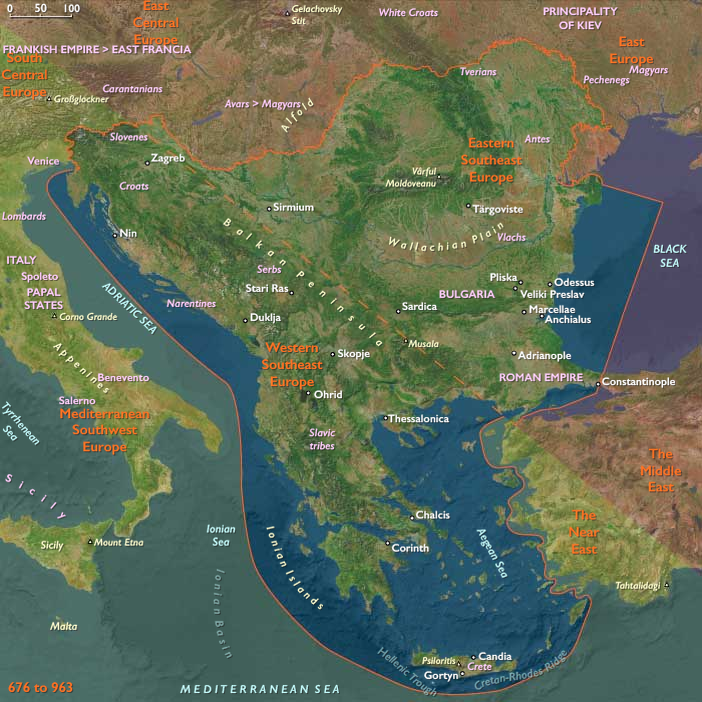
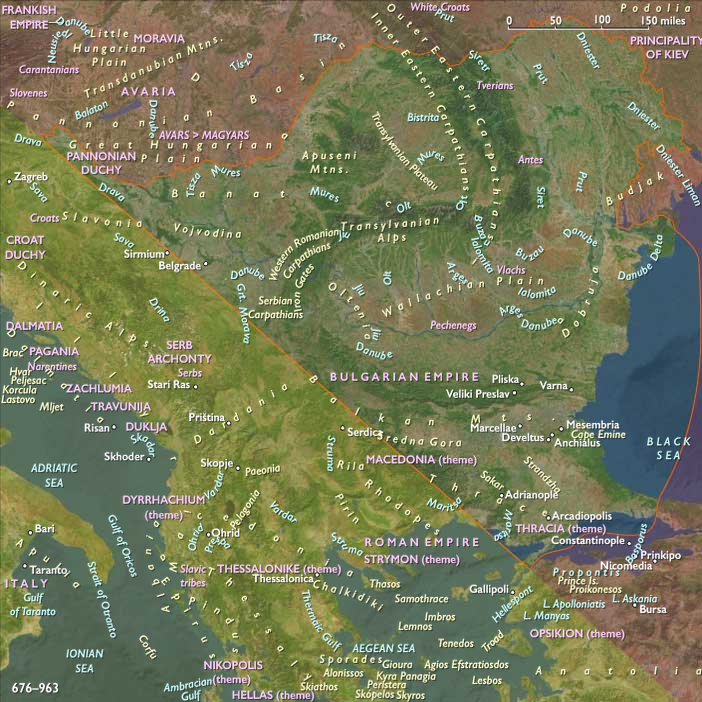
With the active assistance and material support of Boris, they establish centers of Slavic learning at Pliska, …
Locations
People
Groups
- Slavs, West
- Slavs, South
- Christianity, Chalcedonian
- Bulgarian Empire (First)
- Bulgarians (South Slavs)
Subjects
Regions
Subregions
Related Events
Filter results
Showing 10 events out of 53733 total
Varangian (Scandinavian) military leaders and merchants had during the 860s established outposts in Northern Russia at Novgorod and in Ukraine at Kiev.
Prince Oleg, kinsman of Rurik of Jutland, the semilegendary founder of the Rurik dynasty of Kievan Rus’, expands control of the territory along the Dnieper River, joining Novgorod via Smolensk with Kiev, which henceforth will serve as the political and cultural center of the Kievan Rus’.
(In the early chronicles the Varangians are also called Rus’, and this corporate name becomes as well a territorial designation for the Kievan region—the basic territory of the Rus’; later, by extension, it will be applied to the entire territory ruled by members of the Kievan dynasty.)
…Preslav, and Ohrid in the West.
Dacia's Christians had adopted the Slavonic rite, subject to the Bulgarian metropolitan at Ohrid, soon after the conversion of the Bulgars to Christianity. (It will be maintained until the seventeenth century, when Romanian becomes the liturgical language).
Al-Mundhir had inherited the throne of Córdoba at his father's death in 886.
During the two years of his reign, al-Mundhir has continued the fight against the rebel Umar ibn Hafsun.
He dies in 888 at Bobastro, possibly murdered by his brother Abdullah ibn Muhammad al-Umawi, who succeeds him.
This is unlikely, as ibn Muhammad shows very little interest in governing, becoming a neurotic recluse who is only interested in hunting and his faith.
Once in power, however, he shows no reluctance to dispose of those he views as a threat, even if they are family.
Two of his own brothers are executed on his orders, and he commands one of his sons (al-Mutarrif) to kill his own brother.
Berengar is the only one of the reguli (petty kings) to crop up in the aftermath of Charles' deposition besides Arnulf of Carinthia, his deposer, who had been made king before the emperor's death in January 888.
Charter evidence begins Berengar's reign at Pavia between December 26, 887 and January 2, 888, though this has been disputed.
Berengar is not the undisputed leading magnate in Italy at this time, but he may have made an agreement with his former rival, Guy of Spoleto, whereby Guy would have West Francia and he Italy on the emperor's death.
Both Guy and Berengar are related to the Carolingians in the female line.
They represent different factions in Italian politics: Berengar the pro-German and Guy the pro-French.
The Exclusion of Charles the Simple and the Rise of Odo (888)
Charles the Simple, the third and posthumous son of Louis the Stammerer, is denied the throne of West Francia as a child, despite being the legitimate Carolingian heir. His exclusion from power coincides with the decline of the Carolingian Empire and the rise of a new, non-Carolingian dynasty in West Francia.
Why Was Charles the Simple Denied the Throne?
-
His Youth and Lack of Support (884–888)
- When his half-brother Carloman II dies in 884, Charles is too young to rule.
- The Frankish nobles invite Charles the Fat, a distant Carolingian cousin, to become king instead.
- Charles the Fat’s rule ends in disgrace when he is deposed in November 887 and dies in January 888, but Charles the Simple is still not recognized as king.
-
The Rise of Odo (888)
- After Charles the Fat’s deposition, West Francia’s nobles reject Charles the Simple, turning instead to Odo, Count of Paris.
- Odo had gained immense prestige for his leadership during the Viking Siege of Paris (885–886).
- On February 29, 888, Odo is crowned king at Compiègne by Walter, Archbishop of Sens.
- His election marks the end of Carolingian rule in West Francia—at least temporarily.
-
Alternative Claimants: Guy III of Spoleto and Ranulf II of Aquitaine
- A faction of nobles opposes Odo and supports Guy III of Spoleto, an Italian noble who also claims the throne.
- Ranulf II, Duke of Aquitaine, takes Charles under his protection, possibly hoping to secure the throne for him.
- Ranulf later claims the royal title himself, but eventually makes peace with Odo, recognizing his kingship.
Significance of Odo’s Coronation in 888
- Odo is not a Carolingian, making his coronation the first true break from the dynasty of Charlemagne.
- This marks the effective end of the Carolingian Empire, as West Francia now has a non-Carolingian ruler.
- The exclusion of Charles the Simple sets up a future power struggle, as many still view the Carolingians as the legitimate rulers of West Francia.
Though Charles the Simple is denied his birthright in 888, his supporters will eventually restore him to the throne in 898, initiating a Carolingian revival—but by then, the Carolingian dynasty’s political power is already fading, paving the way for the eventual rise of the Capetians in 987.
The Succession Crisis of 888 and Baldwin II’s Role
Following the deposition of Charles the Fat in 888, the Carolingian Empire is officially fractured beyond repair, leading to a power struggle in West Francia. Several figures vie for the throne, including Odo, Count of Paris, who ultimately secures the kingship, while others, including Baldwin II of Flanders, maneuver for influence.
Baldwin II’s Carolingian Bloodline and Political Ambitions
- Baldwin II is a grandson of Charles the Bald, making him a direct descendant of Charlemagne and a potential candidate for the throne of West Francia.
- However, he does not enter the contest, likely recognizing that he lacks sufficient noble support to challenge Odo or other claimants.
Baldwin II and Arnulf of Carinthia
- Instead of seeking the West Frankish crown for himself, Baldwin joins other nobles in attempting to persuade Arnulf of Carinthia (King of East Francia) to claim West Francia as well.
- Arnulf declines, possibly because:
- He prioritizes consolidating his rule in East Francia.
- The situation in West Francia is too unstable, with multiple factions already competing for power.
- The Robertians (led by Odo) are too strong, making an outside claim difficult to enforce.
Conflict Between Baldwin II and King Odo
- Odo is elected King of West Francia in 888, thanks to his heroic defense of Paris during the Viking siege (885–886).
- However, tensions soon rise between Odo and Baldwin II, particularly over the Abbey of Saint Bertin, an important religious and political institution.
- Baldwin attempts to gain control over the abbey, likely to strengthen his influence in Flanders, but Odo refuses to support him.
- Their dispute escalates into open conflict, culminating in Odo attacking Baldwin at Bruges.
- Despite Odo’s efforts, he fails to defeat Baldwin, signaling that Flanders is effectively independent from West Frankish royal authority.
Consequences of the Baldwin-Odo Conflict
- Baldwin II emerges as the dominant power in Flanders, solidifying his rule over the region.
- Odo’s inability to subdue Baldwin reflects the weakness of West Francia’s monarchy, which struggles to control regional lords.
- The conflict between Baldwin and Odo foreshadows the continued fragmentation of West Francia, leading to the rise of feudal principalities.
Conclusion: Baldwin II’s Role in the 888 Succession Crisis
While Baldwin II does not directly seek the West Frankish crown, his actions in 888–889 demonstrate his growing ambition and independence. His refusal to submit to Odo and his military resilience mark the beginning of Flanders as a powerful autonomous principality, shaping its political and military role in medieval Europe.
The End of the Carolingian Empire and the Rise of Feudalism (888)
With the final collapse of the Carolingian Empire in 888, decentralized feudal society becomes the dominant political structure in Western Europe. The once-powerful imperial monarchy is replaced by local lords, who now rule their own estates with near-total autonomy. This system results in:
- Fragmented authority, with regional rulers holding power independent of a central king or emperor.
- The weakening of royal law, as local rulers enforce their own policies and traditions.
- A shift in Jewish life, as Jewish communities experience different conditions depending on the ruling lord rather than a unified imperial policy.
The Jewish Community of Metz and the Church Council of 888
- A church council in Metz (888) issues a decree forbidding Christians and Jews from eating together.
- This marks the earliest recorded Jewish presence in Metz, though Jews may have lived there as early as the 4th century.
- Such restrictions reflect growing ecclesiastical efforts to separate Jewish and Christian communities in feudal society.
The Feudalization of Jewish Status
- Unlike under the Carolingians, where royal policies provided some legal protection, Jewish life under feudalism depends entirely on local rulers.
- In some regions, Jews are protected by their lords, as their role in trade and finance benefits the local economy.
- In other areas, Church influence or noble hostility leads to increased restrictions and social exclusion.
Long-Term Effects of Decentralization
- The rise of feudalism increases the variability of Jewish conditions, making Jewish life precarious and inconsistent across different territories.
- Local laws, rather than royal decrees, shape Jewish rights and restrictions, leading to both moments of tolerance and intense persecution.
- Over time, this decentralized system paves the way for later expulsions, economic roles in medieval finance, and eventual calls for Jewish autonomy under powerful feudal lords.
Thus, the fall of the Carolingian Empire in 888 not only reshapes European political structures but also fundamentally alters the Jewish experience, as regional feudal lords gain authority over their treatment and rights.
Odo’s Struggles: Viking Raids and the Nobles’ Revolt (888–898)
Following his election as King of West Francia in 888, Odo, Count of Paris, faces two major threats:
- Continued Viking raids, which intensify despite his military successes.
- A noble rebellion in favor of Charles the Simple, the Carolingian claimant to the throne.
Odo’s Victory at Montfaucon Against the Vikings
- Odo continues to defend West Francia against Norse incursions, leading his forces in battle against Viking warbands.
- He defeats the Vikings at Montfaucon, showcasing his military prowess, but his victory fails to deter further Norse attacks.
- Viking raids worsen during his reign, particularly in the Loire and Seine valleys, further destabilizing the kingdom.
Noble Resistance and Support for Charles the Simple
- Odo lacks Carolingian blood, and many Frankish nobles still view the Carolingians as the rightful rulers.
- A faction of powerful nobles begins rallying around Charles the Simple, the young Carolingian heir, as a legitimate alternative to Odo.
- This leads to an internal struggle between:
- Odo and his supporters, who favor a strong warrior-king against the Vikings.
- The aristocratic opposition, who prefer the restoration of Carolingian rule through Charles.
A Reign Marked by Constant Conflict
- Odo’s rule is beset by continual warfare, both against external Viking invaders and internal noble factions.
- His legitimacy is constantly challenged, leading to a divided West Francia.
- These conflicts set the stage for the eventual return of the Carolingians to power in 898, when Charles the Simple finally succeeds Odo as king.
The Legacy of Odo’s Reign
- Despite his military successes, Odo is ultimately unable to stop the Viking threat, proving the ineffectiveness of centralized Carolingian-style monarchy in the face of feudal decentralization.
- His struggles against the nobility demonstrate the growing power of feudal lords, who will dominate medieval France for centuries.
- His reign marks the beginning of the end for strong royal authority in West Francia, as the feudal system becomes the dominant political structure.
Though Odo proves himself a capable warrior, his reign highlights the growing weakness of the Frankish monarchy, as Viking raids, noble revolts, and Carolingian loyalists undermine central rule.
Guy, who had failed in his bid to take the West Frankish throne, returns to Italy in summer 888 to gather an army from among the Spoletans and Lombards and oppose Berengar.
This he does, but the battle they fight near Brescia in the fall is a slight victory for Berengar, though his forces are so diminished that he sues for peace nevertheless.
The truce is to last until January 6, 889.
Years: 888 - 888
Locations
People
Groups
- Slavs, West
- Slavs, South
- Christianity, Chalcedonian
- Bulgarian Empire (First)
- Bulgarians (South Slavs)
