The Decline of …
Years: 1089 - 1089
The Decline of Norman Authority in Normandy and Maine (1089)
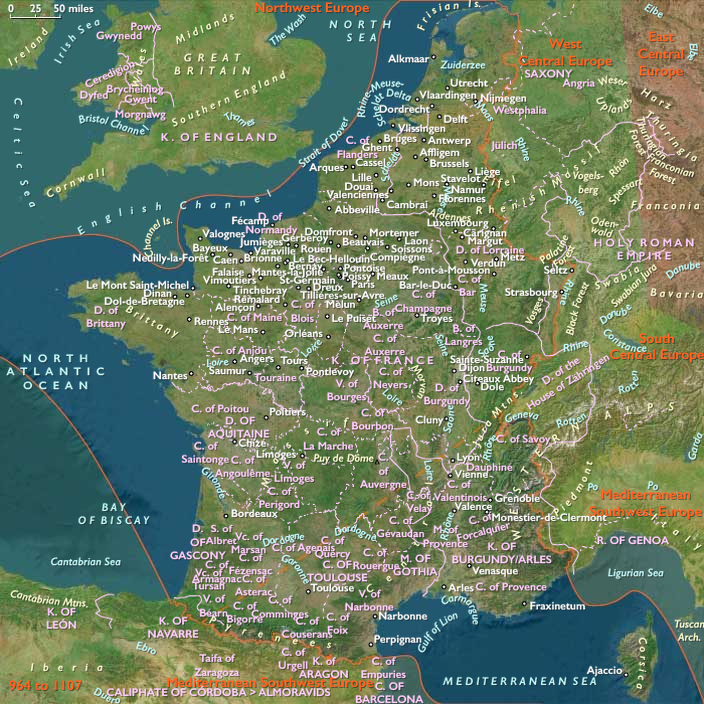
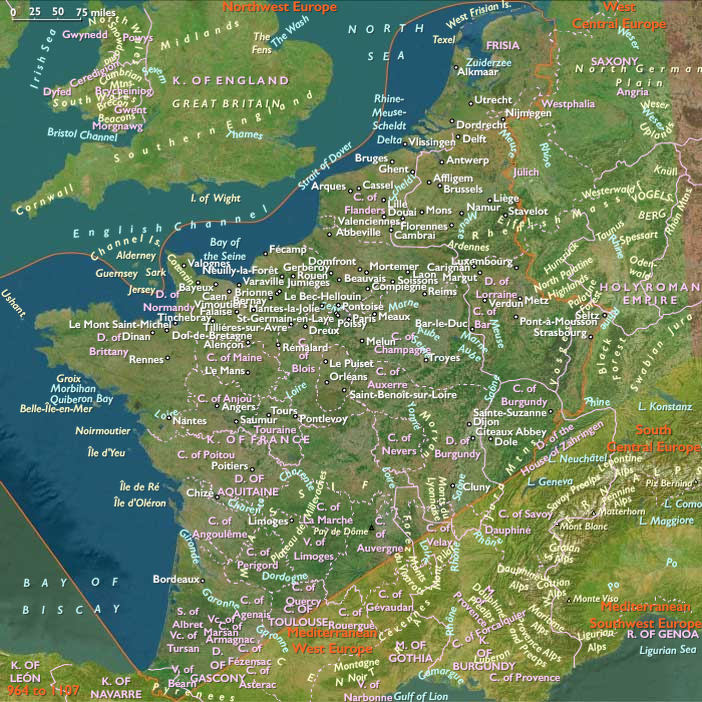
Following the death of William the Conqueror in 1087, his sons’ struggles over the Norman succession led to a significant loss of authority in Normandy. The Norman aristocracy, once subdued by William I, reasserted their independence, while Norman control over Maine collapsed entirely in 1089, marking a major reversal of William’s territorial expansion.
The Weakening of Ducal Authority in Normandy
- William the Conqueror had centralized power in Normandy, reducing the influence of independent-minded nobles.
- However, the division of his empire between Robert Curthose (Normandy) and William Rufus (England)led to internal conflict, which the Norman nobility exploited to reclaim their autonomy.
- Robert’s weak rule in Normandy allowed local lords to reassert their power, reversing many of William I’s reforms and leaving the duchy fractured.
The Revolt and Loss of Maine (1089)
- Maine, which had been under Norman control since 1063–1064, rebelled in 1089, taking advantage of Robert and William Rufus’ disputes.
- The revolt was successful, and Maine largely freed itself from Norman domination, remaining mostly independent thereafter.
- Norman forces were unable to suppress the rebellion, marking one of the most significant territorial losses of the post-Conquest period.
Consequences of the Loss of Authority
- The Norman aristocracy regained much of the power they had lost under William I, reducing the central authority of the duke.
- Maine’s revolt marked the collapse of Norman control over the region, shifting the balance of power toward Anjou and local Manceaux nobles.
- The weakened position of Normandy made future conflicts inevitable, particularly between Robert Curthose, William Rufus, and Henry.
The loss of central authority in Normandy and Maine in 1089 was one of the most significant setbacks for William’s sons, demonstrating the fragility of their inherited empire and paving the way for further struggles between the brothers.
Locations
People
- Alan IV
- Constance of Normandy
- Elias I
- Henry I of England
- Hugh V
- Lanfranc
- Odo
- Philip I of France
- Robert Curthose
- Robert I, Count of Flanders
- William II of England
Groups
- Breton people
- Anglo-Saxons
- Maine, County of
- Flanders, County of
- Anjou, County of
- Normandy, Duchy of
- Brittanny, Duchy of
- Normans
- France, (Capetian) Kingdom of
Commodoties
Subjects
Regions
Subregions
Related Events
Filter results
Showing 10 events out of 50358 total
Wladyslaw I Herman, shortly after his ascension, had been forced by the barons to give up the de facto reins of government to Count Palatine Sieciech.
This turn of events was likely due to the fact that Herman owed the throne to the barons, the most powerful of whom is Sieciech.
In 1089, Wladyslaw I Herman marries Judith of Swabia, who is renamed Sophia in order to distinguish herself from Wladyslaw I's first wife.
Judith of Swabia is a daughter of Emperor Henry III and widow of Solomon of Hungary.
Through this marriage, Boleslaw gains three or four half-sisters, and as a consequence he remains the only legitimate son and heir.
In all likelihood, it is this situation that precipitates the young prince Mieszko’s demise in 1089.
It is believed that Judith of Swabia was actively aiding Sieciech in his schemes to take over the country and that she was a mistress of the Count Palatine; the death of Mieszko Boleslawowic under mysterious circumstances is, in all probability, caused by orders of the Count Palatine and Judith.
In the same year, Wladyslaw I Herman’s first-born son Zbigniew had been sent out of the country to a monastery in Quedlinburg, Saxony.
This suggests that Wladyslaw I Herman intended to be rid of Zbigniew by making him a monk, and therefore depriving him of any chance of succession.
With the help of Sieciech, Judith convinces her husband to postpone the return of Zbigniew, who seems to have been a strong candidate to the succession despite his illegitimacy.
This eliminates two pretenders to the Polish throne, securing young Boleslaw’s inheritance as well as diminishing the growing opposition to Wladyslaw I Herman among the nobility.
Prince Boleslaw’s childhood occurs at a time when a massive political migration out of Poland is taking place, due to Sieciech’s political repressions.
Most of the elites who become political refugees find safe haven in Bohemia.
Another consequence of Sieciech’s political persecution is the kidnapping of Zbigniew by Sieciech’s enemies and his return from abroad in 1093.
Zbigniew takes refuge in Silesia, a stronghold of negative sentiment for both Sieciech as well as his nominal patron Wladyslaw I Herman.
In the absence of Sieciech and Boleslaw, who are captured by Hungarians and kept captive, Prince Wladyslaw I then undertakes a penal expedition to Silesia, which is unsuccessful and subsequently obliges him to recognize Zbigniew as a legitimate heir.
In 1093, Wladyslaw I signs an Act of Legitimization that grants Zbigniew the rights of descent from his line.
Zbigniew is also granted the right to succeed to the throne.
The Cumans proceed to ravage the entire eastern Balkan region as far as Constantinople until Alexios buys them off also and takes them into imperial service.
At home, the emperor's policy of strengthening the central authority and building up professional military and naval forces results in increased imperial strength in western and southern Anatolia and eastern Mediterranean waters.
However, he is unable or unwilling to limit the considerable powers of the landed magnates who have threatened the unity of the empire in the past.
Indeed, he strengthens their position by further concessions, and he has to reward services, military and otherwise, by granting fiscal rights over specified areas.
This method, which is to be increasingly employed by his successors, will inevitably weaken central revenues and imperial authority.
He represses heresy and maintains the traditional imperial role of protecting the Eastern Orthodox church, but he does not hesitate to seize ecclesiastical treasure when in financial need.
The church will subsequently call him to account for this.
The wavering character and incompetent political decisions of George II of Georgia, coupled with the Seljuq yoke, have brought the Kingdom of Georgia into a profound crisis, which climaxes in the aftermath of a disastrous earthquake that had struck Georgia in 1088.
George hands over the crown to his vigorous sixteen-year old son David in 1089.
This changeover is shrouded in mystery and is mentioned only in passing in the Georgian chronicles.
All that is recorded is that George crowned his son as king with his own hands, after which he disappears from the chronicle.
He was most probably forced by his nobles, in a palace coup masterminded by the powerful minister Bishop Giorgi Chkondideli, to abdicate in favor of David.
George is mentioned in prayers dated to 1203 as "king of kings, and caesar of all the East and West", suggesting that he was still alive and given some titles by his reigning son, but exercised no real power.
The Eastern Chalukyas had first been conquered by the Cholas under Raja Raja Chola I in the early eleventh century and have subsequently become very closely aligned to the Chola empire through marital alliances between the Cholas and the Eastern Chalukyas.
This has insulated the Eastern Chalukyas from the interference of the Western Chalukyas, who seek to subjugate the Eastern Chalukyas.
The Eastern Chalukya dynasty loses its three-cornered war with the Hoysalas, the Yadavas, and the Kakatiyas in 1089.
The Hoysalas take territories in modern Mysore (Karnataka) state, and the Yadavas take over areas south of the Narmada (Narbada) River; the truncated Chalukya kingdom, squeezed between the two and blocked on the east by the Kakatiyas, becomes a minor kingdom, and is is absorbed into the Chola empire during the reign of the Kulothunga Chola I.
Zvonimir's death from natural causes is the most commonly accepted of the several versions of Demetrius Zvonimir's death, recorded by Thomas the Archdeacon.
Another account, from the Presbyter of Doclea, says that on April 20, 1089, Pope Urban II, desiring to heal the East-West Schism, asked Zvonimir, his strongest Balkan ally, to come to the military aid of Alexios I Komnenos against the Seljuqs.
Zvonimir convened the Sabor at Kosovo Polje near Knin that year to mobilize the army on behalf of the pope and the emperor, but the nobility refused him and a rebellion erupted, leading to Zvonimir's assassination at the hands of his own soldiers.
In any event, his death marks the collapse of Croatian royal power.
The myth of the "Curse of King Zvonimir" is based on the legend of his assassination.
He is most likely buried in the church of St. Mary in his capital Knin, while his remains are transferred to Solin some time after.
Zvonimir was married to his distant relative Jelena, the sister of Ladislaus I of Hungary.
Through Helen, he was connected to the royal families of not only Hungary, but also Poland, Denmark, Bulgaria, and Constantinople.
She had borne him a son, Radovan, who had predeceased him, and a daughter, Claudia, who, being married to the vojvoda of Lapcani Lika, is ineligible for the throne.
Stephen, the last of the House of Trpimirović, had been due to succeed Peter Kresimir IV, but had been sidelined by the people and clergy in 1075 who instead bestowed the title of king to Zvonimir, previously a ban in Slavonia, and a member of the junior Svetoslavić branch of the House of Trpimirović (descendants of Svetoslav Suronja).
By the time Zvonimir dies in 1089, Stephen is old and seriously affected by ill health.
Nevertheless, he assumes the throne after being persuaded by the aristocracy and clergy.

Roger in 1089 arranges the marriage of his son Jordan to to a daughter of Boniface del Vasto, margrave of Western Liguria, who has several daughters and sons by his first wife Alice, the daughter of Peter of Savoy, and his second wife Agnes, daughter of Prince Hugh de Capet of France, Count of Vermandois.
To another of Boniface’s daughters, he arranges the marriage of another son from a previous relationship, Geoffrey, Count of Ragusa (who may have died before the marriage actually took place).
At the same time, Roger marries Adelaide, a daughter of Manfred del Vasto, Boniface’s brother.
Henry’s Rise and Imprisonment in Normandy (1088–1089)
By 1088, Henry, the youngest son of William the Conqueror, had firmly established himself as Count of the Cotentin, strengthening his network of followers in western Normandy and eastern Brittany. However, his relationship with his older brothers, William Rufus and Robert Curthose, remained strained, leading to his imprisonment in 1088–1089 before his eventual release and continued influence in Normandy.
Henry’s Early Supporters and Power Base
-
Henry built a strong following among Norman and Breton lords, including:
- Roger of Mandeville
- Richard of Redvers
- Richard d’Avranches
- Robert Fitzhamon
- Roger of Salisbury (a key churchman)
-
His power was firm enough that when Duke Robert Curthose attempted to revoke his grant of Cotentin, Henry was able to resist effectively.
-
Robert’s chaotic rule of Normandy allowed Henry to govern much of western Normandy independently.
Henry’s Imprisonment (1088–1089)
-
Henry’s Brief Return to England (July 1088–Autumn 1088)
- After the rebellion against William Rufus failed, Henry returned to England in July 1088, hoping to persuade his brother to restore their mother’s lands to him.
- William Rufus refused Henry’s request, leading Henry to return to Normandy in the autumn of 1088.
-
Odo of Bayeux’s Interference and Henry’s Arrest
- While Henry was away, Odo, Bishop of Bayeux, a longtime rival of Henry, convinced Robert Curthosethat Henry was plotting against him with William Rufus.
- On landing in Normandy, Henry was seized by Odo’s forces and imprisoned in Neuilly-la-Forêt.
- Robert revoked Henry’s authority in Cotentin and reclaimed the county for himself.
-
Henry’s Release (Spring 1089)
- Henry remained in prison over the winter, but by spring 1089, senior Norman nobles pressured Robert to release him.
- Although he was no longer officially Count of Cotentin, Henry continued to control much of western Normandy, operating semi-independently of his brother Robert.
Consequences and Significance
- Henry had lost his formal title, but his supporters remained loyal, allowing him to retain power in western Normandy.
- Robert’s weak leadership and inability to control Normandy effectively meant that Henry continued to act with relative autonomy.
- This period shaped Henry’s ambitions, preparing him for his later rivalry with Robert and William Rufus, and ultimately his own rise as King of England in 1100.
Though briefly imprisoned in 1088–1089, Henry emerged with his influence intact, ensuring that his role in Norman and English politics was far from over.
Sigwin von Are, a deacon in Cologne appointed archbishop here by the Emperor Henry IV in 1076, has remained a staunch supporter of Henry throughout the Investiture Controversy.
He had proclaimed the Peace of God in 1083, only the second bishop in Germany to do so.
He had rebuilt the church of Santa Maria in Cologne after it burned down in 1085, and on May 30, 1087, had crowned Henry's son Conrad King of Germany in Aachen.
He dies in Cologne and is buried in Cologne Cathedral.
Shortly after his death, he will begin to be called called "Sigwin the Pious."
The Norman authorities divide Northumbria into the counties of …
Years: 1089 - 1089
Locations
People
- Alan IV
- Constance of Normandy
- Elias I
- Henry I of England
- Hugh V
- Lanfranc
- Odo
- Philip I of France
- Robert Curthose
- Robert I, Count of Flanders
- William II of England
Groups
- Breton people
- Anglo-Saxons
- Maine, County of
- Flanders, County of
- Anjou, County of
- Normandy, Duchy of
- Brittanny, Duchy of
- Normans
- France, (Capetian) Kingdom of