
Filters:
Sunni Islam, with regard to legal matters, …
Years: 676 - 819
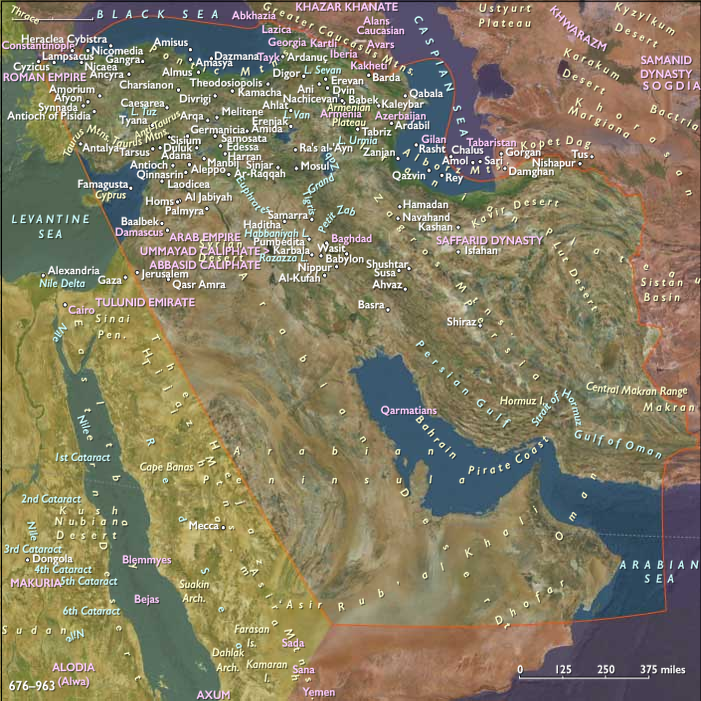
Sunni Islam, with regard to legal matters, develop four orthodox schools that give different weight in legal opinions to prescriptions in the Quran, to the hadith, to the consensus of legal scholars, to analogy (to similar situations at the time of the Prophet), and to reason or opinion.
Named for their founders, the earliest Muslim legal schools are those of Abd Allah Malik ibn Anas (ca. 715-95) and An Numan ibn Thabit Abu Hanifa (ca. 700-67).
The Maliki school is centered in Medina, and the lawbook of Malik ibn Anas is the earliest surviving Muslim legal text, containing a systematic consensus of Medina legal opinions.
The Hanafi school in Iraq stresses individual opinion in making legal decisions.
Muhammad ibn Idris ash Shafii (767-820), known as Al-Shafi‘i, a member of the tribe of Quraysh and a distant relative of the Prophet, studies under Malik ibn Anas in Medina.
He follows a somewhat eclectic legal path, laying down the rules for analogy that will later be adopted by other legal schools.
The last of the four major Sunni legal schools, that of Ahmad ibn Muhammad ibn Hanbal (780-855), is centered in Baghdad.
The Hanbali school, which will become prominent in Arabia as a result of Wahhabi influence, gives great emphasis to the hadith as a source of Muslim law but rejects innovations and rationalistic explanations of the Quran and the traditions.
Named for their founders, the earliest Muslim legal schools are those of Abd Allah Malik ibn Anas (ca. 715-95) and An Numan ibn Thabit Abu Hanifa (ca. 700-67).
The Maliki school is centered in Medina, and the lawbook of Malik ibn Anas is the earliest surviving Muslim legal text, containing a systematic consensus of Medina legal opinions.
The Hanafi school in Iraq stresses individual opinion in making legal decisions.
Muhammad ibn Idris ash Shafii (767-820), known as Al-Shafi‘i, a member of the tribe of Quraysh and a distant relative of the Prophet, studies under Malik ibn Anas in Medina.
He follows a somewhat eclectic legal path, laying down the rules for analogy that will later be adopted by other legal schools.
The last of the four major Sunni legal schools, that of Ahmad ibn Muhammad ibn Hanbal (780-855), is centered in Baghdad.
The Hanbali school, which will become prominent in Arabia as a result of Wahhabi influence, gives great emphasis to the hadith as a source of Muslim law but rejects innovations and rationalistic explanations of the Quran and the traditions.
People
Groups
- Arab people
- Quraysh (Arabic tribe)
- Islam
- Muslims, Sunni
- Umayyad Caliphate (Damascus)
- Muslims, Shi'a
- Umayyad Caliphate (Harran)
- Abbasid Caliphate (Kufa)
- Abbasid Caliphate (Baghdad)
Topics
Subjects
Regions

Subregions

Years: 676 - 819
People
Groups
- Arab people
- Quraysh (Arabic tribe)
- Islam
- Muslims, Sunni
- Umayyad Caliphate (Damascus)
- Muslims, Shi'a
- Umayyad Caliphate (Harran)
- Abbasid Caliphate (Kufa)
- Abbasid Caliphate (Baghdad)
Topics
Subjects
Regions
Subregions