
Moscow had been an insignificant trading outpost …
Years: 1252 - 1395
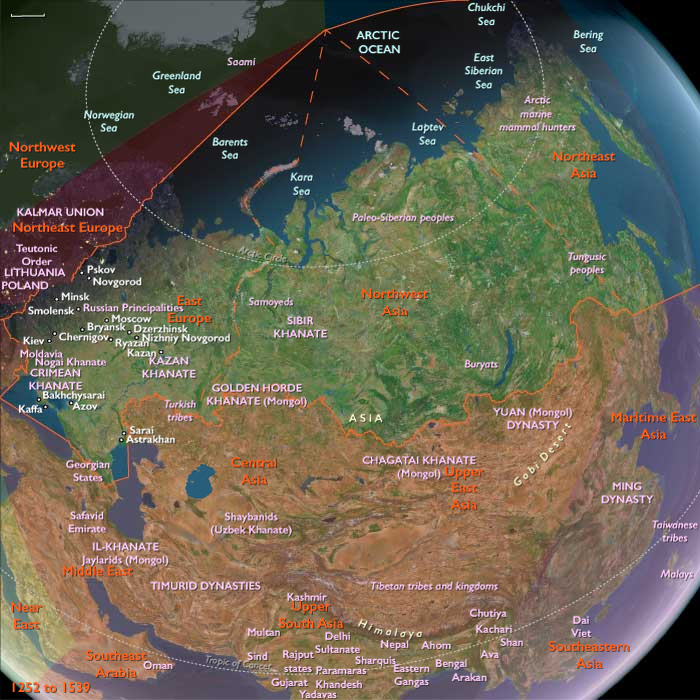
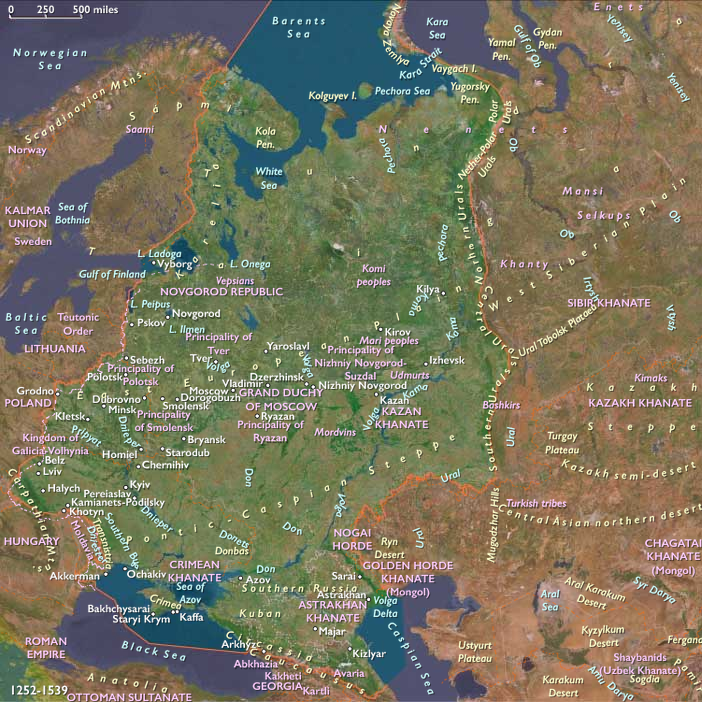
Moscow had been an insignificant trading outpost in the principality of Vladimir-Suzdal' when the Mongols invaded the lands of Kievan Rus'.
The outpost's remote, forested location offers some security from Mongol attack and occupation, and a number of rivers provide access to the Baltic and Black seas and to the Caucasus region.
More important to Moscow's development in what will become the state of Muscovy, however, is its rule by a series of princes who are ambitious, determined, and lucky.
The first ruler of the principality of Muscovy, Daniil Aleksandrovich (d. 1303), secured the principality for his branch of the Rurik Dynasty.
His son, Ivan I (r. 1325-40), known as Ivan Kalita ("Money Bags"), obtains the title "Grand Prince of Vladimir" from his Mongol overlords.
He cooperates closely with the Mongols and collects tribute from other Russian principalities on their behalf.
This relationship enables Ivan to gain regional ascendancy, particularly over Muscovy's chief rival, the northern city of Tver'.
In 1327 the Orthodox metropolitan transfers his residency from Vladimir to Moscow, further enhancing the prestige of the new principality.
Locations
People
Groups
- Lithuanians (Eastern Balts)
- Slavs, East
- Rus' people
- Novgorod, Principality of
- Rurik dynasty
- Kievan Rus', or Kiev, Great Principality of
- Poles (West Slavs)
- Christians, Roman Catholic
- Christians, Eastern Orthodox
- Mongols
- Novgorod Republic
- Vladimir-Suzdal, Great Principality of
- Galicia–Volhynia, Principality of
- Mongol Empire
- Golden Horde, Khanate of the (Mongol Khanate)
- Galicia–Volhynia, Kingdom of
- Galicia–Volhynia, Kingdom of
- Roman Empire, Eastern: Palaiologan dynasty
- Moscow, Principality of
- Belarusians (East Slavs)
- Russians (East Slavs)
- Ukrainians (East Slavs)
- Poland of the later Piasts, Kingdom of
- Moscow, Grand Principality of
- Lithuania, Grand Duchy of
- Poland of the Jagiellonians, Kingdom of
- Lithuania, Grand Duchy of
Topics
Commodoties
Subjects
Regions
Subregions
Years: 1252 - 1395
Locations
People
Groups
- Lithuanians (Eastern Balts)
- Slavs, East
- Rus' people
- Novgorod, Principality of
- Rurik dynasty
- Kievan Rus', or Kiev, Great Principality of
- Poles (West Slavs)
- Christians, Roman Catholic
- Christians, Eastern Orthodox
- Mongols
- Novgorod Republic
- Vladimir-Suzdal, Great Principality of
- Galicia–Volhynia, Principality of
- Mongol Empire
- Golden Horde, Khanate of the (Mongol Khanate)
- Galicia–Volhynia, Kingdom of
- Galicia–Volhynia, Kingdom of
- Roman Empire, Eastern: Palaiologan dynasty
- Moscow, Principality of
- Belarusians (East Slavs)
- Russians (East Slavs)
- Ukrainians (East Slavs)
- Poland of the later Piasts, Kingdom of
- Moscow, Grand Principality of
- Lithuania, Grand Duchy of
- Poland of the Jagiellonians, Kingdom of
- Lithuania, Grand Duchy of
Topics
Commodoties
Subjects
Regions
Subregions