The defeated Knights of Rhodes sail out …
Years: 1523 - 1523
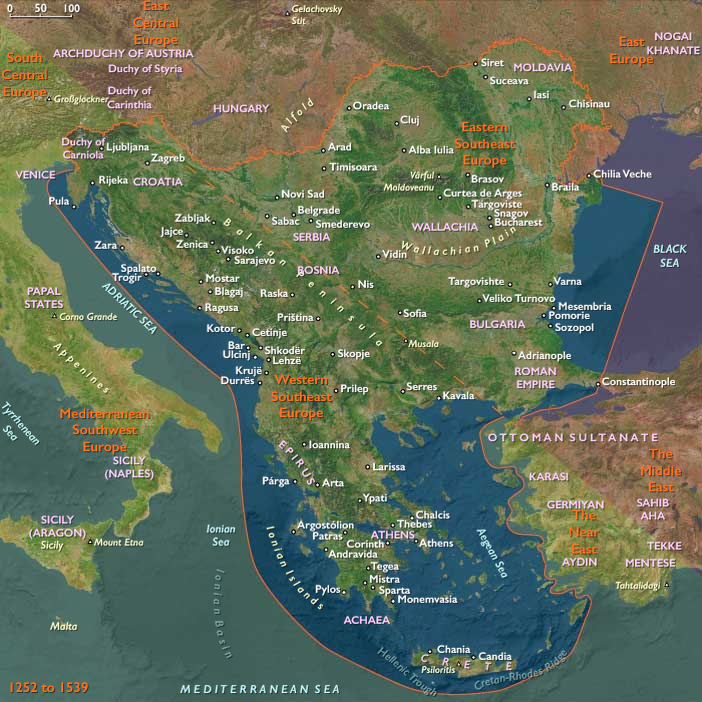
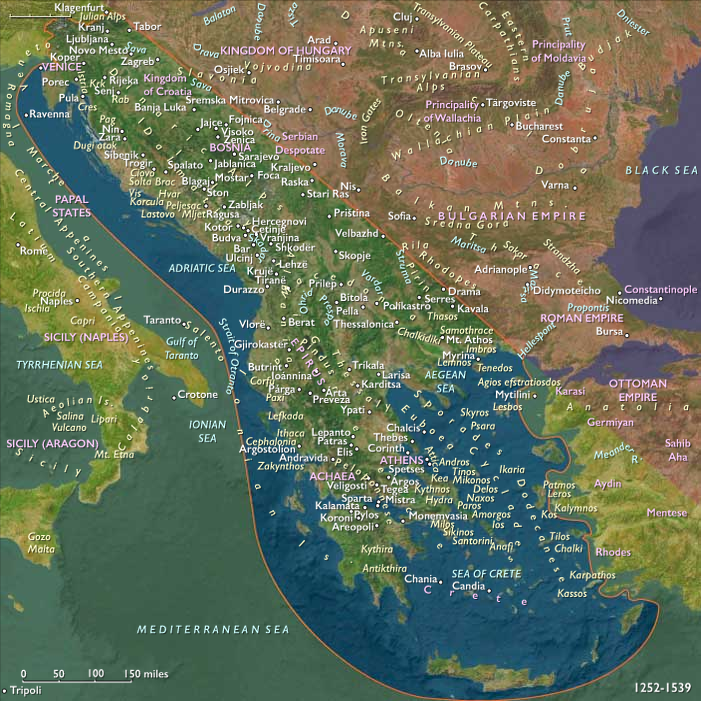
The defeated Knights of Rhodes sail out of Rhodes on January 1, 1523, with as many of the citizens as choose to follow them, ending two centuries of defiance of the Turks.
Despite the defeat, both Christians and Muslims seem to have regarded the conduct of Villiers de L'Isle-Adam as extremely valiant, and the Grand Master is proclaimed a Defender of the Faith by Pope Adrian VI.
Locations
People
Groups
- Islam
- Papal States (Republic of St. Peter)
- Christians, Roman Catholic
- Knights Hospitaller (of Rhodes), Order of the
- Ottoman Empire
- Naples, Kingdom of
Topics
Subjects
Regions
Subregions
Related Events
Filter results
Showing 10 events out of 38565 total
Vasili III has by 1523 annexed to Moscow all the remaining independent Russian principalities.
The Free Imperial City of Augsburg, with a strategic location as intersection of trade routes to Italy, has became a major trading center.
Augsburg produces large quantities of woven goods, cloth and textiles.
Augsburg has become the base of two banking families that have risen to great prominence, the Fuggers and the Welsers.
The Fugger family donates the Fuggerei part of the city devoted to housing for needy citizens, which remains in use today.
First built between 1514 and 1523 under the supervision of the architect Thomas Krebs, by 1523 fifty-two houses have been built, and in the coming years the area will expand with various streets, small squares and a church.
The gates are locked at night, so the Fuggerei is, in its own right, very similar to a small independent medieval town.
It is still inhabited today, affording it the status of being the oldest social housing project in the world.
George of Brandenburg, by the further appropriation of the Duchy of Jägerndorf, comes into possession of all Upper Silesia.
As the owner and mortgagee of these territories, he prepares the way for the introduction of the Protestant Reformation, here in Hungary as well as in his native Franconia.
Earlier than any other German prince or any other member of the Hohenzollern line, including even his younger brother Albert, the Grand Master of the Teutonic Order, he turns his eyes and heart to the new faith proceeding from Wittenberg.
The loss of Belgrade (Nandorfehervar) in 1521 had caused great alarm in Hungary, but the too-late and too-slowly-recruited sixty-thousand strong royal army—led by the king—had forgotten to take food along, so the army therefore disbanded spontaneously under the pressure of hunger and disease without even trying to recapture Belgrade, the southern key of Hungary, from the newly installed Turkish garrisons.
In 1523, Archbishop Pál Tomori, a valiant priest-soldier, is made Captain of Southern Hungary.
The general apathy that had characterized the country forces him to lean on his own bishopric revenues when he starts to repair and reinforce the second line of Hungary's border defense system.
Early Safavid power in Iran had been based on the military power of the Qizilbāsh.
Ismāil had exploited the first element to seize power in Iran, but, eschewing politics after his defeat in Chaldiran, he had left the affairs of the government to the office of the wakīl (chief administrator, vakīl in Turkish).
Ismāil's successors, and most manifestly Shāh Abbās I, will successfully diminish the Qizilbāsh's influence on the affairs of the state.
The Chaldiran battle furthermore holds even more historical significance as it had marked the start of over three hundred years of frequent and harsh warfare, fueled by geopolitics and ideological differences between the Ottomans and the Iranian Safavids (as well as successive Iranian states), mainly regarding territories in Eastern Anatolia, the Caucasus, and Mesopotamia.
The consequences of the defeat at Chaldiran are also psychological for Shah Ismāil: the defeat had destroyed Ismāil's belief in his invincibility, based on his claimed divine status.
His relationships with his Qizilbāsh followers had also been fundamentally altered.
For most of the last decade of Ismail's reign, the domestic affairs of the empire are overseen by the Tajik vizier Mirza Shah Husayn Isfahani.
A native of Isfahan, Mirza Shah had originally served as an architect, but in 1503 had been appointed as the personal vizier of the powerful Qizilbash magnate Durmish Khan Shamlu, who had recently been appointed as the governor of Mirza Shah's native city.
Mirza Shah had been appointed as vakil and vizier in 1514 after the Battle of Chaldiran, which had a damaging impact on the health of Safavid king Ismail I, who withdrew from affairs of the state and began heavily drinking.
The appointment of Mirza Shah to the vakil office is because he had after the battle found Ismail's favorite wife, who was lost in Azerbaijan.
Mirza Shah has used the absence of the king as an opportunity to expand his authority.
Furthermore, Mirza Shah has also become a close friend with Ismail and accompanies him during his period of drinking.
This had enabled Mirza Shah gain influence over the king himself.
In 1521, Mirza Shah had chosen to confront his former master, Durmish Khan Shamlu, managing to send him far away from the Safavid court—to Herat in Khorasan, where he was forced to serve as its governor.
However, Mirza Shah Husayn outsmarts himself in the end, and as a result is assassinated in April 1523 at the hands of furious Qizilbash officers.
Ismail appoint Jalal al-Din Mohammad Tabrizi, the son of the late vizier Muhammad Zakariya Kujuji, as his new vizier.
Quli's campaign against Krishnadevaraya continues until Timmarusu, the Prime Minister of Krishnadevaraya, defeats the Golconda army.
Adrian VI had published Quaestiones in quartum sententiarum praesertim circa sacramenta (Paris, 1512, 1516, 1518, 1537; Rome, 1522), and Quaestiones quodlibeticae XII. (1st ed., Leuven, 1515).
He holds no beatifications in his pontificate but on May 31, 1523, canonizes Saints Antoninus of Florence and Benno of Meissen.
The Pope is not successful as a peacemaker among Christian princes, whom he hopes to unite in a war against the Turks.
He had in August 1523 been forced into an alliance with the Empire, England, and Venice against France; the Sultan Suleiman I in 1522 had meanwhile conquered Rhodes.
He makes only one cardinal in the course of his pontificate, Willem van Enckevoirt, made a cardinal priest in a consistory held on September 10, 1523.
Charles V's ambassador in Rome, Juan Manuel, lord of Belmonte, wrote that he was worried that Charles' influence over Adrian waned after Adrian's election, writing, "The Pope is "deadly" afraid of the College of Cardinals.
He does whatever two or three cardinals write to him in the name of the college."
The pope is mocked by the people of Rome on the Pasquino, and the Romans, who have never taken a liking to a man they see as a "barbarian", rejoice at his death on September 14, 1523, after a somewhat brief tenure as pope.
Most of his official papers are lost after his death.
He is buried in the Santa Maria dell'Anima church in Rome.
He bequeaths property in the Low Countries for the foundation of a college at the University of Leuven that becomes known as Pope's College.
Giulio de’Medici, one of Giuliano de’Medici's illegitimate sons, who has enjoyed a successful career as manager of the affairs of the Medici family and as vice chancellor of the church, overcomes the opposition of the French king and finally succeeds in being elected Pope Clement VII in the next conclave on November 19, 1523.
A devout mans, he brings to the papal throne a high reputation for political ability and possesses in fact all the accomplishments of a wily diplomat.
However, he is considered by his contemporaries as worldly and indifferent to the perceived dangers of the Protestant Reformation by the people of the papacy.
He attempts to follow a middle road in the political struggles between Francis and Charles V. At his accession, Clement VII sends the Archbishop of Capua, Nikolaus von Schönberg, to the Kings of France, Spain, and England, in order to bring the Italian War to an end.
An early report from a protonotary to the emperor records: "As the Turks threaten to conquer Christian states, it seems to him that it is his first duty as Pope to bring about a general peace of all Christian princes, and he begs him (the Emperor), as the firstborn son of the Church, to aid him in this pious work."
The pope's attempt fails, however.

Construction begins on the Cathedral of Granada in 1523.
Unlike most cathedrals in Spain, construction of this cathedral had to await the acquisition of the Nasrid kingdom of Granada from its Muslim rulers in 1492; while its very early plans has Gothic designs, such as are evident in the Royal Chapel of Granada by Enrique Egas, the construction of the church in the main occurs at a time when Spanish Renaissance designs are supplanting the Gothic regnant in Spanish architecture of prior centuries.
Foundations for the church have been laid by the architect Egas starting from 1518 to 1523 atop the site of the city's main mosque.
Titian’s long series of exuberant, powerfully modeled compositions such as Bacchus and Ariadne, painted in 1523, characterize his so-called middle period after 1520.
The early works of Parmigianino, painted in or near Parma, from which Francesco Mazzola takes his name,include frescoes of the legend of Diana and Actaeon, painted in 1523 when Parmigianino is twenty, for the Cittadella di San Vitale in Fontanellato.
He has also worked in San Giovanni and met Correggio, who was at work on the fresco decorations of the cupola.
Years: 1523 - 1523
Locations
People
Groups
- Islam
- Papal States (Republic of St. Peter)
- Christians, Roman Catholic
- Knights Hospitaller (of Rhodes), Order of the
- Ottoman Empire
- Naples, Kingdom of