
The Treaty of Allahabad is signed on …
Years: 1765 - 1765
The Treaty marks the political and constitutional involvement and the beginning of British rule in India.
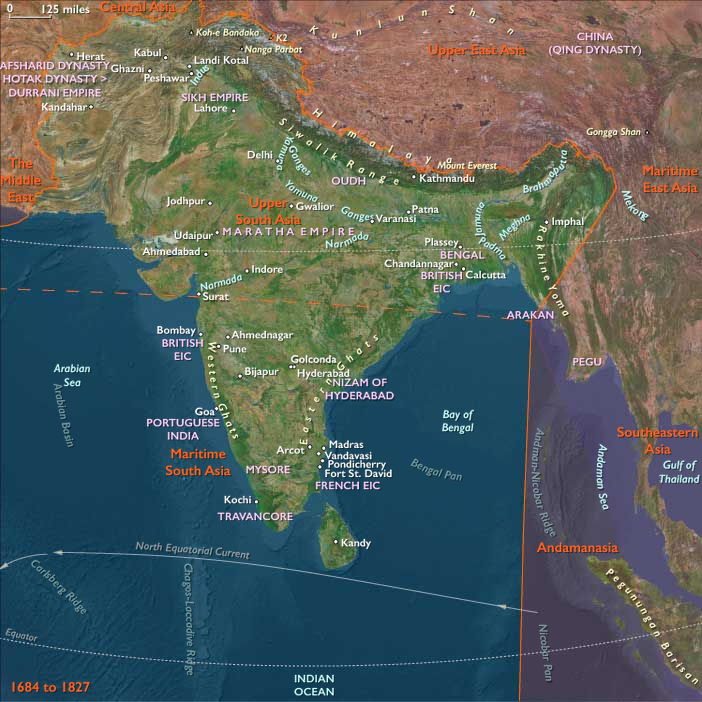
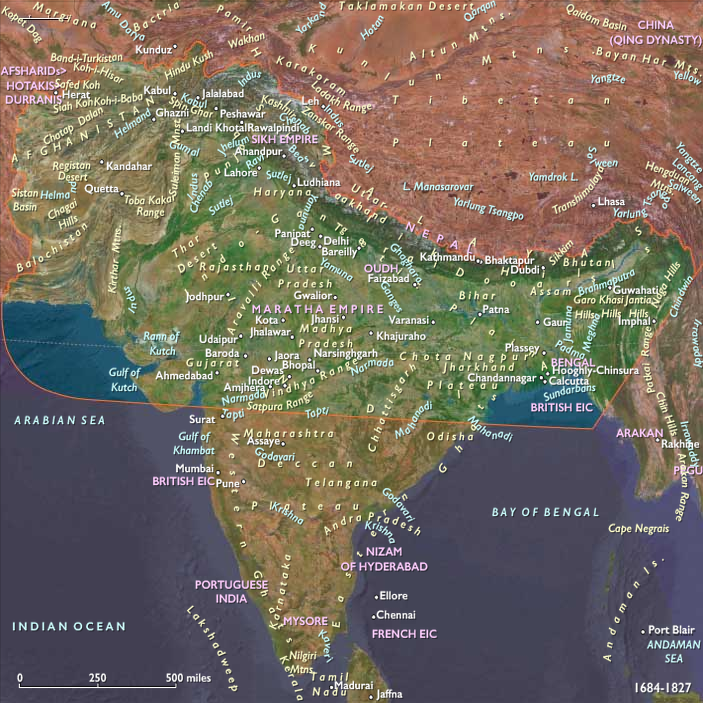
Based on the terms of the agreement, Alam grants the East India Company Diwani rights, or the right to collect taxes on behalf of the Emperor from the eastern province of Bengal-Bihar-Orissa.
Thus the East India Company is appointed as the imperial tax collector for the Eastern province (Bengal-Bihar-Orissa).
These rights allow the Company to collect revenue directly from the people of Bengal, Bihar and Orissa.
In return, the Company pays an annual tribute of twenty-six lakhs of rupees (equal to 260,000 pounds sterling) while securing for Shah Alam II the districts of Kora and Allahabad.
The tribute money paid to the emperor is for the maintenance of the Emperor's court in Allahabad.
The accord also dictates that Shah Alam be restored to the province of Varanasi as long as he continues to pay certain amount of revenue to the Company.
Awadh is returned to Shuja-ud-Daulah, but Allahabad and Kora ware taken from him.
The Nawab of Awadh also has to pay fifty-three lakhs of rupees as war indemnity to the East India Company.
The Nawab of Awadh, Shuja ud Daulah, is made to pay a war indemnity of five million rupees to the Company.
Moreover, the two sign an alliance by which the Company promises to support the Nawab against an outside attack provided he pays for services of the troops sent to his aid.
This alliance makes the Nawab dependent on the Company.
This is a turning point in Indian history.
The Treaty marks the political and constitutional involvement and the beginning of Company rule in India.
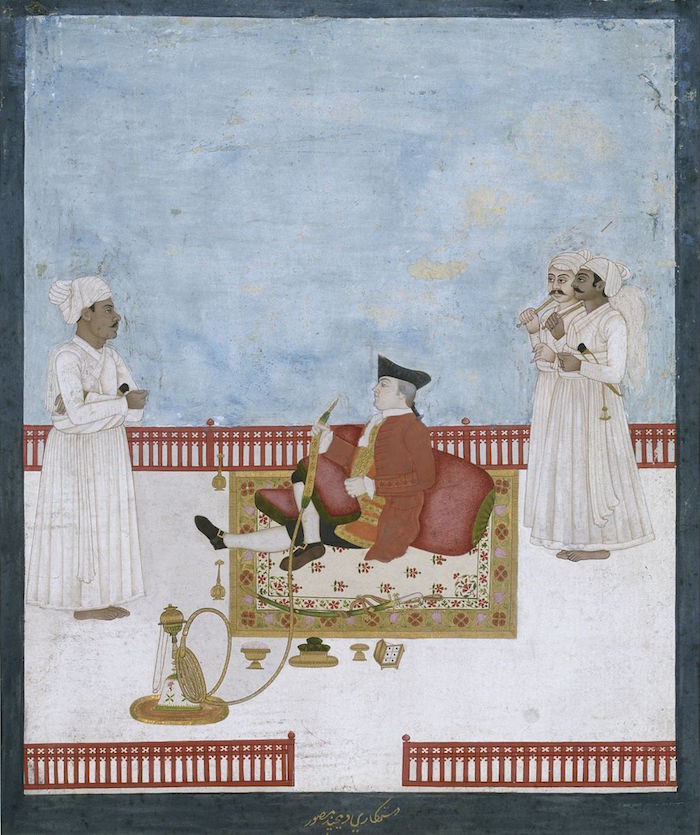
Dip Chand (artist): Portrait of an East India Company Official (between circa 1760 and circa 1764; watercolor, 26.2 × 22.6 cm (10.3 × 8.9 in)http://collections.vam.ac.uk/item/O16731/painting-portrait-of-east-india-company/ The pictures made by Indian artists for the British in India are called Company paintings. This one probably depicts William Fullerton of Rosemount, who joined the East India Company's service in 1744 and was second surgeon in Calcutta in 1751. He was present at the siege of Calcutta in 1756 and became mayor of Calcutta in 1757. In 1763 Fullerton became a surgeon to the Patna Agency. He was the only Englishman to survive the massacre of the English during the war with Mir Kasim of Murshidabad. An excellent linguist, he clearly mixed with Indians more than was common and had one or more Indian bibis (mistresses).
Locations
People
Groups
- Mughal Empire (Delhi)
- Britain, Kingdom of Great
- East India Company, British (United Company of Merchants of England Trading to the East Indies)
- Bengal, Nawabs of
Subjects
Regions
Subregions
Related Events
Showing 10 events out of 26218 total
Years: 1765 - 1765
Dip Chand (artist): Portrait of an East India Company Official (between circa 1760 and circa 1764; watercolor, 26.2 × 22.6 cm (10.3 × 8.9 in)http://collections.vam.ac.uk/item/O16731/painting-portrait-of-east-india-company/ The pictures made by Indian artists for the British in India are called Company paintings. This one probably depicts William Fullerton of Rosemount, who joined the East India Company's service in 1744 and was second surgeon in Calcutta in 1751. He was present at the siege of Calcutta in 1756 and became mayor of Calcutta in 1757. In 1763 Fullerton became a surgeon to the Patna Agency. He was the only Englishman to survive the massacre of the English during the war with Mir Kasim of Murshidabad. An excellent linguist, he clearly mixed with Indians more than was common and had one or more Indian bibis (mistresses).
Locations
People
Groups
- Mughal Empire (Delhi)
- Britain, Kingdom of Great
- East India Company, British (United Company of Merchants of England Trading to the East Indies)
- Bengal, Nawabs of
Subjects
Regions
Subregions