
The Durrani have both numeric as well …
Years: 1761 - 1761
January
The Durrani have both numeric as well as qualitative superiority over the Marathas.
The combined Afghan army is much larger than that of Marathas.
Though the Marathas infantry is organized along European lines and their army has some of the best French-made guns of the time, their artillery is static and lacks mobility against the fast-moving Afghan forces.
Moreover, the senior Maratha chiefs constantly bicker with one another.
Each has ambitions of carving out his independent state and has no interest in fighting against a common enemy.
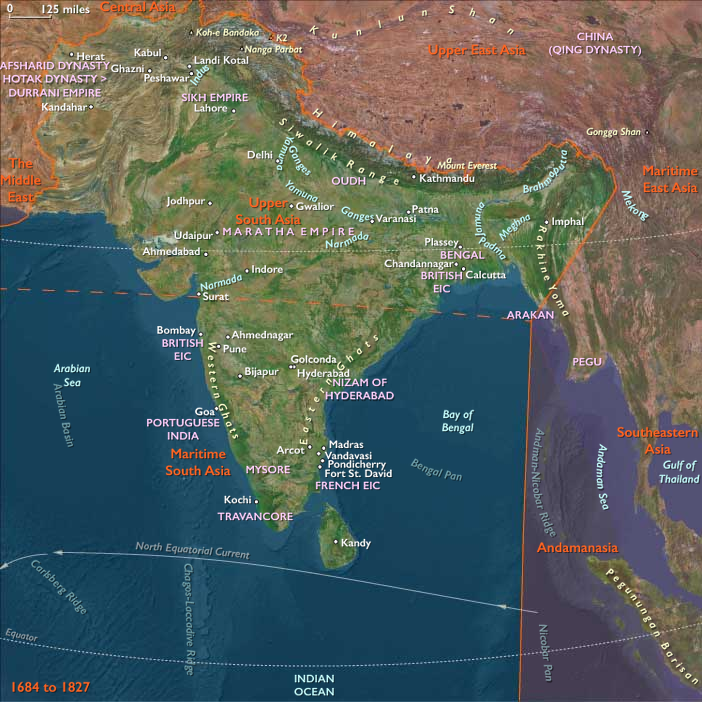
The Marathas are fighting alone a thousand miles from their capital, Pune.
Peshwa's decision to appoint Sadashivrao Bhau as the Supreme Commander instead of Malharrao Holkar or Raghunathrao proves to be an unfortunate one, as Sadashivrao is totally ignorant of the political and military situation in North India.
Ahmad Shah’s superiority in pitched battle could have been negated if the Marathas had conducted their traditional ganimi kava, or guerrilla warfare, as advised by Malharrao Holkar, in Punjab and in north India.
Abdali is in no position to maintain his field army in India indefinitely.
In the final phase of several days of battle near Panipat, the Marathas, under Mahadaji Shinde, attack Najib.
Najib successfully fights a defensive action, however, keeping Shinde's forces at bay.
By noon of January 14, 1761, it looks as though Sadashivrao Bhau will clinch victory for the Marathas once again.
The Afghan left flank still holds, but the center is cut in two and the right is almost destroyed.
Ahmad Shah has watched the fortunes of the battle from his tent, guarded by the still unbroken forces on his left.
He sends his bodyguards to call up his fifteen thousand reserve troops from his camp and arranges them as a column in front of his cavalry of musketeers (Qizilbash) and two thousand swivel-mounted shutarnaals or Ushtranaal—small cannons.
Bhau, seeing his forward lines dwindling and civilians behind, has not kept any reserves, and upon seeing Vishwasrao disappear in the midst of the fighting, he feels he has no choice but to come down from his elephant and lead the battle.
Vishwasrao has already been killed by a shot to the head.
Bhau and his loyal bodyguards fight to the end, the Maratha leader having three horses shot out from under him.
At this stage Holkar, realizing the battle is lost, breaks from the Maratha left flank and retreats.
If Holkar had remained in the battlefield, the Maratha defeat would have been delayed but not averted.
The Maratha army is routed and flees under the devastating attack.
While fifteen thousand soldiers manage to reach Gwalior, the rest of the Maratha forces—including large numbers of non-combatants—are either killed or captured.
The combined Afghan army is much larger than that of Marathas.
Though the Marathas infantry is organized along European lines and their army has some of the best French-made guns of the time, their artillery is static and lacks mobility against the fast-moving Afghan forces.
Moreover, the senior Maratha chiefs constantly bicker with one another.
Each has ambitions of carving out his independent state and has no interest in fighting against a common enemy.
The Marathas are fighting alone a thousand miles from their capital, Pune.
Peshwa's decision to appoint Sadashivrao Bhau as the Supreme Commander instead of Malharrao Holkar or Raghunathrao proves to be an unfortunate one, as Sadashivrao is totally ignorant of the political and military situation in North India.
Ahmad Shah’s superiority in pitched battle could have been negated if the Marathas had conducted their traditional ganimi kava, or guerrilla warfare, as advised by Malharrao Holkar, in Punjab and in north India.
Abdali is in no position to maintain his field army in India indefinitely.
In the final phase of several days of battle near Panipat, the Marathas, under Mahadaji Shinde, attack Najib.
Najib successfully fights a defensive action, however, keeping Shinde's forces at bay.
By noon of January 14, 1761, it looks as though Sadashivrao Bhau will clinch victory for the Marathas once again.
The Afghan left flank still holds, but the center is cut in two and the right is almost destroyed.
Ahmad Shah has watched the fortunes of the battle from his tent, guarded by the still unbroken forces on his left.
He sends his bodyguards to call up his fifteen thousand reserve troops from his camp and arranges them as a column in front of his cavalry of musketeers (Qizilbash) and two thousand swivel-mounted shutarnaals or Ushtranaal—small cannons.
Bhau, seeing his forward lines dwindling and civilians behind, has not kept any reserves, and upon seeing Vishwasrao disappear in the midst of the fighting, he feels he has no choice but to come down from his elephant and lead the battle.
Vishwasrao has already been killed by a shot to the head.
Bhau and his loyal bodyguards fight to the end, the Maratha leader having three horses shot out from under him.
At this stage Holkar, realizing the battle is lost, breaks from the Maratha left flank and retreats.
If Holkar had remained in the battlefield, the Maratha defeat would have been delayed but not averted.
The Maratha army is routed and flees under the devastating attack.
While fifteen thousand soldiers manage to reach Gwalior, the rest of the Maratha forces—including large numbers of non-combatants—are either killed or captured.
Locations
People
- Ahmad Shah Durrani
- Malhar Rao Holkar
- Najib ad-Dawlah
- Sadashiv Bhau
- Shah Alam II
- Shuja-ud-Daulah
- Timur Shah Durrani
- Vishwas Rao
Groups
- Hinduism
- Durrani (Pashtun tribal confederacy)
- Islam
- Maratha
- Rohilla (Pashtun tribe)
- Mughal Empire (Delhi)
- Maratha Empire
- Durrani Empire
Topics
Subjects
Regions
Subregions

Related Events
Showing 10 events out of 26382 total
Years: 1761 - 1761
January
Locations
People
- Ahmad Shah Durrani
- Malhar Rao Holkar
- Najib ad-Dawlah
- Sadashiv Bhau
- Shah Alam II
- Shuja-ud-Daulah
- Timur Shah Durrani
- Vishwas Rao
Groups
- Hinduism
- Durrani (Pashtun tribal confederacy)
- Islam
- Maratha
- Rohilla (Pashtun tribe)
- Mughal Empire (Delhi)
- Maratha Empire
- Durrani Empire
Topics
Subjects
Regions
Subregions