The decline of Ottoman institutions in Anatolia, …
Years: 1603 - 1603
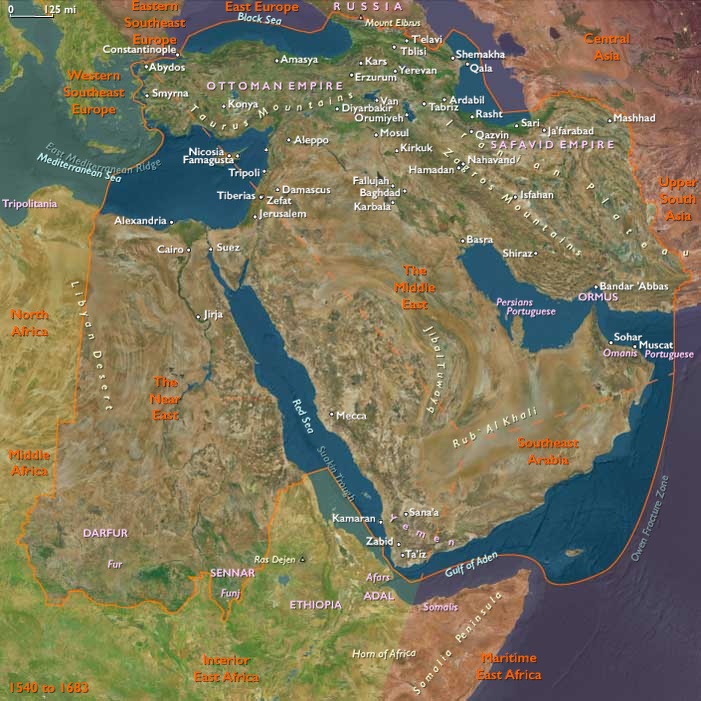
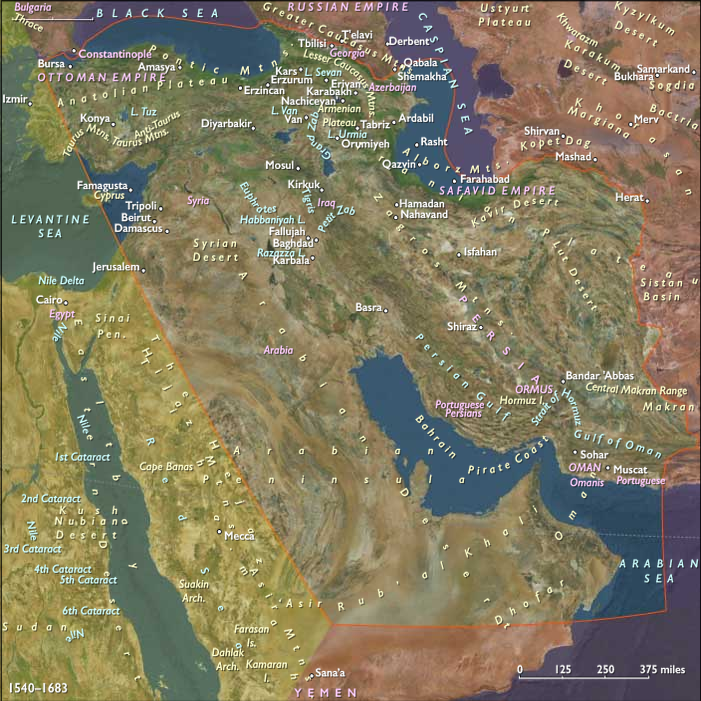
The decline of Ottoman institutions in Anatolia, particularly the land-tenure system, has resulted in extensive revolts by the sipahiyan (cavalry based on quasi-feudal land units) and by the peasants, who are oppressed by taxes.
Locations
People
Groups
Topics
Commodoties
Subjects
Regions
Subregions
Related Events
Filter results
Showing 10 events out of 33830 total
Various species of carp (collectively known as Asian carp) have been domesticated and reared as food fish in China for thousands of years.
Some of these normally gray or silver species have a tendency to produce red, orange or yellow color mutations; this was first recorded during the Jin dynasty (265–420).
During the Tang dynasty (618–907), it was popular to raise carp in ornamental ponds and watergardens.
A natural genetic mutation produced gold (actually yellowish orange) rather than silver coloration.
People began to breed the gold variety instead of the silver variety, keeping them in ponds or other bodies of water.
On special occasions at which guests were expected they would be moved to a much smaller container for display.
The domestication of goldfish was firmly established by the Song dynasty (960–1279).
In 1162, the empress of the Song Dynasty ordered the construction of a pond to collect the red and gold variety.
By this time, people outside the imperial family were forbidden to keep goldfish of the gold (yellow) variety, yellow being the imperial color.
This is probably the reason why there are more orange goldfish than yellow goldfish, even though the latter are genetically easier to breed.
During the Ming dynasty, goldfish have also began to be raised indoors, which allows mutations weakening the fishes' cold resistance to persist.
The first occurrence of fancy-tailed goldfish was recorded in the Ming Dynasty.
In 1603, goldfish are introduced to Japan.
Ieyasu proclaims himself shogun in 1603 and retires soon after, abdicating the shogunate to his son Tokugawa Hideie, but he will continue to wield actual power.
The Tokugawa Shogunate, known also as the Edo Shogunate, inaugurates Japan’s Azuchi Momoyama Era, in which culture will once again flourish.
Kepler, slowly continuing his analysis of Tycho's Mars observations—now available to him in their entirety—begins the slow process of tabulating the Rudolphine Tables, while also picking up the investigation of the laws of optics from his lunar essay of 1600.
Both lunar and solar eclipses present unexplained phenomena, such as unexpected shadow sizes, the red color of a total lunar eclipse, and the reportedly unusual light surrounding a total solar eclipse.
Related issues of atmospheric refraction apply to all astronomical observations.
The Persians retake Tabriz in 1603 after a lengthy siege.
Abbas has since the treaty of 1589-90 been regarded as almost an Ottoman vassal.
The Safavids have never beaten their western neighbors in a straight fight.
Abbas had decided in 1602 that he would longer put up with Ottoman insults.
After a particularly arrogant series of demands from the Turkish ambassador, the shah has him seized, has his beard shaved and sends it to his master, the sultan, in Constantinople.
This is a declaration of war.
Abbas first recaptures Nahavand and destroys the fortress in the city, which the Ottomans had planned to use as an advance base for attacks on Iran.
Abbas now pretends he is setting off on a hunting expedition to Mazandaran with his men.
This is merely a ruse to deceive the Ottoman spies in his court—his real target is Azerbaijan.
He changes course for Qazvin where he assembles a large army and sets off to retake Tabriz, which has been in Ottoman hands for decades.
For the first time, the Iranians make great use of their artillery and the town—which has been ruined by Ottoman occupation—soon falls.
Abbas now sets off to besiege Yerevan, the capital of Armenia, and one of the main Turkish strongholds in the Caucasus.
Sarsa Dengel had intended to make his nephew as his heir, recognizing that to avert the civil war that will likely follow his death an adult will be needed, and the emperor's own sons are quite young.
These plans are changed primarily through the influence of Empress Sena Maryam, stepmother of Emperor's eldest surviving son Prince Yaqob, who had been made emperor in 1597.
The empress had had Za Dengel seized and confined in a religious retreat on the island of Dek in Lake Tana.
Za Dengel eventually managed to escape, taking refuge in Gojjam.
Za Dengel had in 1603 been made Emperor by his cousin Ras Za Sellase, who intended Za Dengel to be little more than a figurehead.
He was crowned as Asnaf Segad ('He to whom the horizons bow').
However, Za Dengel summons the Jesuit Pedro Páez to his court at Dankaz, who persuades him to embrace Catholicism.
Cristóvão da Gama (son of the legendary Portuguese explorer Vasco da Gama) had some decades earlier, in 1541, led a military expedition to save the Ethiopian emperor Gelawdewos from the onslaught of Ahmed Gragn, a Muslim Imam who almost destroyed the existence of the Ethiopian state.
The Jesuits who had accompanied or followed the expedition into Ethiopia, and fixed their headquarters at Fremona (near Adwa), have been oppressed and neglected over the past six decades, but not actually expelled.
Father Pedro Páez, born in Olmeda de las Cebollas (now Olmeda de las Fuentes, near Madrid), had studied at Coimbra and, sent from Goa to Ethiopia as a missionary in 1589, had been held captive in Yemen for seven years, from 1590 to 1596, where he had used his time to learn Arabic.
During this period he had to travel through the Hadramaut and Rub'al Khali deserts, and tasted coffee in Mocha, being most probably the first European to undergo such experiences.
Finally arriving at Massawa in 1603, he had proceeded to Debarwa where he met the chief of the Portuguese in Ethiopia, John Gabriel, on May 11, and four days later had made his way to Fremona.Unlike his predecessor, Andre de Oviedo, Paul Henze describes Paez as "gentle, learned, considerate of the feelings of others".
When summoned to the court of the young negusä nägäst Za Dengel, his knowledge of Amharic and Ge'ez, as well as his knowledge of Ethiopian customs impresses the sovereign so much that Za Dengel decides to convert from the Coptic Tewahido Church to Catholicism —although Páez, a man of great tact and judgment, warns him not to announce his declaration too quickly.
However, when Za Dengel proclaims changes in the observance of the Sabbath, Páez retires to Fremona, and waits out the ensuing civil war that ends with the emperor's death.
Peter Paul Rubens's Calvinist parents had fled Antwerp for Cologne in 1568, after increased religious turmoil and persecution of Protestants during the rule of the Spanish Netherlands by the Duke of Alba.
Jan Rubens had become the legal advisor (and lover) to Anna of Saxony, the second wife of William I of Orange, and settled at her court in Siegen in 1570.
Following Jan Rubens' imprisonment for the affair, Peter Paul Rubens was born in 1577.
The family had returned to Cologne the next year.
In 1589, two years after his father's death, Rubens had moved with his mother to Antwerp, where he had been raised as a Catholic.
Religion would figure prominently in much of his work and Rubens will later become one of the leading voices of the Catholic Counter-Reformation style of painting.
In Antwerp, Rubens had received a humanist education, studying Latin and classical literature, beginning at fourteen his artistic apprenticeship with Tobias Verhaeght.
Subsequently, he studied under two of the city's leading painters of the time, the late Mannerist artists Adam van Noort and Otto van Veen.
Much of his earliest training involved copying earlier artists' works, such as woodcuts by Hans Holbein the Younger and Marcantonio Raimondi's engravings after Raphael.
Completing his education in 1598, he entered the Guild of St. Luke as an independent master.
Rubens had traveled in 1600 to Italy, stopping first in Venice, where he saw paintings by Titian, Veronese, and Tintoretto, before settling in Mantua at the court of Duke Vincenzo I of Gonzaga.
The coloring and compositions of Veronese and Tintoretto had had an immediate effect on Rubens's painting, and his later, mature style will be profoundly influenced by Titian.
With financial support from the Duke, Rubens had traveled in 1601 to Rome by way of Florence, where he studied classical Greek and Roman art and copied works of the Italian masters; the Hellenistic sculpture Laocoön and his Sons is especially influential on him, as is the art of Michelangelo, Raphael and Leonardo da Vinci.
Influenced also by the recent, highly naturalistic paintings by Caravaggio, he later makes a copy of that artist's Entombment of Christ, recommends that his patron, the Duke of Mantua, purchase The Death of the Virgin, and will be instrumental in the acquisition of The Madonna of the Rosary for the Dominican church in Antwerp.
During this first stay in Rome, Rubens had completed his first altarpiece commission, St. Helena with the True Cross, for the Roman church of Santa Croce in Gerusalemme.
He travels to Spain in 1603 on a diplomatic mission; delivering gifts from the Gonzagas to the court of Philip III, he is able to study the Philip II's extensive collections of Raphael and Titian.
He also paints an equestrian portrait of the Duke of Lerma during his stay (Prado, Madrid) that demonstrates the influence of works like Titian's Charles V at Mühlberg (1548; Prado, Madrid).
This journey marks the first of Rubens's many combinations of art and diplomacy.