The death of Olof Skötkonung is said …
Years: 1022 - 1022
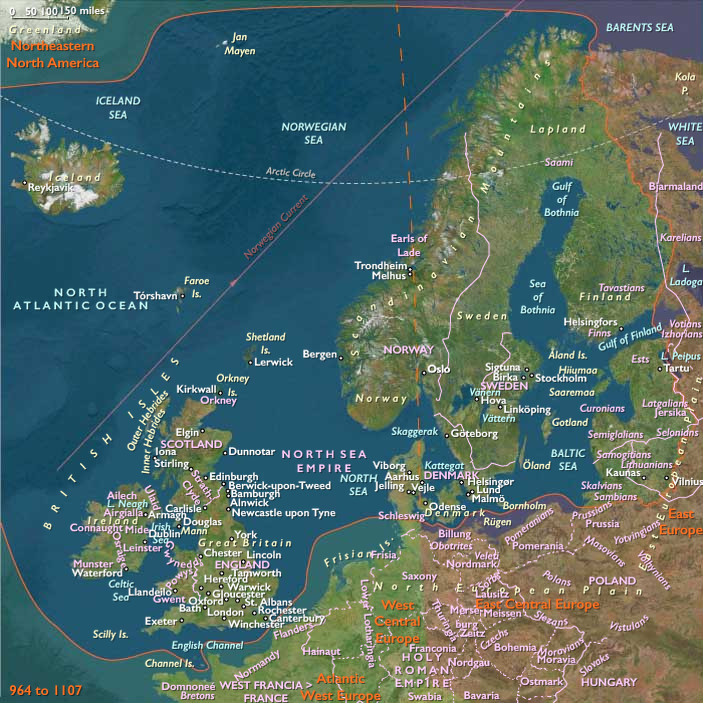
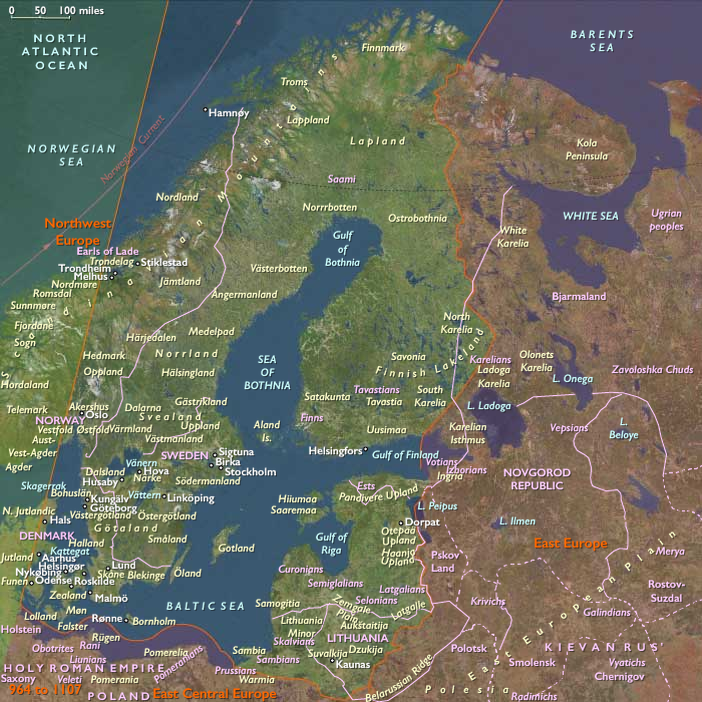
The death of Olof Skötkonung is said to have taken place in the winter of 1021–1022.
According to a legend, he was martyred at Stockholm after refusing to sacrifice to pagan gods.
Locations
People
- Anund Jacob
- Estrid of the Obotrites
- Ingegerd Olofsdotter of Sweden
- Olaf II Haraldsson
- Olof Skötkonung
- Yaroslav I
Groups
- Polytheism (“paganism”)
- Christianity, Chalcedonian
- Obotrites (Slavic tribal confederation)
- Varangians
- Swedes (North Germanic tribe)
- Kievan Rus', or Kiev, Great Principality of
- Sweden, Kingdom of
- Norway, Danish dependent Kingdom of
Commodoties
Subjects
Regions
Subregions
Related Events
Filter results
Showing 10 events out of 51651 total
Basil’s expansionist policy, having fueled the annexation of the possessions of David of Tao in 1000, finally extinguishes Armenian independence, after King Seneqerim-Hovhannes Artsruni of Vaspurakan (Van) in ceding his dominions to the emperor in 1021-22, hands over his entire kingdom in exchange for vast domains in Sebasteia, where he and fourteen thousand of his retainers settle; and …
…the Bagratid king of Ani, Hovhannes-Smbat III, is compelled to make the emperor heir to his estates.
His enthronement in 1020 had been strongly opposed by his younger brother Ashot, who one year later in 1021 rebels against him, driving his forces to Ani, the capital, surrounding and conquering the city and dethroning his brother and usurping power from him.
Following a compromise agreement between the two feuding brothers, he agrees to withdraw his rebel forces from Ani and allow the legal heir to return to power, continuing rule as Hovhannes-Smbat III of Ani over limited areas around the capital, whereas Ashot (known as Ashot IV Qadj) is enthroned as a concurrent king and ruler in further Armenian provinces closer to Persia and Georgia.
The annexation of Armenia, the homeland of many of the East Roman empire’s great emperors and soldiers, will help to solidify Empire’s eastern wall for nearly a century.
Sitt al-Mulk has for two years continued to wield influence as an advisor after Ali az-Zahir came of age, as evidenced by the very generous appanages that have come her way.
After the assumption of power and the elimination of her rivals, she had abolished many of the strange rules that Al-Hakim had promulgated in his reign.
She has also severely persecuted the Druze religion, which believes in Al-Hakim's divinity, eliminating it entirely from Egypt, and restricting it to the mountains of Lebanon.
She has worked to reduce tensions with Constantinople e over the possession of Aleppo, but before negotiations can be completed she dies on February 5, 1023, at the age of fifty-two.
A group of her favorites takes power after her death.
Under this regime, the Fātimid state slips into crisis as famine and plague lead to anarchy.
Ibn Hazm, an Arabic writer, was born into a notable family said to claim Persian descent.
His great-grandfather Hazm was a convert to Islam, his grandfather Sa'id moved to Córdoba and his father Ahmad had both held high advisory positions in the court of the Umayyad Caliph Hisham II.
Conflicting evidence raised by some modern day scholars indicate that Ibn Hazm was a descendant of a Christian Iberian family in Manta Lisham (near Sevilla).
As one of the major members of the Zahiri group, he is well known in his time.
Some other scholars reprimand him, but Ibn Hazm is a great resister.
Living among the circle of the ruling hierarchy of the Umayyad government, young Ibn Hazm, had gained an excellent educational opportunity at Cordoba.
His talent had gained him fame and entered service under the Caliphs of Córdoba.
Ibn Hazm's father had died in 1012 and Ibn Hazm had continued to speak in favor of a centralized political structure.
He is often accused of supporting the Umayyads, for which he is frequently imprisoned.
He lays out the concept of courtly love in his 1022 work, “The Arabic Ring of the Dove.”
Emperor Henry, obliging the pope’s request to fight the eastern empire in Italy, sets out in 1022, down the Adriatic coast for southern Italy commanding a large force.
He sends Pilgrim, Archbishop of Cologne, ahead with a slightly smaller army along the Tyrrhenian littoral with the objective of subjugating the Principality of Capua.
A third army, smaller still, under the command of Poppo of Treffen, who Henry had in 1019 appointed Patriarch of Aquileia, goes through the Apennines to join Henry in besieging the imperial fortress of Troia.
Pilgrim does capture Pandulf IV of Capua and extract oaths of allegiance from both Capua and the Principality of Salerno, but all three divisions fail to take Troia from Boioannes.
Henry nearly executes the treacherous prince of Capua, but relents at the last moment at Pilgrim's pleading and instead sends him off to Germany in chains and appoints Pandulf of Teano to replace him as prince.
Though his main objective had been missed, Henry leaves the south in the knowledge that western imperial authority still extends that far.
On his return journey, he attends a synod at Pavia, where he advocates Church reform.
Al-Muizz ibn Badis had ascended the throne of the Zirid Dnasty if Ifriqiyah as a minor following the death of his father Badis ibn Mansur, with his aunt acting as regent.
In 1016, there had been a bloody revolt in Ifriqiya in which the Fatimid residence Al-Mansuriya had been completely destroyed and 20,000 Shiites massacred.
The unrest had forced a ceasefire in the conflict with the Hammadids of Algeria, and their independence had been finally recognized in 1018.
Al-Muizz takes over the government in 1022 following the overthrow of his aunt.
Goryeo and the Liao dynasty reach a negotiated peace agreement in 1023 and establish normal relations.
The Khitan will never again invade Goryeo.
The surrendered Khitan troops have been divided up among the provinces of Goryeo and settled in isolated and guarded communities.
These prisoners are valued for their skill in hunting, butchering, skinning, and leather tanning.
Over the next few centuries, they will evolve into the Baekjeong class, who will come to form the lowest caste of the Korean people.
Bernard II returns now to war with the Slavs (Obodrites and Lutici) and draws them into his sphere of power and influence through their leader, Godescalc (Gottschalk).
Basil is pictured both in near-contemporary history and in manuscript illustrations as a short, well-proportioned figure, with brilliant light-blue eyes, a round face, and full, bushy whiskers, which he twirls in his fingers when angry or while giving an audience.
He dresses plainly and even when wearing the purple chooses only a dark hue.
An abrupt speaker, he scorns rhetoric yet is capable of wit.
He has been described as mean, austere, and irascible, spending most of his time as though he were a soldier on guard.
He shows no obvious interest in learning, but he does apparently commission works of religious art, and has churches and monasteries rebuilt or completed in Boeotia and in Athens, though this may be accounted for by conventional piety.
The ruthlessness and tenacity that serve Basil in his military and diplomatic activities are displayed in his domestic policy as well.
Its keynote is the strengthening of imperial authority by striking at his overpowerful subjects, particularly the military families who rule like princes in Asia Minor.
The byproduct of this policy is the imperial protection of the small farmers, some of whom owe military service to the crown and pay taxes to the central exchequer.
Title to land is rigorously inspected, and vast estates are arbitrarily confiscated.
Thus, in spite of his costly wars, Basil can boast a full treasury, some of it stored in specially constructed underground chambers.
The emperor now looks further west and plans to strengthen imperial control in southern Italy and to regain Sicily from the Arabs.
Giorgi, the future George I of Georgia, was born in 998 or, according to a later version of the Georgian chronicles, in 1002, to King Bagrat III.
Upon his father’s death on May 7, 1014, he had inherited the kingdoms of Abkhazia, Kartli and Kakheti united into a single state of Georgia.
As his predecessor, Giorgi continued to be titled as King of the Abkhazians (Ap'xaz) and Georgians (K'art'velians).
Contemporary sources, however, frequently omit one of the two components of this title when abbreviating it.
The new sovereign’s young age had been immediately exploited by the great nobles, who had been suppressed under the heavy hand of Bagrat.
Around the same year, the easternmost provinces of Kakheti and Hereti, not easily acquired by Bagrat, had staged a revolt and reinstated their own government under Kvirike III (1010/1014–1029), who had also incorporated a portion of the neighboring Arran (Ran), allowing him to claim the title of King of the Kakhetians and Ranians.
Giorgi, unable to prevent the move, had sought an alliance with this kingdom, rather than attempting to reincorporate it into the Georgian state, thus leaving a long-standing claim to Kakheti and Hereti to his successors.
The major political and military event during Giorgi’s reign, a war against Constantinople’s Empire, has its roots back in the 990s, when the Georgian prince David III Kuropalates of Tao, following his abortive rebellion against Emperor Basil II, had to agree to cede his extensive possessions in Tao and the neighboring lands to the emperor on his death.
All the efforts by David’s stepson and Giorgi’s father, Bagrat III, to prevent these territories from being annexed to the empire had been in vain.
Giorgi, young and ambitious, had launched a campaign to restore the Kuropalates’ succession to Georgia and occupied Tao in 1015–1016.
He had also entered in an alliance with the Fatimid Caliph of Egypt, Al-Hakim, putting Basil in a difficult situation by forcing him to refrain from an acute response to Giorgi’s offensive.
Beyond that, the Empire has been involved in a relentless war with the Bulgarians, limiting their actions to the west.
But as soon as Bulgaria is conquered, and Al-Hakim is no longer alive, Basil leads his army against Georgia.
An exhausting war has lasted for two years, and ends in a decisive imperial victory, forcing Giorgi to agree to a peace treaty, in which he has not only to abandon his claims to Tao, but to surrender several of his southwestern possessions to Basil, and to give his three-year-old son, Bagrat, as hostage.
Following the peace treaty, Constantinople is visited by Catholicos-Patriarch Melkisedek I of Georgia, who gains imperial financial aid for the construction of "Svetitskhoveli" (literally, the Living Pillar), a major Orthodox cathedral in the eastern Georgian town of Mtskheta.

Years: 1022 - 1022
Locations
People
- Anund Jacob
- Estrid of the Obotrites
- Ingegerd Olofsdotter of Sweden
- Olaf II Haraldsson
- Olof Skötkonung
- Yaroslav I
Groups
- Polytheism (“paganism”)
- Christianity, Chalcedonian
- Obotrites (Slavic tribal confederation)
- Varangians
- Swedes (North Germanic tribe)
- Kievan Rus', or Kiev, Great Principality of
- Sweden, Kingdom of
- Norway, Danish dependent Kingdom of