
Atlantic West Europe, 656–667: Merovingian Decline and …
Years: 656 - 667
Atlantic West Europe, 656–667: Merovingian Decline and Rise of Regional Power
The period from 656 to 667 marked a pivotal moment in the Merovingian kingdom of the Franks, as royal authority weakened significantly, allowing local aristocratic families and regional powers to assert greater independence. These developments laid the foundation for future political structures across Atlantic West Europe.
Political and Military Developments
-
Neustria and Austrasia:
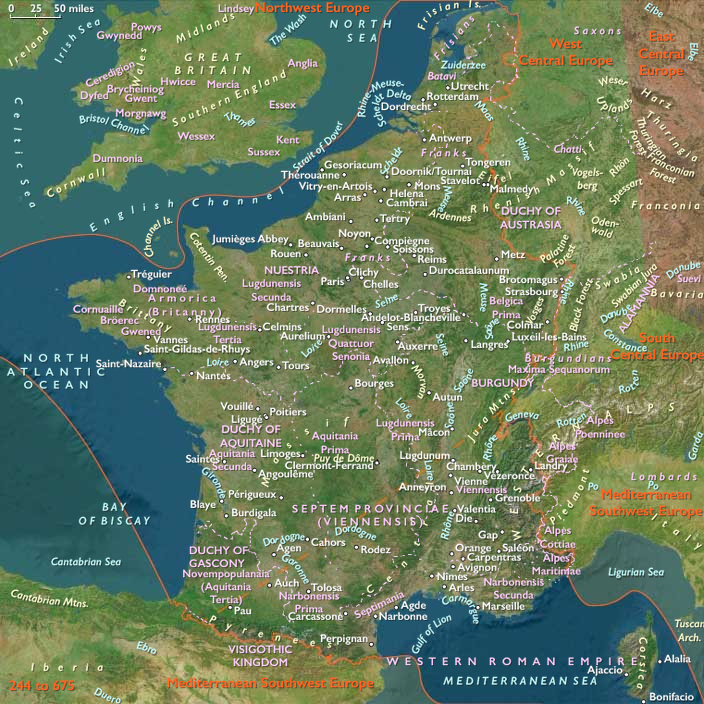
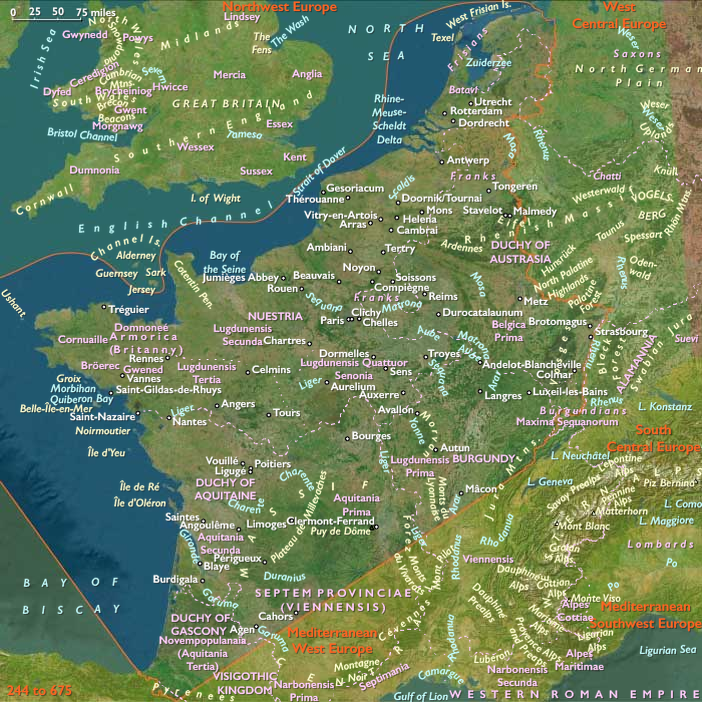
- After the death of King Clovis II (657), the kingdom was divided among his sons. Clotaire III became king in Neustria and Burgundy (r. 657–673), while his brother Childeric II ruled Austrasia (r. 662–675).
- Increasing rivalry between these Frankish kingdoms intensified, contributing to political fragmentation.
-
Rise of the Mayors of the Palace:
- The weakening Merovingian monarchy led to the increasing power of aristocratic administrators known as Mayors of the Palace, especially Ebroin in Neustria and Wulfoald in Austrasia. These figures effectively controlled royal authority and dominated internal politics.
-
Aquitaine's Growing Autonomy:
- Aquitaine increasingly functioned as a semi-autonomous region under local dukes, who managed to distance themselves politically and militarily from central Frankish authority.
-
Brittany and Normandy:
- Breton chieftains consolidated control within Brittany, increasingly independent from Merovingian influence.
- The region later known as Normandy saw only intermittent Frankish influence, with limited central oversight.
Economic and Social Developments
- Ruralization and Estate Consolidation:
- Continued growth in large estates controlled by local elites shaped rural society, as the decline of urban centers accelerated the shift toward agrarian-based economies dominated by manorial holdings.
- Localized Trade Networks:
- Long-distance trade declined temporarily; economic activity was primarily regional and local, focused around monasteries and manorial estates.
Religious and Cultural Developments
-
Monastic Expansion and Influence:
- Monastic communities, such as Luxeuil in Burgundy, remained significant centers of learning, manuscript production, and spiritual influence.
- The monasteries provided stability amidst political uncertainty, preserving cultural continuity.
-
Spread of Christianity in Peripheral Regions:
- Continued missionary activities gradually consolidated Christianity in more remote areas, notably Brittany, which still retained elements of Celtic religious traditions alongside the growing Christian influence.
Long-Term Significance
This era laid critical foundations for the political structure of medieval Europe, highlighting the transition from centralized Merovingian royal control to the rise of regional aristocratic governance and autonomy. The weakening of royal authority, combined with the growing strength of local leaders and monasteries, shaped the socio-political landscape of Atlantic West Europe in subsequent decades.
People
Groups
- Franks
- Breton people
- Christianity, Chalcedonian
- Aquitaine, (Frankish) Duchy of
- Austrasia, Frankish Kingdom of
- Neustria and Burgundy, Frankish Kingdom of
- Burgundy, Frankish Kingdom of
Topics
Subjects
Regions
Subregions
Years: 656 - 667
People
Groups
- Franks
- Breton people
- Christianity, Chalcedonian
- Aquitaine, (Frankish) Duchy of
- Austrasia, Frankish Kingdom of
- Neustria and Burgundy, Frankish Kingdom of
- Burgundy, Frankish Kingdom of
Topics
Subjects
Regions
Subregions