The Danish fleet arrives in May and …
Years: 1520 - 1520
May
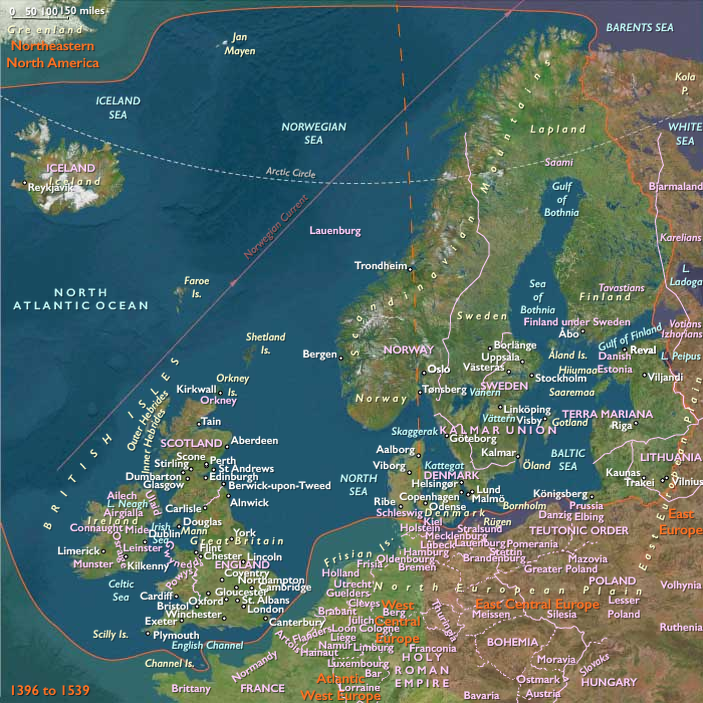
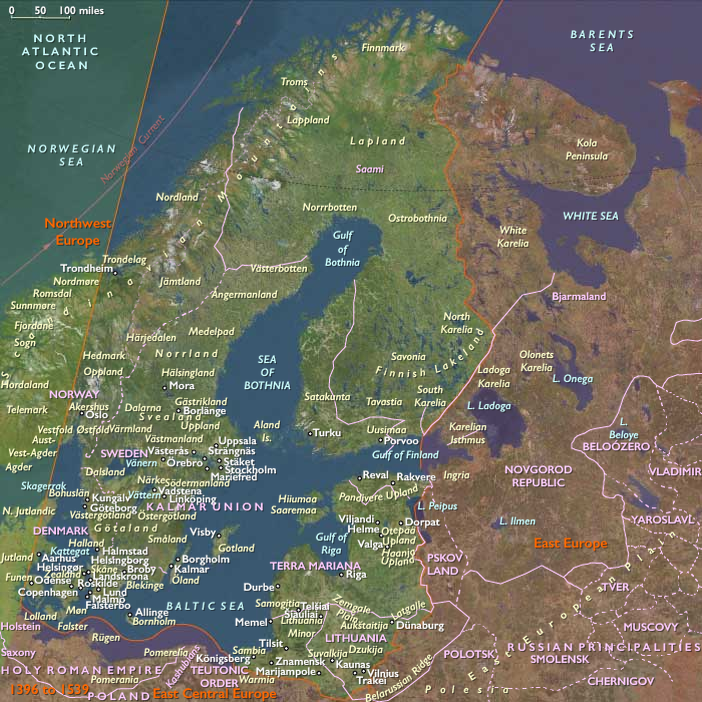
The Danish fleet arrives in May and Stockholm is attacked by land and sea.
Locations
People
Groups
- Christians, Roman Catholic
- Lübeck, Free City of
- Kalmar Union (of Denmark, Norway and Sweden)
- Sweden, autonomous Kingdom of
Topics
Commodoties
Subjects
Regions
Subregions
Related Events
Filter results
Showing 10 events out of 38792 total
The fourteenth century Nagarakretagama, Canto 14, which identifies Timor as an island within Majapahit's realm, is the earliest historical record about Timor, the largest and easternmost of the Lesser Sunda Islands in the Malay Archipelago,.
Timor had been incorporated into Javanese, Chinese and Indian trading networks of the fourteenth century as an exporter of aromatic sandalwood, slaves, honey and wax.
The Portuguese begin trading with Timor in 1520.
The progressive internal decay of the Polish Church, in a situation analogous with that of other European countries, has created conditions favorable for the dissemination of the Reformation ideas and currents.
For example, there is a chasm between the lower clergy and the nobility-based Church hierarchy, which is quite laicized and preoccupied with temporal issues, such as power and wealth, often corrupt.
The middle nobility, which has already been exposed to the Hussite reformist persuasion, increasingly looks at the Church's many privileges with envy and hostility.
Sigismund I quickly reactsagainst the "religious novelties", issuing his first related edict in 1520, banning any promotion of the Lutheran ideology, or even foreign trips to the Lutheran centers.
Selim, whose victories over the Safavids and the Mamluks have made him in effect the ruler over all of Islam, has resurrected and assumed the title of caliph, which makes the Ottoman sultan the spiritual as well as the temporal ruler of the Muslim world.
He has spent the last few years in Istanbul solidifying the supremacy of the sultanate, exploiting the prestige and revenues that have resulted from his Eastern victories.
A great patron of Islamic art and literature and himself a poet, he dies at fifty September 22, 1520, at Çorlu; Süleiman, the only of Selim’s son that had survived his father’s massacre of all his relatives upon ascending the Ottoman throne, succeeds him with a position unequaled by any sultan before or after.
He is left without opposition and with a great deal of control over the devsirme class, as well as over the remnants of the Turkish notables.
The conquest of the Arab world has doubled the revenues of the treasury without imposing important additional financial obligations, leaving Süleyman with wealth and power unparalleled in Ottoman history.
As governor of Damascus, Janbirdi al-Ghazali is in charge of safeguarding the pilgrim caravan destined to make hajj in the Hejaz for the pilgrim route from Damascus to Aqaba in southern Transjordan.
In order to do this successfully, he subjugates the Turkmen nomads in the area.
After two years, he manages to have those same Turkmen tribes protecting the pilgrims.
By 1520, hajj caravans are traveling without incident.
In line with Ottoman state policy at this time, al-Ghazali embarks on major development projects in Damascus.
Having been appointed the nazir or "supervisor" of Damascus's main waqf, he has the Umayyad Mosque repaired and redecorated.
He also has a number of other mosques, schools and canals rebuilt and repaired.
Supervisors of madrasas ("religious schools") who are deemed negligent are stripped of their position and their school buildings restored.
Following the succession of Süleyman the Magnificent to the sultanate after Selim's death in 1520, al-Ghazali revolts against the Ottoman state.
He seeks to restore Mamluk suzerainty, declaring himself "sultan" or al-Malik al-Ashraf ("the most noble king").
He bans preachers in mosques from upholding the Ottoman sultan's name in Friday prayers, purges Ottoman officials and soldiers from Syria, and bans Ottoman dress by the provinces's citizens.
After he declares himself sultan, the cities of Tripoli, Hama, and Hims joins his rebellion.
Following failed attempts to enlist the support of Shah Ismail of the Safavid Empire and Kha'ir Bey, the Ottoman governor of Egypt, he nonetheless raises an army and sets out to conquer Aleppo.

The residents of Aleppo support the Ottoman sultanate, however, and resist al-Ghazali's efforts.
His army besieges the city for fifteen days, during which over two hundred residents and Ottoman soldiers are killed, but to no avail.
He withdraws to Damascus soon after to rally his forces.
The town of Zeila, identified in antiquity with the commercial port of Avalites described in the first century-Greco-Roman travelogue the Periplus of the Erythraean Sea, an area situated in the historic northern Barbara region of present Somlaia, had evolved into an early Islamic center with the arrival of Muslims shortly after the hijra.
By the ninth century, Zeila is described as the capital of an already-established Adal kingdom, and had attained its height of prosperity in the fourteenth century.
Travelers' reports, such as the memoirs of the Italian Ludovico di Varthema, indicate that Zeila continued to be an important marketplace during the sixteenth century, despite being sacked by the Portuguese in 1517.
The Ottoman Turks, consolidating their position at the entrance to the Red Sea, garrison Zeila in 1520.
Pedro Machuca had painted The Virgin and the Souls in Purgatory in 1517 the increasingly popular Mannerist style.
The details of his life are poorly known.
Born in Toledo, he is said to have been a pupil or friends with Michelangelo and Pontormo.
Returning to Spain in 1520, he works as a painter in the Royal Chapel of Granada, as well as in Jaén, Toledo, and Uclés.
Little is known about Spanish sculptor Bartolomé Ordóñez before the last five years of his life.
His will indicates that he was an hidalgo born in Burgos, and that he had a sister named Marina in that city.
Assuming this is correct, he would have grown up amidst the first flowering of the Spanish Renaissance, where such pioneers as Andrés de Nájera were working, under the influence of Gil de Siloé, who had studied in Italy, and Domenico Fancelli, who was from Italy.
Returning to his native Spain at the beginning of 1519 , he had establishes himself in Barcelona, executing many woodcarvings for the cathedral there.
Ordóñez had in May 1519 undertaken a contract for work previously contracted to Domenico Fancelli: the tombs of Philip I and Joanna of Castile in Granada and of Cardinal Cisneros in Alcalá de Henares, and according to his last will, those of some of the Fonseca family.
He travels to Carrara in autumn of the same year, with the intent of returning to Barcelona, but upon the death of his wife he starts a new studio in Carrara; he works feverishly here, but dies on December 6, 1520.
Ludovico Ariosto and Leonardo da Vinci had shared a patron in Cardinal Ippolito d'Este’s older sister the Marchioness Isabella d’Este, who appears in Ludovico’s masterpiece, Orlando Furioso.
She also appears in Leonardo’s “Sketch for a Portrait of Isabella d’Este,” at the Louvre.
The cardinal had gone to Hungary in 1518, and wished Ariosto to accompany him.
The poet had excused himself, pleading ill health, his love of study, and the need to care for his elderly mother.
His excuses were not well-received, and he was denied even an interview.
The cardinal's brother, Alfonso, duke of Ferrara, now took Ariosto under his patronage.
By then, Ariosto had already distinguished himself as a diplomat, chiefly on the occasion of two visits to Rome as ambassador to Pope Julius II.
In 1520, Ariosto writes an Italian comedy, Il negromante, in the style of the comedies of Plautus and Terence.
Pope Leo X and his kinsman, Cardinal Guilio de'Medici, commission Michelangelo to design and construct the Medici Chapel, or New Sacristy, in 1520 as a burial chapel for the Medici family, located on the north side of the church of San Lorenzo in Florence.
This four-year project will be Michelangelo’s first essay in architecture.
He will also design its monuments dedicated to certain members of the Medici family, with sculptural figures of the four times of day that are destined to influence sculptural figures reclining on architraves for many generations to come.
Years: 1520 - 1520
May
Locations
People
Groups
- Christians, Roman Catholic
- Lübeck, Free City of
- Kalmar Union (of Denmark, Norway and Sweden)
- Sweden, autonomous Kingdom of