
The Swedes of the ninth century had …
Years: 1015 - 1015
The Swedes of the ninth century had voyaged east while the Danes and Norwegians had gone south and west.
The large Russian mainland and its many navigable rivers had offered good prospects for merchandise and, at times, plundering.
These routes had brought them into contact with the Eastern Roman and Muslim empires.
Since the East was rich and well-defended, Viking activity there centered mainly around peaceful trade instead of pillage, as in Western Europe.
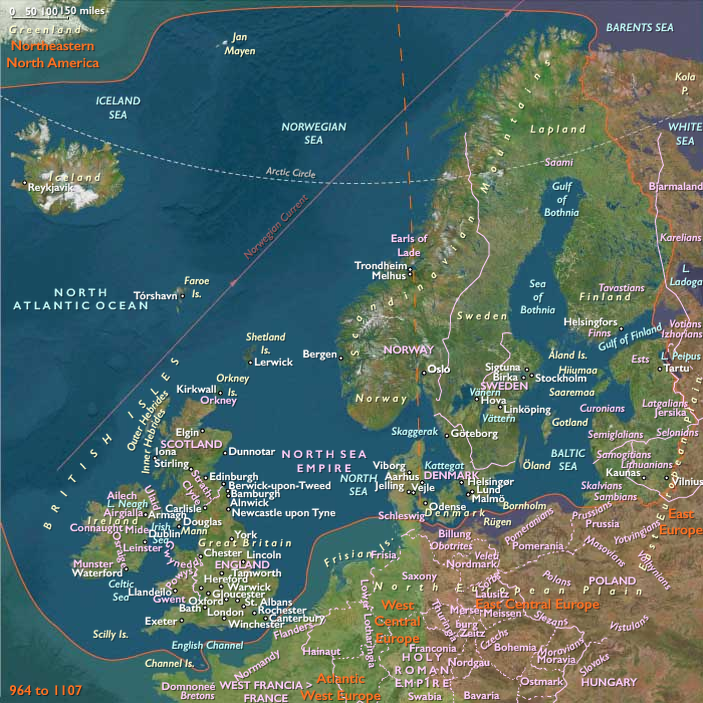
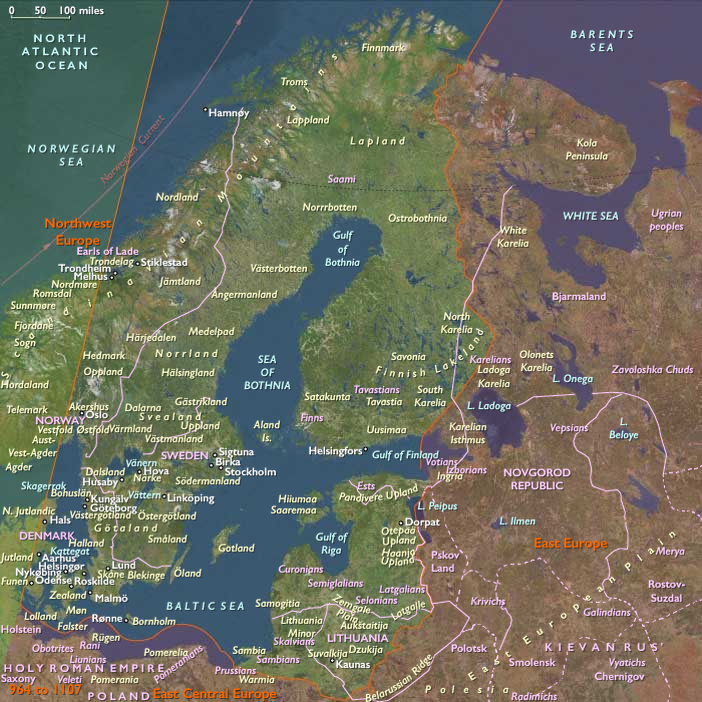
During the ninth century, extensive Scandinavian settlements had been made on the east side of the Baltic sea.
The Tale of Bygone Years (dated to 1113) relates how the Varangians arrived in Constantinople, and of piratical expeditions on the Black Sea and on the Caspian Sea.
The semi-legendary expeditions by Rurik (Rørik) and Askold (Haskuld) established settlements that resulted in the first Russian states; Novgorod and Kievan Rus', a predecessor state of Belarus, Russia and Ukraine.
The Slavic tribes in Russia were weak and submitted to the Vikings with little resistance, but had also rapidly assimilated their conquerors.
The Varangians had accumulated some wealth from its foreign trades.
A center of trade in northern Europe had developed on the island of Birka, not far from where Stockholm was later constructed, in mid Sweden.
Birka was probably demolished already during the eleventh century, but remains show its wealth in the ninth and tenth centuries.
Thousands of graves, coins, jewelry and other luxury items have been found here.
There are also other locations in Sweden where precious treasures have been found, revealing a widespread trade between Sweden and eastern countries down to Asia.
The Swedes have by 1015 abandoned their now-unprofitable trade routes to the east.
Locations
Groups
- Slavs, East
- Varangians
- Vikings
- Danes (Scandinavians)
- Swedes (North Germanic tribe)
- Norse
- Novgorod, Principality of
- Roman Empire, Eastern: Macedonian dynasty
- Kievan Rus', or Kiev, Great Principality of
- Sweden, Kingdom of
Commodoties
Subjects
Regions
Subregions
Related Events
Showing 10 events out of 51769 total
Years: 1015 - 1015
Locations
Groups
- Slavs, East
- Varangians
- Vikings
- Danes (Scandinavians)
- Swedes (North Germanic tribe)
- Norse
- Novgorod, Principality of
- Roman Empire, Eastern: Macedonian dynasty
- Kievan Rus', or Kiev, Great Principality of
- Sweden, Kingdom of
Commodoties
Subjects
Regions
Subregions