The Croatian-Hungarian language conflict reemerges in the …
Years: 1832 - 1832
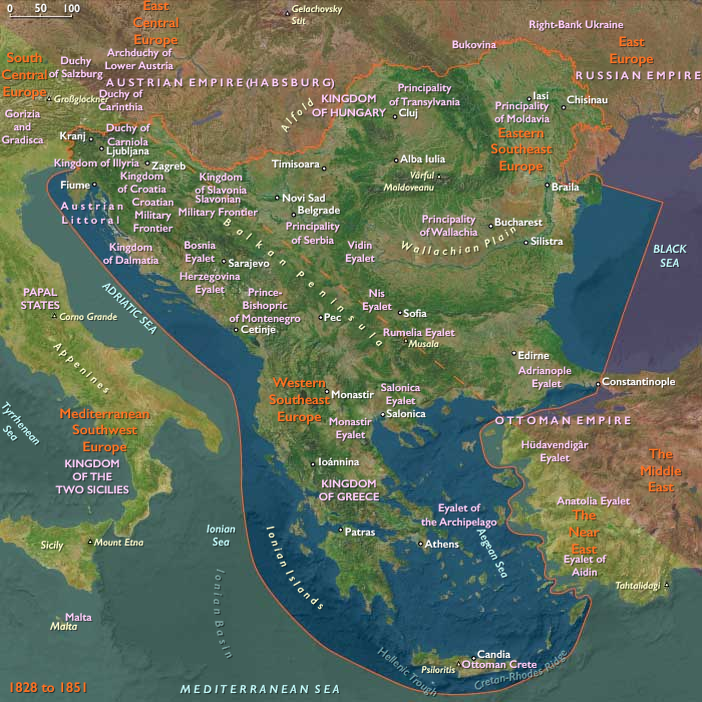
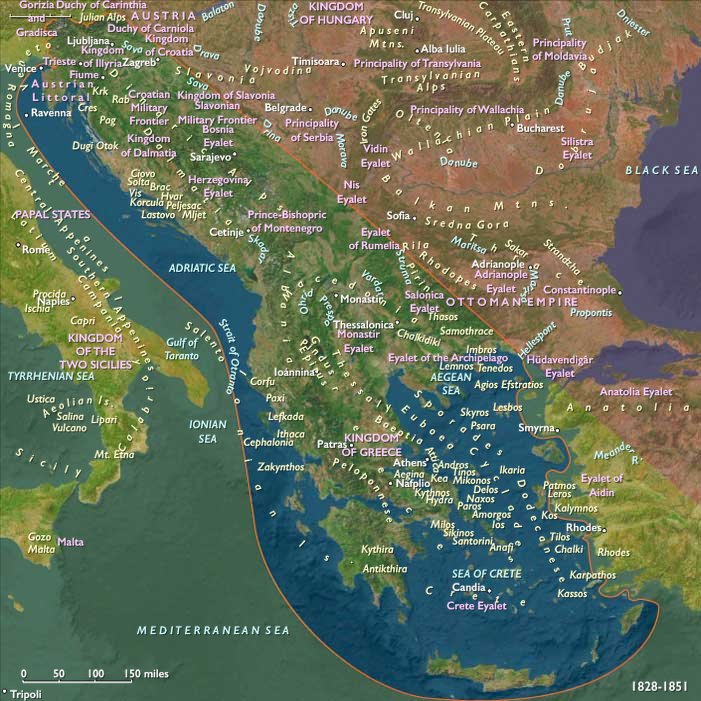
The Croatian-Hungarian language conflict reemerges in the 1830s, as Hungarian reformers grow more critical of Austrian domination.
French-educated Croatian leaders, fearing Hungarian linguistic and political domination, begin promoting the Croatian language and formation of a Slavic kingdom within the Austrian Empire.
In 1832, for the first time in centuries, a Croatian noble addresses the Sabor in Croatian. (The Kingdom of the Serbs, Croats and Slovenes will emerge from the wreckage of the Austro-Hungarian Empire nearly a hundred years later)
Locations
Groups
Subjects
Regions
Subregions
Related Events
Filter results
Showing 10 events out of 18850 total
The British attack Naning once again with a much larger force near the end of 1832.
This time, Dol Said does not have the help of his allies: his army is defeated and he surrenders.
Opium is now the most significant commodity in world trade.
Britain had imported 18,956 chests of Indian opium to China in 1830.
Turkish exports to China in 1830 had totaled one hundred tons, as compared to seven tons in 1805.
With the expiration in 1832 of the official monopoly of the opium traffic by the British East India Company, its mandate to rule and dictate the trade policies of British India no longer in effect, Jardine-Matheson and Company of London inherits India's opium from the Company.
The iconic Great Wave off Kanagawa, a woodblock print by the Japanese artist Hokusai, is published in 1832 as the first in Hokusai's series "Thirty-Six Views of Mount Fuji,” created by Hokusai both as a response to a domestic travel boom and as part of a personal obsession with Mount Fuji.
Destined to be is his most famous work, it depicts an enormous wave threatening boats near the Japanese prefecture of Kanagawa; Mount Fuji can be seen in the background.
The wave is probably not intended to be a tsunami, but a great off-shore wave created by the wind.
Like the other prints in the series, it depicts the area around Mount Fuji under particular conditions.
It is this series, specifically the Great Wave print and Fuji in Clear Weather, that secures Hokusai’s fame both within Japan and overseas.
Johann Wolfgang von Goethe's Faust, a tragic play, published in two parts: Faust: der Tragödie erster Teil (translated as: Faust: The Tragedy Part One) and Faust: der Tragödie zweiter Teil (Faust: The Tragedy Part Two), is a closet drama, meaning that it is meant to be read rather than performed.
Goethe's most famous work and considered by many to be one of the greatest works of German literature.
The revised 1828–1829 edition, the last to be edited by Goethe himself, had followed the 1808 publication of Part One, preliminarily completed by Goethe in 1806.
Before these had appeared a partial printing in 1790 of Faust, a Fragment.
The earliest forms of the work, known as the Urfaust, had been developed between 1772 and 1775; however, the details of that development are no longer entirely clear.
Goethe finishes writing Faust Part Two in 1832, the year of his death.
In contrast to Faust Part One, the focus here is no longer on the soul of Faust, which has been sold to the devil, but rather on social phenomena such as psychology, history, and politics.
The second part has formed the principal occupation of Goethe's last years and appears only posthumously in 1832.
Giuseppe Mazzini had traveled in 1831 to Tuscany, where he had become a member of the Carbonari, a secret association with political purposes.
On October 31 of this year he had been arrested at Genoa and interned at Savona.
During his imprisonment he had devised the outlines of a new patriotic movement aiming to replace the unsuccessful Carbonari.
Although freed in early 1832, he chooses exile instead of life confined into the small hamlet which is requested of him by the police, moving to Geneva in Switzerland.
Mazzini was born in Genoa, then part of the Ligurian Republic, under the rule of the French Empire.
His father, Giacomo, originally from Chiavari, was a university professor who had adhered to Jacobin ideology; his mother, Maria Drago, was renowned for her beauty and religious (Jansenist) fervor.
From a very early age, Mazzini showed good learning ability (as well as a precocious interest towards politics and literature), and had been admitted to the University at only fourteen, graduating in law in 1826, initially practicing as a "poor man's lawyer".
He also had hoped to become a historical novelist or a dramatist, and in the same year he had written his first essay, Dell'amor patrio di Dante ("On Dante's Patriotic Love"), which would be published in 1837.
In 1828–29, he collaborated with a Genoese newspaper, L'indicatore genovese, which was however soon closed by the Piedmontese authorities.
He then became one of the leading authors of L'Indicatore Livornese, published at Livorno by F.D. Guerrazzi, until this paper was closed down by the authorities, too.
American author Washington Irving, in a bid to broaden his reputation, had completed his History of the Life and Voyages of Christopher Columbus in 1828, the fruit of his past two years as a resident of Spain, and had followed this with “A Chronicle of Granada” in 1829.
The final fruit of his three-year Spanish interlude is a resonant collection of sketches and legends, The Alhambra, published in 1832.
Honoré de Balzac, after writing several novels, in 1832 conceived the idea for an enormous series of books that would paint a panoramic portrait of "all aspects of society".
The moment the idea came to him, Balzac raced to his sister's apartment and proclaimed: "I am about to become a genius"!
Although he originally calls it Etudes des Mœurs (literally "Studies of manners", or "The Ways of the World") it eventually becomes known as La Comédie Humaine, and he includes in it all the fiction that he has published in his lifetime under his own name.
This is to be Balzac's life work and his greatest achievement.
As an apprentice at law in 1819, Balzac had produced his first play, Cromwell, in 1819, having convinced his prosperous middle class family to subsidize him meagerly for two years while he wrote, fueled by countless cups of coffee, in a Paris garret.
Realizing he would have trouble finding a composer, however, he turned to other pursuits.
In 1820 Balzac completed the five-act verse tragedy Cromwell.
When he finished, Balzac went to Villeparisis and read the entire work to his family; they were unimpressed.
He followed this effort by starting (but never finishing) three novels: Sténie, Falthurne, and Corsino.
Readers advised him to try anything but writing.
Undaunted, Balzac turned to writing Gothic thrillers, working with several collaborators under various pen names.Balzac had met Laure de Berny, a woman twice his age and the mother of nine children, in 1821, who braved ridicule to become the mistress of the twenty-two-year old writer.
In 1821 also, Balzac had met the enterprising Auguste Le Poitevin, who persuaded the author to write short stories, which Le Poitevin then sells to publishers.
Balzac quickly turned to longer works, and by 1826 he had written nine novels, all published under pseudonyms and often produced in collaboration with other writers.
These books were potboiler novels, designed to sell quickly and titillate audiences.
During this time Balzac wrote two pamphlets in support of primogeniture and the Society of Jesus.
The latter, regarding the Jesuits, illustrate his lifelong admiration for the Catholic Church.
In the late 1820s Balzac had dabbled in several business ventures, a penchant his sister blamed on the temptation of an unknown neighbor.
His first enterprise was in publishing which turned out cheap one-volume editions of French classics including the works of Molière.
This business failed miserably.
Balzac had better luck publishing the Memoirs of the Duchess of Abrantès, with whom he also had a love affair.
Balzac borrowed money from his family and friends, and tried to build a printing business, then a typefounder enterprise.
His inexperience and lack of capital caused his ruin in these trades.
He gave the businesses to a friend (who made them successful) but carries the debts for many years.
As of April 1828 Balzac owed fifty thousand francs to his mother.

In London, the disease claims six thousand five hundred and thirty-six victims and came to be known as "King Cholera"; in Paris, twenty thousand die (of a population of six hundred and fifty thousand), and total deaths in France amount to one hundred thousand.
Romanticism has had a profound impact on the development of western jewelry beginning in the late eighteenth century.
Perhaps the most significant influences are the public’s fascination with the treasures being discovered through the birth of modern archaeology, and the fascination with Medieval and Renaissance art.
Changing social conditions and the onset of the industrial revolution also lead to growth of a middle class that wants and can afford jewelry.
As a result, the use of industrial processes, cheaper alloys, and stone substitutes leads to the development of paste or costume jewelry.
Distinguished goldsmiths continue to flourish, however, as wealthier patrons seek to ensure that what they wear still stands apart from the jewelry of the masses, not only through use of precious metals and stones but also though superior artistic and technical work; one such artist is the young French goldsmith Françoise Désire Fromment Meurice.
Alexandre Dumas, expressing romanticism through a contemporary setting, produces the drama Antony in 1831 and the suspenseful drama la Tour de Nesle in 1832.