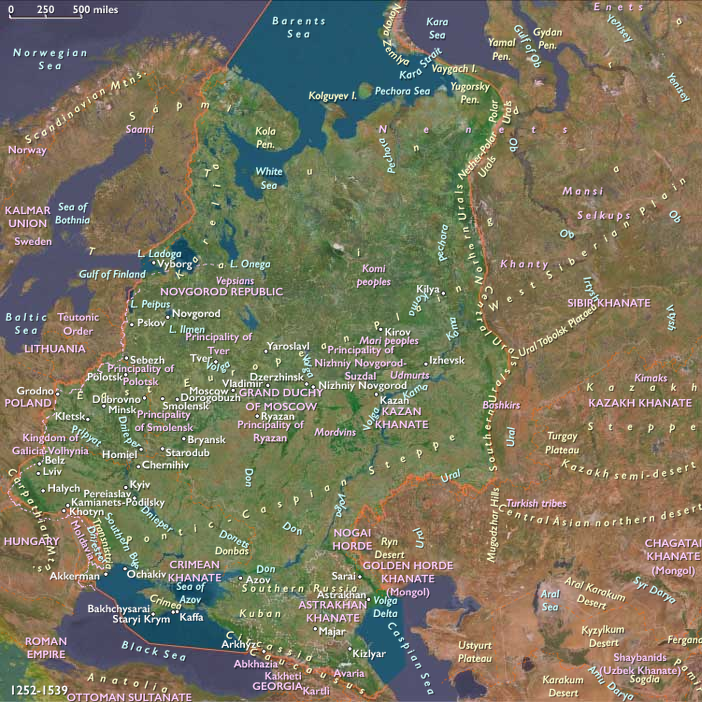
The Crimean Khanate originated in the early …
Years: 1475 - 1475
The Crimean Khanate originated in the early fifteenth century when certain clans of the Golden Horde Empire ceased their nomadic life in the the Kipchak Steppes of today's Ukraine and southern Russia and decided to make Crimea their yurt (homeland).
At that time, the Golden Horde of the Mongol empire had governed the Crimean peninsula as an ulus since 1239, with its capital at Qirim (Staryi Krym).
The local separatists had invited a Genghisid contender for the Golden Horde throne, Hacı Giray, to become their khan.
Accepting their invitation, Hacı Giray had traveled from exile in Lithuania and warred for independence against the Horde from 1420 to 1441, in the end achieving success.
He then had to fight off internal rivals before he could ascend the throne of the khanate in 1449, after which he moved its capital to Qırq Yer (today part of Bahçeseray).
The khanate includes the Crimean Peninsula (except the south and southwest coast and ports, controlled by the Republic of Genoa) as well as the adjacent steppe.
Following the death of Hacı I Giray in 1466, his sons have contended against each other to succeed him.
The Ottomans had intervened and installed one of them, Meñli I Giray, on the throne for some months until he was deposed by his brother Nur Devlet.
Meñli had been restored to the throne in January 1469, but loses power again in March 1475 as a result of a rebellion of the rival brothers and nobility.
In 1475 the Ottoman forces, under the command of Gedik Ahmet Pasha, conquer the Greek Principality of Theodoro and the Genoese colonies at Cembalo, Soldaia, and Caffa (modern Feodosiya).
The Empire annexes the Crimean coast, but recognizes the legitimacy of the khanate rule of the steppes, as the khans are descendants of Genghis Khan.
Henceforth the khanate is a protectorate of the Ottoman Empire.
The Ottoman sultan will wield veto power over the selection of new Crimean khans.
Menli I Giray, now become a vassal of the sultan, takes the imperial title "Sovereign of Two Continents and Khan of Khans of Two Seas."
Related Events
Showing 10 events out of 40831 total
Years: 1475 - 1475
Locations
People
Groups
- Genoa, (Most Serene) Republic of
- Theodoro, Principality of (Gothia)
- Crimean Tatars
- Lithuania, Grand Duchy of
- Crimean Khanate
- Ottoman Empire
Regions
Subregions