The court hearing takes place in Berytos …
Years: 7BCE - 7BCE
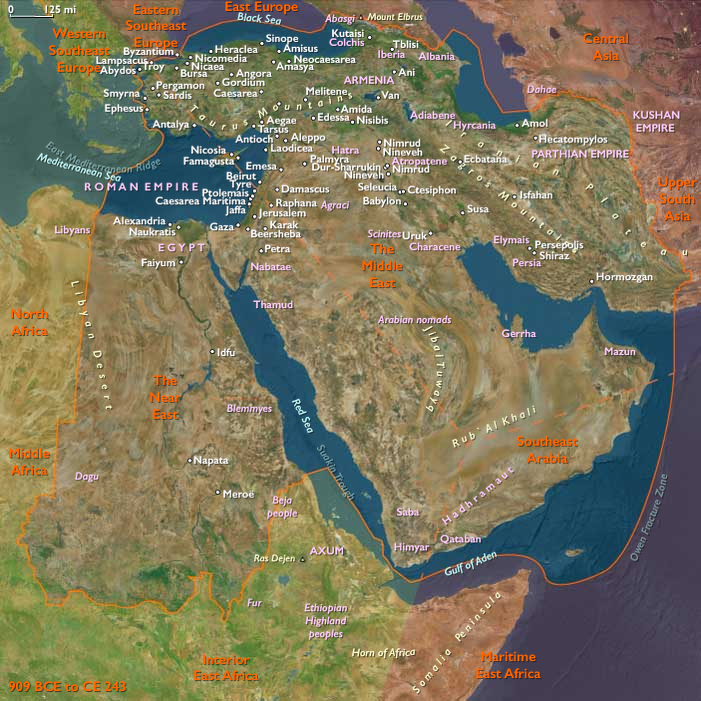
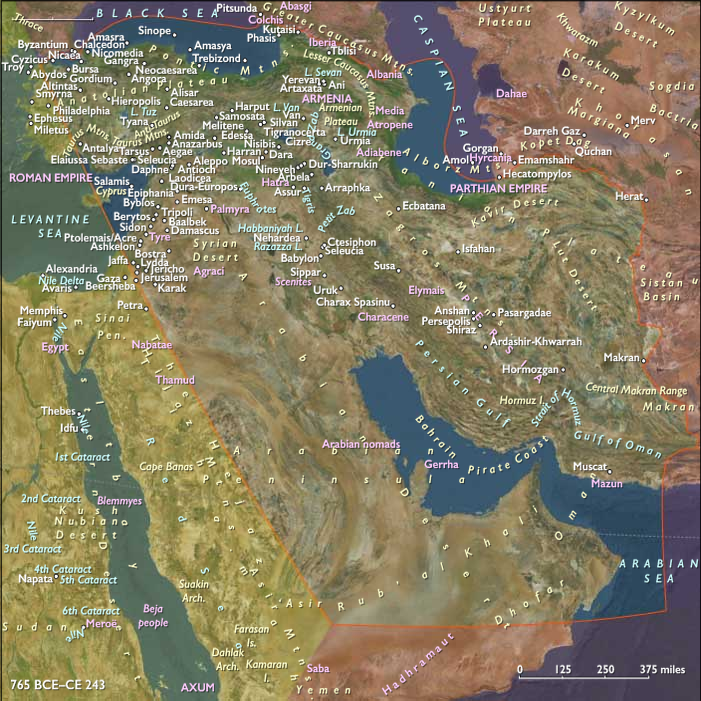
The court hearing takes place in Berytos (Beirut) in 7 BCE before a Roman court, which finds Alexander and Aristobulos guilty.
The succession is changed following their execution so that Antipater, Herod’s son from Doris, is the exclusive successor to the throne.
The succession incorporates Herod Philip, his son from Mariamne II, in second place.
Locations
People
- Alexander (son of Herod)
- Antipater II (son of Herod the Great)
- Aristobulus IV (son of Herod)
- Herod the Great
Groups
Topics
Commodoties
Subjects
Regions
Subregions
Related Events
Filter results
Showing 10 events out of 62102 total
Roman historian Titus Livius, immersed in the past, evidently reads extensively in Greek and Latin literature and had been earlier influenced by Cicero.
His one hundred and forty-two-book history of Rome, despite its republican sentiments, gains the favor of Augustus and is recognized as a classic during the author’s lifetime.
Known in English as Livy, born in Patavium (Padua) in 64 or 59, BCE but having spent most of his life in Rome, he has witnessed the civil wars, the fall of the republic, and the establishment of the principate, but little else is known of his life.
His uncritical History of Rome perpetuates many inaccuracies of earlier writers and demonstrates scant knowledge of military matters, but shows a genius for vivid style and gift for dramatic composition.
Livy covers the period from the arrival of Aeneas in Italy and the "foundation" of the city of Rome to 9 BCE, following an annalistic arrangement of events but focusing on the characters of the leading figures in the episodes.
He presents history through representative individuals and championing the old Roman virtues of discipline, piety, and patriotism.
(Summaries exist of all but one of the original one hundred and forty-two books, but only thirty-five are extant in complete form—Books 1-10, covering 753 to 293 BCE and Books 21-45, dealing with the years 218 to 167 BCE.)
Sadducean opposition to Herod, according to Josephus, had led him to treat the Pharisees favorably (The Antiquities of the Jews, xiv. 9, § 4; xv. 1, § 1; 10, § 4; 11, §§ 5–6).
Herod is an unpopular ruler, perceived as a Roman puppet.
His notorious treatment of his family and of the last Hasmonaeans has further eroded his popularity, despite his restoration and expansion of the Second Temple.
Herod in 6 BCE proceeds harshly against the Pharisees, who reportedly have announced that the birth of the Messiah will mean the end of his rule.
Tiberius, having replaced Drusus in Germany and now the clear candidate for imperial succession, had returned to Rome and been elected consul for a second time in 7 BCE.
He is elevated in 6 BCE to a share in his stepfather's tribunician power and control in the East, all of which mirror positions held previously by the late Marcus Vipsanius Agrippa, the close friend, son-in-law and minister to Augustus.
Shortly afterward, on the verge of accepting command in the East and becoming the second most powerful man in Rome, Tiberius goes into retirement on the island of Rhodes.
This is attributed by some historians to jealousy of his stepnephew Gaius Caesar, adopted by Augustus in this year.
The promiscuous, and very public, behavior of his unhappily married wife, Julia, may have also played a part.
Indeed, Tacitus calls it Tiberius' intima causa, his innermost reason for departing for Rhodes, and seems to ascribe the entire move to a hatred of Julia and a longing for Vipsania, who he had divorced in obedience to the wishes of Augustus.
Tiberius has found himself married to a woman he loathes, who publicly humiliates him with nighttime escapades in the Forum, and forbidden to see the woman he had loved.
Whatever Tiberius's motives, the withdrawal is almost disastrous for Augustus's succession plans.
Gaius and Lucius are still in their early teens, and Augustus, now fifty-seven years old, has no immediate successor.
There is no longer a guarantee of a peaceful transfer of power after Augustus's death, nor a guarantee that his family, and therefore his family's allies, will continue to hold power should the position of princeps survive.
Somewhat apocryphal stories tell of Augustus pleading with Tiberius to stay, even going so far as to stage a serious illness.
Tiberius's response was to anchor off the shore of Ostia until word came that Augustus had survived, then sailing straightway for Rhodes.
With Tiberius's departure, succession rests solely on Augustus' two young grandsons, Lucius and Gaius Caesar.
The Roman plebs agitate for Gaius to be created consul, despite the fact that he is only 14 and has not yet assumed the toga virilis, a plain white toga worn on formal occasions by most Roman men of legal age, generally about fourteen to eighteen years, but it could be any stage in their teens.
The first wearing of the toga virilis is part of the celebrations on reaching maturity.
As a compromise, it is agreed that he should have the right to sit in the Senate House, and he was made consul designatus with the intention that he should assume the consulship in his twentieth year.
Gaius is at this point created "Prince of Youth" ("princeps iuventutis"), an honorific that makes him one of the symbolic heads of the equestrian order.
Antipater, charged with the intended murder of Herod, is in 5 BCE brought before the court at Berytos.
The sentence must first be approved only by the Roman emperor.
Herod, now seriously ill and in excruciating pain from what may be chronic kidney disease complicated by Fournier's gangrene, names as his successor Herod Antipas, his son by his fourth wife, Malthace.
In Gades, (modern Cádiz) and …
…Carthago Nova (modern Cartagena) Spain, Mauretanian client king Juba II is appointed by Augustus as an honorary Duovir, described as a chief magistrate of a Roman colony or town, most probably involved with trade and also a Patronus Colonaie.
Controversy surrounds the exact date of the death of Juba II’s queen Cleopatra Selene II.
An epigram by Greek Epigrammatist Crinagoras of Mytilene is considered to be Cleopatra’s eulogy (D. W. Roller, The World of Juba II and Kleopatra Selene [London 2003]; p. 249–51): The moon herself grew dark, rising at sunset, Covering her suffering in the night, Because she saw her beautiful namesake, Selene, Breathless, descending to Hades, With her she had had the beauty of her light in common, And mingled her own darkness with her death.
If this poem is not simply literary license, then astronomical correlation can be used to help pinpoint the date of Cleopatra's death.
Lunar eclipses occurred in 9, 8, 5 and 1 BCE and CE 3, 7, 10, 11 and 14.
The event in 5 BCE most closely resembles the description given in the eulogy, but the date of her death cannot be ascertained with any certainty When Cleopatra dies, she is placed in the Royal Mausoleum, east of Caesarea, that had been built by her and Juba, which is still visible.
A fragmentary inscription is dedicated to Juba and Cleopatra as the King and Queen of Mauretania.
The Pharisees, according to Josephus, ultimately opposed Herod and thus in 4 BCE fell victims to his bloodthirstiness ("The Antiquities of the Jews, xvii. 2, § 4; 6, §§ 2–4).
Young students of the Torah smash the golden eagle over the main entrance of the Temple of Jerusalem after the Pharisee teachers claim that is a Roman symbol.
Herod has the students arrested, brought to trial, and punished.
The family of Boethus, whom Herod had raised to the high-priesthood, revives the spirit of the Sadducees, and henceforth the Pharisees will again have them as antagonists (The Antiquities of the Jews, xviii. 1, § 4).
Augustus in this year approves of the death penalty for Antipater, who Herod executes.
Having thus executed his sole heir, Herod again changes his will: Archelaus (from the marriage with Malthace) is to rule as king over Herod's entire kingdom, while Antipas (from Malthace) and Philip (from the fifth marriage with Cleopatra of Jerusalem) as Tetrarchs over Galilee and Peraea, also over Gaulanitis (Golan), Trachonitis (Hebrew: Argob), Batanaea (now Ard-el-Bathanyeh) and Panias.
Salome I is also given a small toparchy in the Gaza region.
Since the work of Emil Schürer in 1896 (Emil Schürer, A History of the Jewish People in the Time of Jesus Christ, 5 vols. New York, Scribner’s, 1896) most scholars have agreed that Herod died at the end of March or early April in 4 BCE.
However, Schürer's consensus did not go unchallenged in the twentieth century, with several scholars endorsing 1 BCE as the year of Herod's death.
Evidence for the 4 BCE date is provided by the fact that Herod's sons, between whom his kingdom is divided, date their rule from 4 BCE, and Archslaus apparently also exercised royal authority during Herod's lifetime.
Josephus states that Philip the Tetrarch's death took place in 34 CE after a thirty-seven-year reign, in the twentieth year of Tiberius; he also writes that Herod's final illness was excruciating.
Modern scholars agree he suffered throughout his lifetime from depression and paranoia.
More recently, others report that the visible worms and putrefaction described in his final days are likely to have been scabies; the disease might have accounted for both his death and psychiatric symptoms.
Similar symptoms will attend the death of his grandson Agrippa I in CE 44.
Josephus also states that Herod was so concerned that no one would mourn his death, that he commanded a large group of distinguished men to come to Jericho, and he gave order that they should be killed at the time of his death so that the displays of grief that he craved would take place.
Fortunately for them, Herod's son Archelaus and sister Salome do not carry out this wish.
Archelaus is proclaimed king by the army, but declines to assume the title until he has submitted his claims to Augustus in Rome.
Before setting out, he quells with the utmost cruelty a sedition of the Pharisees, slaying nearly three thousand of them.
Herod's plans for the succession have to be ratified by Augustus because of Judea's status as a Roman client kingdom,
The three heirs therefore travel to Rome to make their claims, Antipas arguing he ought to inherit the whole kingdom and the others maintaining that Herod's final will ought to be honored.
Despite qualified support for Antipas from Herodian family members in Rome, who favor direct Roman rule of Judea but consider Antipas preferable to his brother, Augustus largely confirms the division of territory set out by Herod in his final will.
Archelaus has, however, to be content with the title of ethnarch rather than king.
Augustus allots to Archelaus the greater part of the kingdom (Judea and Idumea, which are Jewish, and Samaria, which is not).

Antipas, as tetrarch, receives Galilee and Peraea (east of the Jordan River).
These territories are separated by the region of the Decapolis, with Galilee to the north and Perea to the south.
The non-Jewish areas (except Samaria) are assigned to a third son, Philip, to Herod's sister Salome, or to the province of Syria.
Philip is to rule Trachonitis, Batanaea, and Auranitis, the area between the Decapolis and Damascus.
Years: 7BCE - 7BCE
Locations
People
- Alexander (son of Herod)
- Antipater II (son of Herod the Great)
- Aristobulus IV (son of Herod)
- Herod the Great