
The country known as Sumer is, by …
Years: 3069BCE - 2926BCE
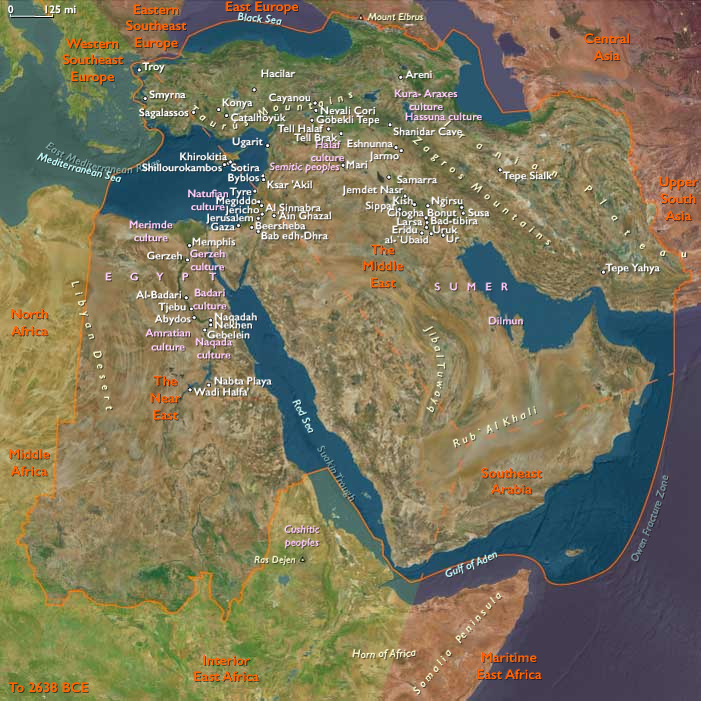
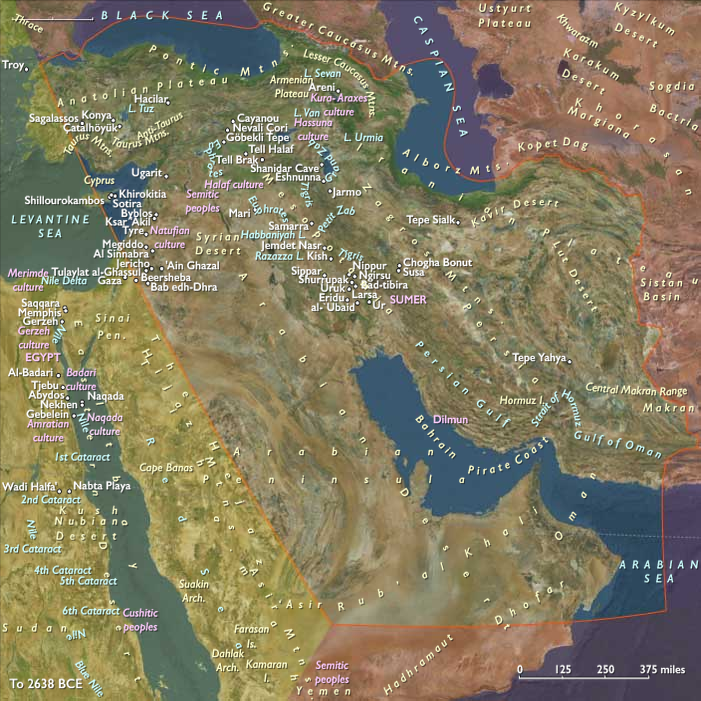
The country known as Sumer is, by the third millennium the site of at least twelve separate city-states, each comprising a walled city and its surrounding villages and land, and each worshipping its own deity, whose temple is the central structure of the city.
Sippar (present Abu Habba), located twenty miles (thirty-two kilometers) southwest of present Baghdad, Iraq, is probably occupied before 3000.
Given that thousands of cuneiform tablets have been recovered at the site, relatively little is known about the history of Sippar.
As was often the case in Mesopotamia, it was part of a pair of cities, separated by a river.
Sippar was on the east side of the Euphrates, while its sister city, Sippar-Amnanum, was on the west.
While pottery finds indicate that the site of Sippar was in use as early as the Uruk period, substantial occupation occurred only in the Early Dynastic period of the third millennium BCE.
The five "first" cities said to have exercised pre-dynastic kingship are Sippar (Tell Abu Habbah), …
Locations
Groups
- Polytheism (“paganism”)
- Eridu, City-state of
- Nippur, city-state of
- Kish, City-state of
- Jemdet Nasr period
- Isin, city-state of
Topics
- Piora Oscillation ending the Neolithic Subpluvial
- Early Bronze Age II (Near and Middle East)
- Subboreal Period
Commodoties
Subjects
Regions
Subregions
Years: 3069BCE - 2926BCE
Locations
Groups
- Polytheism (“paganism”)
- Eridu, City-state of
- Nippur, city-state of
- Kish, City-state of
- Jemdet Nasr period
- Isin, city-state of
Topics
- Piora Oscillation ending the Neolithic Subpluvial
- Early Bronze Age II (Near and Middle East)
- Subboreal Period
Commodoties
Subjects
Regions
Subregions