
Filters:
The military successes of the War of …
Years: 1749 - 1749
The military successes of the War of the Austrian Succession had inclined the French public to overlook Louis' adulteries, but after 1748, in the wake of the anger over the terms of the Treaty of Aix-la-Chapelle, pamphlets against the king's mistresses become increasingly widely published and read.
Jeanne-Antoinette Poisson, later the Marquise de Pompadour, who had met Louis XV in February 1745 at a masked ball given in honor of the marriage of the Dauphin, is one of the most famous mistresses of the reign.
She is the daughter of a chief agent of the powerful Paris family of financiers who had become embroiled in the intrigue that had ousted the Duke of Bourbon as a state minister in favor of Cardinal Fleury.
Starting in 1743 with the death of Fleury, the king had ruled alone without a first minister.
He had read many times the instructions of Louis XIV: "Listen to the people, seek advice from your Council, but decide alone."
His political correspondence reveals his deep knowledge of public affairs as well as the soundness of his judgement.
Most government work is conducted in committees of ministers that meet without the king.
The king reviews policy only in the Conseil d'en haut, the High Council, which is composed of the king, the Dauphin, the chancellor, the finance minister, and the foreign minister.
Created by Louis XIV, the council is in charge of state policy regarding religion, diplomacy, and war.
Here, he lets various political factions oppose each other and vie for influence and power: on the broadest level, the dévot party, led by the Comte d'Argenson, secretary of state for war, opposes the parti philosophique, which supports Enlightenment philosophy and is led by finance minister Jean Baptiste de Machault D'Arnouville.
The parti philosophique is supported by the Marquise de Pompadour, who has acted as a sort of minister without portfolio from the time she became royal mistress in 1745.
The Marquise is in favor of reforms.
Supported by her clan of financiers (Pâris-Duverney, Montmartel, etc.), she obtains from the king the appointment of ministers as well as their dismissal (such as Philippe Orry in 1745 and the Navy secretary Maurepas in 1749).
On her advice, the king supports the policy of fiscal justice designed by Machault d'Arnouville.
In order to finance the budget deficit, which amounts to one hundred million livres in 1745, Machault d'Arnouville had created a tax on the twentieth of all revenues that affect the privileged classes as well as commoners.
This breach in the privileged status of the aristocracy and the clergy, normally exempt from taxes, is a first in French history, although it had already been advocated by men such as Vauban under Louis XIV.
However, the new tax is received with violent protest from the privileged classes sitting in the estates of the few provinces that still retain the right to decide over taxation (most provinces had long lost their provincial estates and the right to decide over taxation).
The new tax is also opposed by the clergy and by the parlements.
Jeanne-Antoinette Poisson, later the Marquise de Pompadour, who had met Louis XV in February 1745 at a masked ball given in honor of the marriage of the Dauphin, is one of the most famous mistresses of the reign.
She is the daughter of a chief agent of the powerful Paris family of financiers who had become embroiled in the intrigue that had ousted the Duke of Bourbon as a state minister in favor of Cardinal Fleury.
Starting in 1743 with the death of Fleury, the king had ruled alone without a first minister.
He had read many times the instructions of Louis XIV: "Listen to the people, seek advice from your Council, but decide alone."
His political correspondence reveals his deep knowledge of public affairs as well as the soundness of his judgement.
Most government work is conducted in committees of ministers that meet without the king.
The king reviews policy only in the Conseil d'en haut, the High Council, which is composed of the king, the Dauphin, the chancellor, the finance minister, and the foreign minister.
Created by Louis XIV, the council is in charge of state policy regarding religion, diplomacy, and war.
Here, he lets various political factions oppose each other and vie for influence and power: on the broadest level, the dévot party, led by the Comte d'Argenson, secretary of state for war, opposes the parti philosophique, which supports Enlightenment philosophy and is led by finance minister Jean Baptiste de Machault D'Arnouville.
The parti philosophique is supported by the Marquise de Pompadour, who has acted as a sort of minister without portfolio from the time she became royal mistress in 1745.
The Marquise is in favor of reforms.
Supported by her clan of financiers (Pâris-Duverney, Montmartel, etc.), she obtains from the king the appointment of ministers as well as their dismissal (such as Philippe Orry in 1745 and the Navy secretary Maurepas in 1749).
On her advice, the king supports the policy of fiscal justice designed by Machault d'Arnouville.
In order to finance the budget deficit, which amounts to one hundred million livres in 1745, Machault d'Arnouville had created a tax on the twentieth of all revenues that affect the privileged classes as well as commoners.
This breach in the privileged status of the aristocracy and the clergy, normally exempt from taxes, is a first in French history, although it had already been advocated by men such as Vauban under Louis XIV.
However, the new tax is received with violent protest from the privileged classes sitting in the estates of the few provinces that still retain the right to decide over taxation (most provinces had long lost their provincial estates and the right to decide over taxation).
The new tax is also opposed by the clergy and by the parlements.
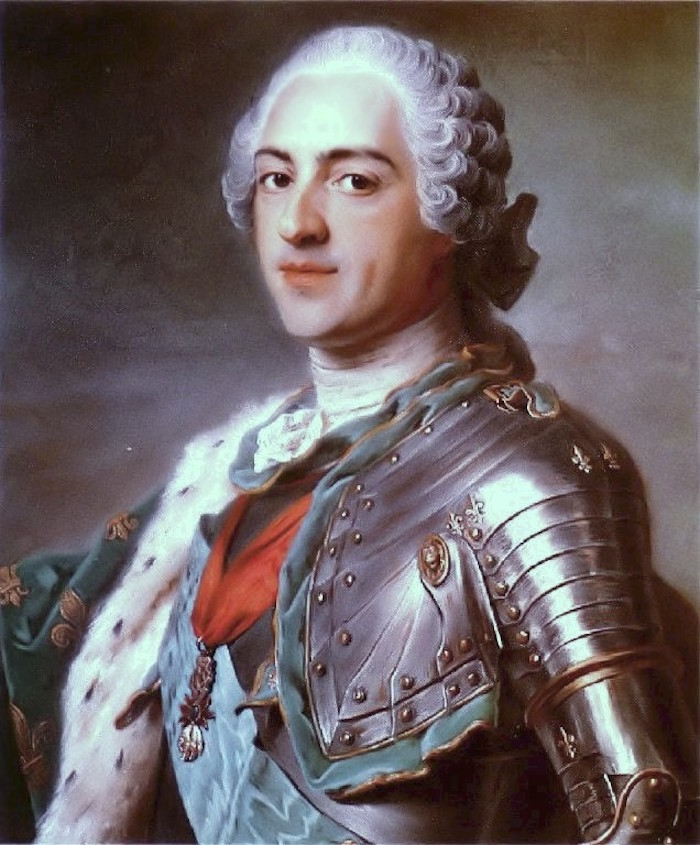
Maurice Quentin de La Tour: Portrait of Louis XV of France (1748). Pastel sur papier gris-bleu collé en plein sur une toile tendue sur châssis. 60 × 54 cm (23.6 × 21.3 in). Louvre Museum
Locations
People
Groups
Topics
Commodoties
Subjects
Regions
Subregions
Years: 1749 - 1749
Maurice Quentin de La Tour: Portrait of Louis XV of France (1748). Pastel sur papier gris-bleu collé en plein sur une toile tendue sur châssis. 60 × 54 cm (23.6 × 21.3 in). Louvre Museum
Locations
People
Groups
Topics
Commodoties
Subjects
Regions
Subregions