
The Cornish Rebellion of 1497 (Cornish: Rebellyans …
Years: 1497 - 1497
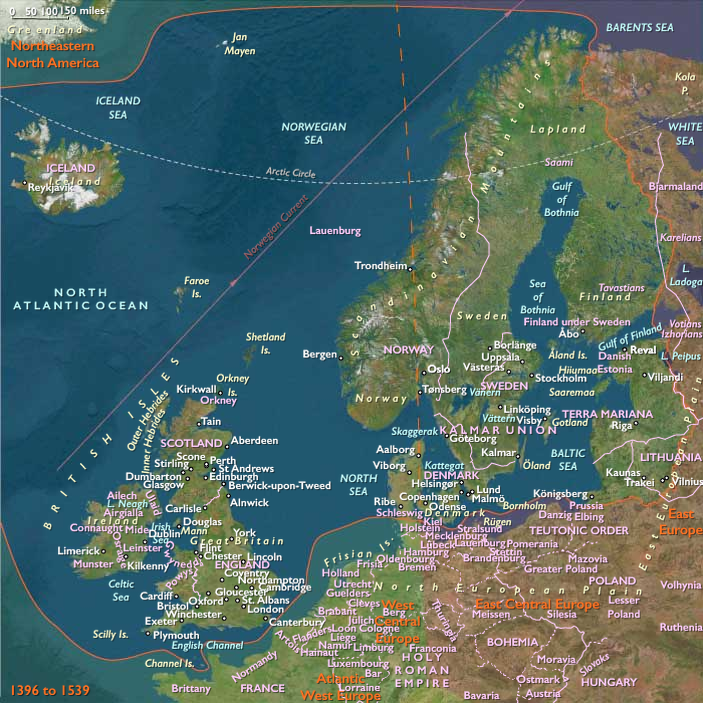
The Cornish Rebellion of 1497 (Cornish: Rebellyans Kernow) is a popular uprising by the people of Cornwall in the far southwest of Britain.
Its primary cause is a response of people to the raising of war taxes by King Henry VII on the impoverished Cornish, to raise money for a campaign against Scotland, motivated by brief border skirmishes that are inspired by Perkin Warbeck's pretense to the English throne.
Tin miners are angered as the scale of the taxes overturns previous rights granted by Edward I of England to the Cornish Stannary Parliament, which exempted Cornwall from all taxes of tenths or fifteenths of income.
The Cornish have little sympathy for English wars against Scotland, considering that most Cornish are not English speakers at this time.
People
Groups
Topics
Commodoties
Subjects
Regions
Subregions
Related Events
Filter results
Showing 10 events out of 40144 total
Most territories around Babur’s kingdom are ruled by his relatives, who are descendants of either Timur or Genghis Khan, and are constantly in conflict.
At this time, rival princes are fighting over the city of Samarkand to the west, which is ruled by his paternal cousin.
Babur has a great ambition to capture it and in 1497, he besieges Samarkand for seven months before eventually gaining control over it.
He was fifteen years old and for him, this campaign is a huge achievement.
Babur is able to hold it despite desertions in his army but later falls seriously ill.
Meanwhile, a rebellion back home, approximately three hundred and fifty kilometers (two hundred and twenty miles away, among nobles who favor his brother, robs him of Fergana.
As he is marching to recover it, he loses Samarkand to a rival prince, leaving him with neither Fergana nor Samarkand.
He had held Samarkand for one hundred days and will always consider this defeat as his biggest loss, obsessing over it even later in his life after his conquests in India.
Ivan III had unsuccessfully attempted to conquer Viborg from Sweden in the Russo-Swedish War of 1495–1497, but this attempt had been checked by the Swedish garrison in Viborg Castle led by Lord Knut Posse.
The Kalmar Union’s King John, titular elected monarch of Denmark, Norway, and Sweden for the past sixteen years, grows impatient with the vacillations of Sweden’s long-ruling regent, Sten Sture the Elder, who has continued to deny John the rulership of Sweden.
In 1497, John and his forces seize Kalmar, the union’s political center, in southeastern Sweden.
Sweden’s regent, Sten Sture the Elder, retaliates for the Danish seizure of Kalmar by laying siege to the Swedish coronation center of Uppsala, and intercepts John’s forces as they advance on the main Swedish commercial center of Stockholm.
The Danes, however, defeat Sture’s Dalecarlian (Darlarnan) reinforcements before they can link with the main Swedish forces.
Sture accepts defeat.
King John Albert of Poland, the son and successor of Casimir, had begun military preparations for a new raid into Ottoman-held Moldavia in 1494, despite a three-year truce, signed on April 6 of that year.
Moldavian ruler Stephen III has promised to help the Poles as soon as they reach the Black Sea ports.
It has taken Poland three years to complete preparations.
Its army is composed of Polish Crown forces, aided by a number of foreign mercenaries, four hundred Teutonic Knights under Grand Master Johann von Tieffen, and a six hundred-strong unit from Mazovia.
Altogether, the Polish army is some forty thousand strong, with two hundred cannon.
Polish units of the pospolite ruszenie, the name for the mobilization of armed forces during the period of the Kingdom of Poland and the Polish-Lithuanian Commonwealth, had gathered in May–June 1497 in Podolia, and in early August of this year, the army crosses the Dniestr river, entering Moldavia.
However, Stephan, suspecting that the Polish monarch wants to depose him, resists the invading Poles.
On September 24, 1497, the Polish army begins the siege of Suceava, which is a failure, and on October 19 the Poles begin to retreat.
Pope Alexander VI excommunicates Savonarola on May 12, 1497, and threatens the Florentines with an interdict if they persist in harboring him, but, when this censure is published in Florence, a defiant Savonarola denies its validity.
His intransigence soon alienates his supporters in the Florentine government.
Lucrezia Borgia was born at Subiaco, near Rome, to Vannozza dei Cattanei, one of the mistresses of Lucrezia's father Rodrigo, who now reigns Pope Alexander VI.
A matrimonial arrangement had been drawn up on February 26, 1491, between Lucrezia and the Lord of Val D'Ayora in the kingdom of Valencia, Don Cherubino Joan de Centelles, which had been annulled less than two months later in favor of a new contract engaging Lucrezia to Don Gaspare Aversa, count of Procida.
When Rodrigo became pope later in 1491, he sought to be allied with powerful princely families and founding dynasties of Italy.
As such, he had called off Lucrezia's previous engagements and arranged for her to marry Giovanni Sforza, a member of the House of Sforza who is Lord of Pesaro and titled Count of Catignola.
Giovanni is an illegitimate son of Costanzo I Sforza and a Sforza of the second rank.
He had married Lucrezia on June 12, 1493 in Rome.
Before long, the Borgia family no longer needed the Sforzas, and the presence of Giovanni Sforza in the papal court has become superfluous.
Giovanni had refused to agree to an annulment of the marriage and accused Lucrezia of paternal and fraternal incest.
The pope asserted that his daughter's marriage had not been consummated and was thus invalid.
Giovanni was offered her dowry in return for his cooperation.
The Sforza family had threatened to withdraw their protection should he refuse.
In March 1497, Giovanni had finally signed confessions of impotence and documents of annulment before witnesses.
Plans for the conquest of Melilla, a port on the Mediterranean coast of Morocco, known to the Phoenicians as Rusaddir, and successively held by the Carthaginians, Romans, Byzantines, and Moors, had been laid juts after the Fall of Granada in 1492.
Spanish captains Lezcano and Lorenzo Zafra had visited the coast of Northwestern Africa to identify possible locations for the Spanish to conquere, and Melilla had been identified as a prime candidate.
However, Melilla was in the Portuguese zone of influence under the terms of the 1479 Treaty of Alcáçovaz.
At Tordesillas in 1494, the Portuguese ruler had agreed to make an exception and permitted the Spanish to attempt the conquest of Melilla.
Melilla is part of the Wattasid Sultanate of Morocco when the Catholic Monarchs, Queen Isabella I of Castile and King Ferdinand II of Aragon, request of Juan Alfonso Pérez de Guzmán, 3rd Duke of Medina Sidonia, to take the city.
The duke disparches Pedro Estopiñán, who conquers the city virtually without a fight in 1497, as internal conflicts had depleted it of troops, and its defenses had been weakened.
The Moroccan Wattasid ruler Muhammad al-Shaykh sends a detachment of cavalrymen to retake control of the city, but they are repulsed by the guns of the Spanish ships.
Death and Legacy of Jean d'Ockeghem (c. 1497)
Jean d'Ockeghem, an innovative and highly celebrated Flemish composer, died around 1497, leaving behind a significant musical legacy, including approximately twenty chansons, fourteen complete masses, and around ten motets.
Renowned especially for his mastery in composing masses, Ockeghem explored various compositional techniques, notably the use of the cantus firmus method. His surviving Requiem is the earliest known musical setting of that text, following the loss of an earlier setting by Guillaume Dufay. Ockeghem’s style was distinctly romantic and experimental, marked by a characteristic avoidance of frequent cadences and continuous, overlapping phrases across different voice parts.
Ockeghem likely studied with or was closely associated with the composer Gilles Binchois at the Burgundian court. He was also connected with Antoine Busnois, who composed a motet honoring Ockeghem prior to 1467. Contemporary writings frequently link Dufay, Busnois, and Ockeghem, reflecting a lineage of musical influence. Despite stylistic differences, Ockeghem inherited fundamental techniques from this older generation, thereby bridging the Burgundian musical tradition with subsequent Netherlandish composers such as Jacob Obrecht and Josquin des Prez.
Ockeghem served prominently at the French royal court under kings Charles VII and Louis XI, and also held positions at Notre Dame de Paris and St. Benoît. In 1470, he participated in a diplomatic mission to Spain on behalf of Louis XI, aiming to prevent an alliance between Spain, England, and Burgundy against France, and to negotiate the marriage of Isabella I of Castile to Charles, Duke of Guyenne, Louis XI's brother.
After Louis XI's death in 1483, precise details about Ockeghem's activities are scarce, though he is known to have visited Bruges and Tours. He likely died in Tours, where his will was made.
Ockeghem’s considerable reputation is demonstrated by the numerous laments written upon his death in 1497. The most notable among these is Josquin des Prez’s widely admired musical setting, Nymphes des bois, which memorializes Ockeghem’s profound influence on Renaissance music.
The Arrival of Syphilis in England and the Low Countries (1497)
In 1497, the impact of the syphilis epidemic, first documented following European encounters with the Americas in 1493, extended into Atlantic West Europe, profoundly influencing the region’s social and medical landscape. Initially termed the French Disease or Morbus Gallicus, reflecting prevailing geopolitical hostilities, syphilis rapidly transcended national boundaries, highlighting the interconnectedness of trade routes and military exchanges that facilitated its spread.
The disease posed significant medical challenges, compelling physicians to reconsider traditional practices and spurring advancements in medical knowledge and public health measures. Treatments were largely ineffective, often toxic, and included remedies involving mercury, which frequently worsened patients' conditions. This period thus marked an intensified engagement with medical experimentation, laying the groundwork for developments in epidemiology and public health.
Culturally, syphilis's arrival heightened societal anxieties, influencing artistic expressions and moral discourses that framed the disease as divine punishment for moral failings, further stigmatizing affected populations.
Consequences and Legacy:
The epidemic's severity led to increased scrutiny of public hygiene, gradual improvements in medical care, and a shift toward a more systematic approach to disease management. The syphilis epidemic underscores the broader narrative of the dramatic, often tragic interactions resulting from Europe’s expanding global connections during the late medieval and early modern periods.
