
Alaungpaya, his forces welled by levies from …
Years: 1755 - 1755
January
Locations
People
Groups
- Mon people
- Kachin people
- Bamar or Burmans
- Mon Kingdoms
- Shan people
- Myanmar (Burma), (Toungoo dynasty) Kingdom of
- Shan States
- Ava, Toungoo dynastic state of
- Chinese Empire, Qing (Manchu) Dynasty
- East India Company, British (United Company of Merchants of England Trading to the East Indies)
- French Company of the Indies
- Manipur, Kingdom of
- Hanthawaddy Kingdom, Restored, or Pegu (Bago), (restored) Mon Kingdom of
- Myanmar (Burma), (Alaungpaya, or Konbaung dynasty) Kingdom of
Topics
- Colonization of Asia, Dutch
- Colonization of Asia, French
- Colonization of Asia, British
- Konbaung–Hanthawaddy War
Commodoties
Subjects
Regions
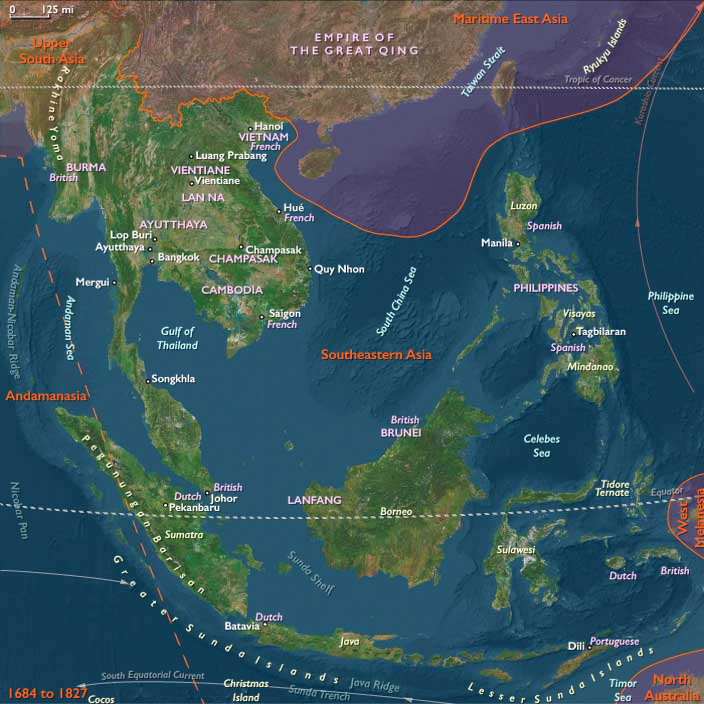
Subregions
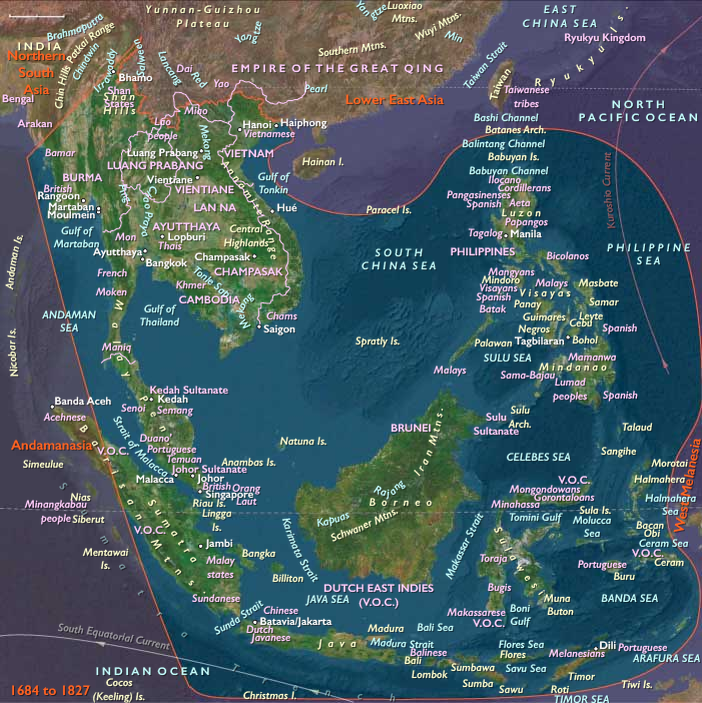
Related Events
Filter results
Showing 10 events out of 26883 total
The VOC decided that it did have not the military capability to suppress this rebellion, though in 1752, Mas Said had broken away from Hamengkubuwana.
All parties were tired of war by 1754 and ready to negotiate.
The kingdom of Mataram is divided in 1755 under an agreement signed in Giyanti between the Dutch under the Governor General Nicolaas Hartingh and rebellious prince Mangkubumi.
The treaty divides nominal control over central Java between Surakarta, under Pakubuwana, and ...
The Qing dynasty has gone to war against the Dzungars, who live in the area stretching from the west end of the Great Wall of China to present-day eastern Kazakhstan and from present-day northern Kyrgyzstan to southern Siberia (most of which is located in present-day Xinjiang).
They are the last nomadic empire to threaten China, which they have done from the early seventeenth century.
Amursana had suffered several defeats at the hands of Dawachi and was thus forced to flee with his small army to the protection of the Qing imperial court.
The Yongzheng Emperor's successor, the Qianlong Emperor, has pledged his to support Amursana, who recognizes Qing authority; among those who support Amursana and the Chinese are the Khoja brothers Burhān al-Dīn and Khwāja-i Jahān.
Khan Khoja is kept as hostage whereas Burhan-ud-din is sent with Oirat, Chinese and Turks to re-conquer the Altishah, the six oasis towns along the rim of the Tarim Basin.
Qianlong in 1755 sends the Manchu general Zhaohui, who is aided by Amursana, Burhān al-Dīn and Khwāja-i Jahān, to lead a campaign against the Dzungars.
After several skirmishes and small scale battles along the Ili River, the Qing army led by Zhaohui approaches Ili (Gulja; modern Yining City) and forces Dawachi to surrender.
Qianlong appoints Amursana as the Khan of Khoid and one of four equal khans—much to the displeasure of Amursana, who had wanted to be the Khan of the Dzungars.
Cronstedt gives the name tung sten (meaning heavy stone) in 1755 to scheelite, one of the mineral forms of the undiscovered element now known as tungsten in English, French, and many other languages as the name of the element, but not in the Nordic countries.
The alternative name "wolfram" (or "volfram") is used in most European (especially Germanic and Slavic) languages, and is derived from the mineral wolframite, which is the origin of its chemical symbol, W.
The name "wolframite" is derived from German "wolf rahm" ("wolf soot" or "wolf cream"), the name given to tungsten by Johan Gottschalk Wallerius in 1747.
This, in turn, derives from "lupi spuma", the name Georg Agricola used for the element in 1546, which translates into English as "wolf's froth", and is a reference to the large amounts of tin consumed by the mineral during its extraction.
Ahmad Shah, who, unlike his Iranian predecessor, has little interest in the area west of Afghanistan, is principally concerned with creating a state that will lie astride the major overland trade routes that pass from northern India to Central and western Asia.
Qandahar is naturally important in this scheme, but a great deal of attention must also be paid to such centers in North India as Multan and Lahore.
Therefore, Ahmad Shah has mounted nine and possibly ten expeditions to the Punjab, beginning with the first year of his reign, after he had taken Kabul in 1747.
In the same way that the Powindah (pastoral nomads) annually migrate from Afghanistan to India in the agricultural off-season, the Abdali-led armies always set out to the east in autumn and winter; when summer's heat approaches, they beat a tactical retreat to the Afghanistan hill country.
Inoculation for smallpox had been introduced in Rome in 1754, but the practice is halted after appearing to cause a number of deaths.
Johnson's famous dictionary comes out in two forms.
The first is the 1755 Folio edition, which comes in two large volumes on April 15.The folio edition also features full literary quotes by those authors that Johnson quoted, such as Dryden and Shakespeare.
It is followed a few weeks later by a second edition published in one hundred and sixty-five weekly parts.
The original goal had been to publish the dictionary in two folio volumes: A–K and L–Z, but this had soon proved unwieldy, unprofitable, and unrealistic.
No bookseller could possibly hope to print this book without help; outside a few special editions of the Bible no book of this heft and size had even been set to type.
In spite of its shortcomings, the dictionary is far and away the best of its day.
Its scope and structure will be carried forward in dictionaries that followed, including Noah Webster's Webster's Dictionary in 1828 and the Oxford English Dictionary later in the same century.
There was from the beginning universal appreciation not only of the content of the Dictionary but also of Johnson's achievement in single-handedly creating it.
Reviews, such as they were, proved generous in tone.Despite the Dictionary's critical acclaim, Johnson's general financial situation will continue in its dismal fashion for some years after 1755.
Joseph Black describes his discovery of carbon dioxide ("fixed air") and magnesium in a paper to the Philosophical Society of Edinburgh in 1755.
The Scottish chemist has observed that magnesia, now known to be a compound of magnesium, gives rise to a soluble sulfate, whereas that derived from lime (which is now known to be calcium oxide) is known to be insoluble.
Magnesia is thus shown to be an alkaline earth different from lime.
after war broke out between the French and British, and their respective native allies, servingunder Captain Hugh Waddell on the North Carolina frontier.
Waddell's unit is assigned to serve in the command of General Edward Braddock in 1755, and Boone acts as a wagoner, along with his cousin Daniel Morgan, who will later be a key general in the American Revolution.
In the Battle of the Monongahela, the denouement of the campaign and a bitter defeat for the British, Boone narrowly escapes death when the baggage wagons are assaulted by native troops.
Boone will remain critical of Braddock's blunders for the rest of his life.
While on the campaign, Boone had met John Finley, a packer who works for George Croghan in the trans-Appalachian fur trade.
Finley first interests Boone in the abundance of game and other natural wonders of the Ohio Valley.
Finley will take Boone on his first fateful hunting trip to Kentucky twelve years later.
Boone is of English and Welsh ancestry.
Because the Gregorian calendar was adopted during his lifetime, Boone's birth date is sometimes given as November 2, 1734 (the "New Style" date), although Boone used the October date.
The Boone family belongs to the Religious Society of Friends, called "Quakers", and had been persecuted in England for their dissenting beliefs.
Daniel's father, Squire (his first name, not a title) Boone (1696–1765) had emigrated from the small town of Bradninch, Devon (near Exeter, England) to Pennsylvania in 1713, to join William Penn's colony of dissenters.
Squire Boone's parents, George Boone III and Mary Maugridge, had followed their son to Pennsylvania in 1717, and in 1720 built a log cabin at Boonecroft.
In 1720, Squire Boone, who worked primarily as a weaver and a blacksmith, married Sarah Morgan (1700–77).
Sarah's family were Quakers from Wales, and had settled in 1708 in the area that will become Towamencin Township of Montgomery County.
In 1731, the Boones moved to the Oley Valley, near the modern city of Reading.
There they built a log cabin, partially preserved today as the Daniel Boone Homestead.
Daniel, the sixth of eleven children, spent his early years on what was then the edge of the frontier.
Several Lenape villages were nearby.
The pacifist Pennsylvania Quakers had good relations with the natives, but the steady growth of the white population had compelled many natives to move further west.
Boone had been given his first rifle at the age of twelve, as families depend on hunting for much of their food.
He had learned to hunt from both local settlers and the Lenape.
Folk tales have often emphasized Boone's skills as a hunter.
In one story, the young Boone was hunting in the woods with some other boys, when the howl of a panther scattered all but Boone.
He calmly cocked his rifle and shot the predator through the heart just as it leaped at him.
The validity of this claim is contested, but the story will be told so often that it will become part of his popular image.
In Boone's youth, his family became a source of controversy in the local Quaker community when two of the oldest children married outside the endogamous community, in present-day Lower Gwynedd Township, Pennsylvania.
In 1742, Boone's parents had been compelled to publicly apologize after their eldest child, Sarah, married John Willcockson, a "worldling" (non-Quaker).
Because the young couple had "kept company", they were considered "married without benefit of clergy".
When the Boones' oldest son Israel married a "worldling" in 1747, Squire Boone stood by him.
Both men were expelled from the Quakers; Boone's wife continued to attend monthly meetings with their younger children.
In 1750, Squire Boone sold his land and moved the family to North Carolina.
Daniel Boone did not attend church again.
He identifies as a Christian and will have all of his children baptized.
The Boones had eventually settled on the Yadkin River, in what is now Davie County, about two miles (three kilometers) west of Mocksville.
This is in the western backwoods area.
Because he grew up on the frontier, Boone had had little formal education, but deep knowledge of the woods.
According to one family tradition, a schoolteacher once expressed concern over Boone's education, but Boone's father said, "Let the girls do the spelling and Dan will do the shooting."
Boone had received some tutoring from family members, though his spelling remains unorthodox.
The historian John Mack Faragher cautions that the folk image of Boone as semi-literate is misleading, and argues that he "acquired a level of literacy that was the equal of most men of his times."
Boone regularly takes reading material with him on his hunting expeditions—the Bible and Gulliver's Travels are favorites.
He is often the only literate person in groups of frontiersmen.
Boone will sometimes entertain his hunting companions by reading to them around the evening campfire.
Years: 1755 - 1755
January
Locations
People
Groups
- Mon people
- Kachin people
- Bamar or Burmans
- Mon Kingdoms
- Shan people
- Myanmar (Burma), (Toungoo dynasty) Kingdom of
- Shan States
- Ava, Toungoo dynastic state of
- Chinese Empire, Qing (Manchu) Dynasty
- East India Company, British (United Company of Merchants of England Trading to the East Indies)
- French Company of the Indies
- Manipur, Kingdom of
- Hanthawaddy Kingdom, Restored, or Pegu (Bago), (restored) Mon Kingdom of
- Myanmar (Burma), (Alaungpaya, or Konbaung dynasty) Kingdom of
Topics
- Colonization of Asia, Dutch
- Colonization of Asia, French
- Colonization of Asia, British
- Konbaung–Hanthawaddy War
