
The constitutional basis of Octavian's power will …
Years: 27BCE - 27BCE
The constitutional basis of Octavian's power will remain a continuous succession of consulships from 31 until 23 BCE, but he he ostensibly “transfers the State to the free disposal of the Senate and people” in January 27, earning the misleading, though outwardly plausible, tribute that he has restored the republic.
The Senate implores him not to abandon the state—which he has absolutely no intention of doing.
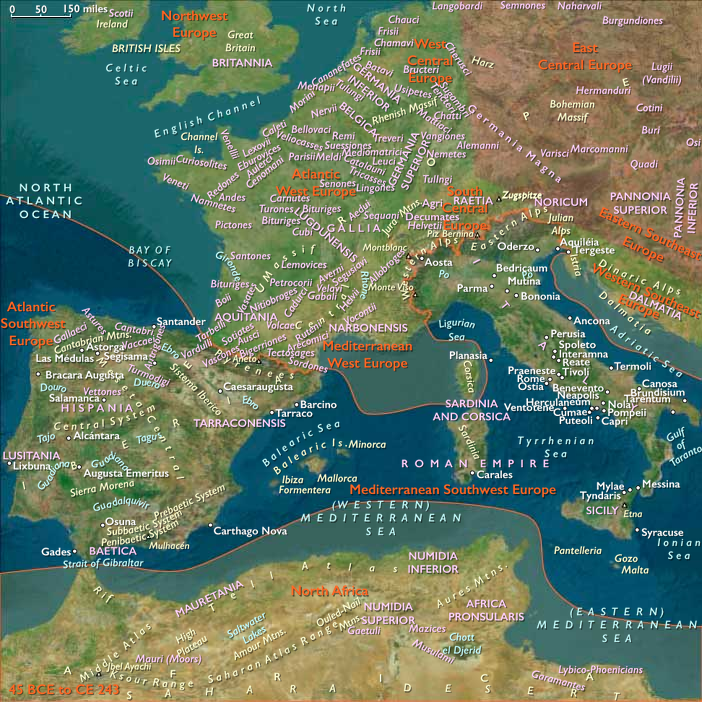
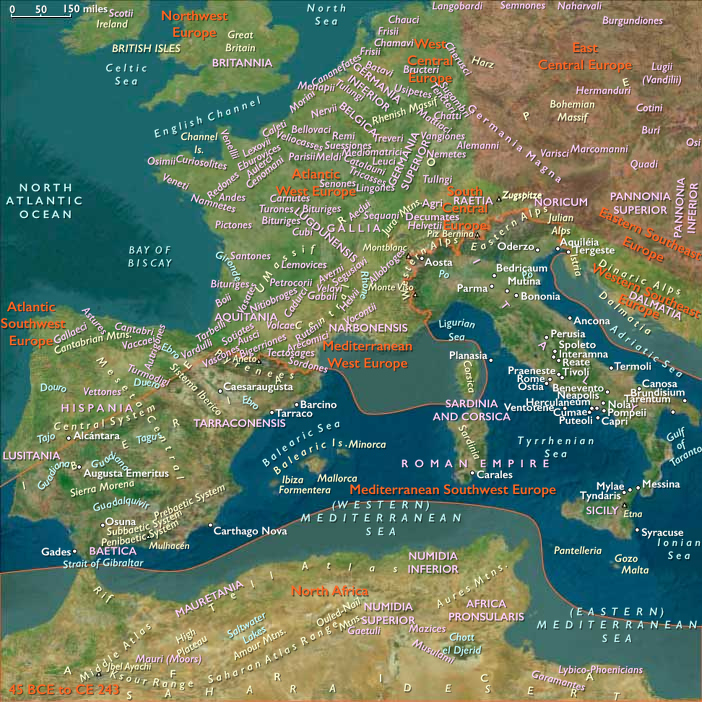
At the same time he makes this purely theatrical gesture, he obtains from the Senate a ten-year tenure of an area of government (provincia) comprising Spain, Gaul, and Syria, the three regions containing the bulk of the army.
The Senate grants Octavian a number of prerogatives that legitimize his position, awarding him the military command (imperium; hence the modern term emperor).
The remaining provinces are to be governed by proconsuls appointed by the Senate in the old republican fashion.
Octavian, however, believes that his supreme prestige—crystallized in the meaningful term auctoritas—safeguards him against any defiance by these personages; and he is indeed able, more or less indirectly, to influence their appointments, just as he will be able (on the rare occasions when he regards it as desirable) to influence the appointments to the consulships and other metropolitan offices that continue to exist in “republican” fashion.
Four days after these measures, his surname of Caesar, acquired through adoption in Julius' will, is supplemented by “Augustus,” an appellation with an antique religious ring, believed to be linked etymologically with auctoritas and with the ancient practice of augury.
The word augustus is often contrasted with humanus; its adoption as the title representing the new order cleverly indicates, in an extraconstitutional fashion, his superiority over the rest of mankind.
With the aid of writers such as Virgil, Livy, and Horace, all of whom in their different ways shared the same ideas, he will show his patriotic veneration of the old Italian faith by reviving many of its ceremonials and repairing numerous temples.
The republic is dead, replaced by Octavian with the principate, "rule by the first citizen:” a monarchy disguised as a republic, with the princeps (the emperor) ostensibly ruling by commission from the Senate and the people.
Rome’s jurisconsults, prominent citizens who find the study and interpretation of the law a satisfying and respected pursuit, have great prestige, and are regularly consulted by officials and laymen alike.
With the establishment of the principate, Octavian grants certain jurisconsults the authority to issue responses to legal queries as though he himself had been asked.
At least since the rise to prominence of the Scipio family around 275 BCE, it has been a habit of many Roman generals to choose from the ranks a private force of Italians (Roman citizens and Latins), consisting of both infantry and cavalry, to act as guards of the tent or the person.
The term Praetorian derives from the tent of the commanding general or praetor of a Roman army in the field—the praetorium.
In time, this cohort had come to be known as the cohors praetoria, and various notable figures possessed one, including Julius Caesar, Mark Antony and Augustus (Octavian).
As Caesar had discovered with the Legio X Equestris, a powerful unit more dangerous than its fellow legions is desirable in the field.
While Augustus understands the need to have a protector in the maelstrom of Rome, he is careful to uphold the Republican veneer of his regime.
Thus, from the ranks of the legions throughout the provinces, he allows only nine cohorts to be formed, originally of five hundred, later increased to one thousand men each, and only three kept on duty at any given time in the capital.
A small number of detached cavalry units (turmae, sing.
turma) of thirty men each are also organized.
While they patrol inconspicuously in the palace and major buildings, the others are stationed in the towns surrounding Rome; no threats are possible from these individual cohorts.
Locations
People
Groups
Topics
Commodoties
Subjects
Regions
Subregions
Years: 27BCE - 27BCE
Locations
People
Groups
Topics
Commodoties
Subjects
Regions
Subregions