
The compromise peace with the Persians concluded …
Years: 387 - 387
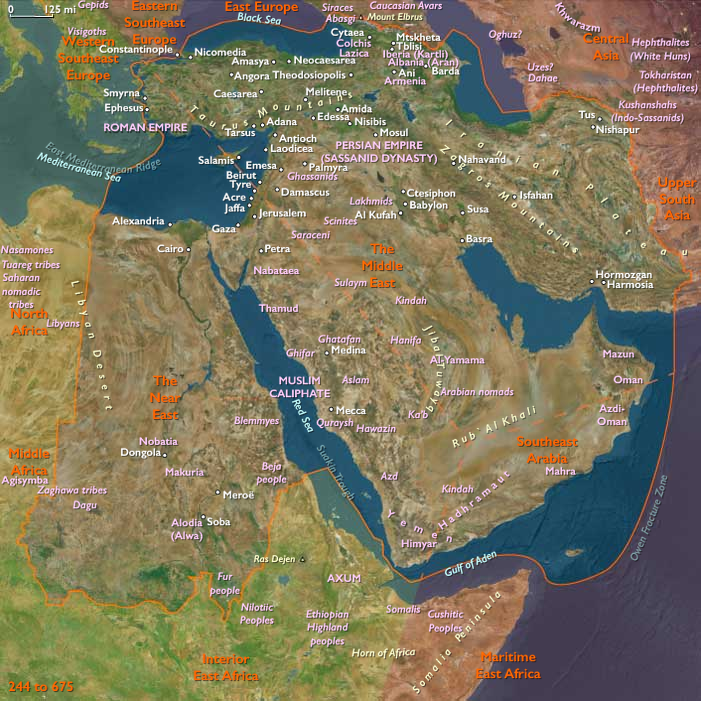
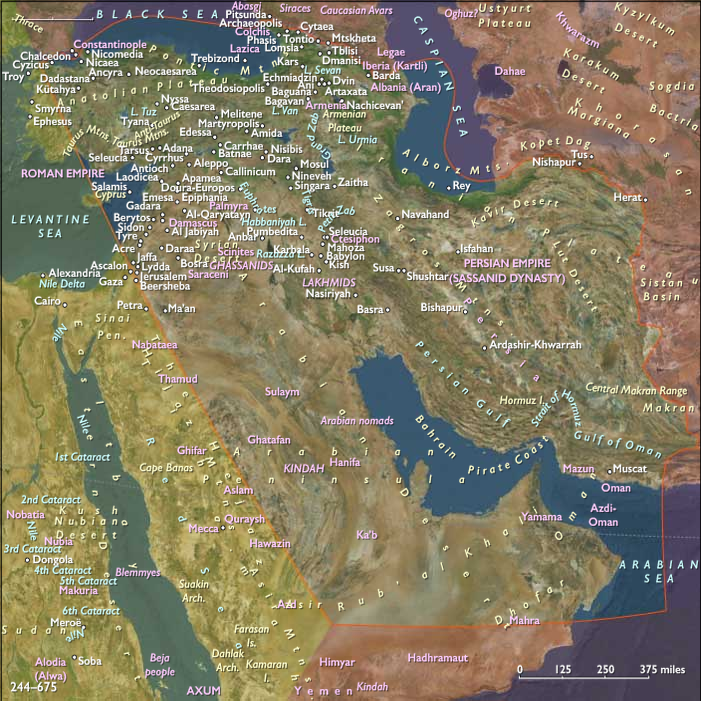
The compromise peace with the Persians concluded in 387 gives Rome a small section of Armenia, where the emperor founds Theodosiopolis (Erzurum)
The Persians had been forced by Diocletian to relinquish Armenia, and Tiridates III, the son of Tiridates II, had in about 287 been restored to the throne under Roman protection; his reign had determined the course of much of Armenia's subsequent history, and his conversion by St. Gregory the Illuminator and the adoption of Christianity as the state religion (c. 314) has created a permanent gulf between Armenia and Persia.
Locations
People
Groups
- Persian people
- Armenian people
- Armenia, Kingdom of
- Persian Empire, Sassanid, or Sasanid
- Roman Empire: Valentinian dynasty (Rome)
- Roman Empire: Theodosian dynasty (Constantinople)
- Armenia, (East Roman [Byzantine] vassal) Principality of
Topics
Commodoties
Subjects
Regions
Subregions
Related Events
Filter results
Showing 10 events out of 59526 total
Tuoba Gui, the grandson (or son) of the final Prince of Dai, Tuoba Shiyijian, had reasserted independence by 386, initially with the title of Prince of Dai, and then as the Prince of Wei, and his state is therefore known in history as Northern Wei.
Zhai Liao has repeatedly tried to attack Jin during the past two years, but has been repelled in his efforts, and he apparently enters into an alliance with Western Yan's emperor Murong Yong.
In 387, Murong Chui attacks Zhai Liao, and many of Zhai Liao's subordinates surrender quickly.
Zhai Liao, in fear, agrees to submit to Later Yan, and Murong Chui permits him to remain at his post and creates him the Duke of Henan.
In winter 387, Zhai Liao repudiates allegiance to Later Yan and attacks Later Yan's Qinghe (roughly modern Xingtai, Hebei) and Pingyuan (roughly modern Dezhou, Shandong) prefectures.
Theodosius has resided mainly in Constantinople from the end of 380 to 387, during which time he has taken most of his measures to improve the capital.
The plan for the Forum Tauri, designed after the model of Trajan's Forum in Rome, is outstanding: it is the largest public square known in antiquity.
It is unclear, however, to what extent the Emperor has encouraged the flowering of art and literature in his time.
In international affairs, long-standing negotiations with the Persians over the division of power in Armenia have resulted in a treaty that is to become the basis for a long period of peace on Rome’s eastern border.
Events in Armenia apparently occupy the attention of Ardashir II during his four-year reign.
Arsaces's son Pap had been murdered during Shapur's reign and the Romans had replaced him with a certain Varaztad, who was a distant member of the Arsacid family.
However, real power was in the hands of one Moushegh Mamikonian, apparently a noble in the Armenian court.
Moushegh, suspected of having conspired with the Emperor of Rome, had later been murdered by Varazdat.
This act had roused the indignation of Moushegh's brother Manuel, who had rebelled against Varazdat and with the support of Persia deposed him and placed upon the Armenian throne Zermandueht, the widow of Pap, who had then made Manuel the Sparapet or Commander-in-chief.
In return for their services, Manuel had allowed the Persians to maintain a garrison in Armenia, but this arrangement did not work for long.
A nobleman named Meroujan had incorrectly informed Manuel that the commandant of the Persian garrison desired to capture him.
Enraged, Manuel had fallen upon the ten thousand Persian soldiers stationed in Armenia and murdered them, but Manuel died soon afterwards and confusion followed.
Ardashir and the Roman Emperor Theodosius, desiring to maintain peace in the borderlands, had decided upon a treaty, but Ardashir died in 383 before the treaty could be signed; his son Shapur III had eventually signed and ratified the treaty in the year 384, resulting in the splitting of the kingdom between the Roman and the Sassanid empires three years later.
Samudragupta’s forces have waged more or less continual war against the Shakas (Scythians) based in Ujjain (modern Madhya Pradesh state).
During Samudragupta‘s half-century of rule over northern India, he had expanded his Magadha kingdom west to the borders of the Punjab and east to Assam.
By the time of his death in 380, a dozen kingdoms in the Deccan plateau area had recognized Gupta overlordship.
His second son had already succeeded him around 375 as Chandragupta II; his eldest son Ramagupta, who had succeeded in 370, having been captured by th5949e Western Saka Satraps ("Kshatrapas").
Samudragupta, known to have been a man of culture, had been a patron of learning, a celebrated poet, and a musician.
Several coins depict him playing on the Indian lyre or Veena.
He had also restored the old Vedic practice of the Ashwamedha (horse sacrifice), and, though he had favored the Hindu religion like the other Gupta kings, he was reputed to possess a tolerant spirit vis-a-vis other religions.
A clear illustration of this is the permission granted by him to the king of Ceylon to build a monastery for Buddhist pilgrims in Bodh Gaya.
The Buddhist tradition in India now embraces the Tantric movement and develops the Yogacara school of meditative practices.
India’s Shakta and Tantra cults promote speculation on the mystical origins of divine energy and fertility but the Hindu orthodoxy eschews both trends.
The cult of Vishnu, nourished by the Gupta dynasty, has thrived: it now becomes distinct from that of Shiva.
Jerome and his fellow pilgrims, joined by Bishop Paulinus of Antioch, had visited Jerusalem, Bethlehem, and the holy places of Galilee, and now go to Egypt, the home of the great heroes of the ascetic life.
At the Catechetical School of Alexandria, Jerome listens to the blind catechist Didymus the Blind expounding the prophet Hosea and telling his reminiscences of Anthony the Great, who had died thirty years before.
He also spends some time in Nitria, admiring the disciplined community life of the numerous inhabitants of that "city of the Lord," but detecting even there "concealed serpents," i.e., the influence of the theology of Origen.
Augustine's life has changed in Milan.
While still at Carthage, he had begun to move away from Manichaeism, in part because of a disappointing meeting with the Manichean Bishop, Faustus of Mileve, a key exponent of Manichaean theology.
In Rome, he is reported to have completely turned away from Manichaeanism, and instead embraced the skepticism of the New Academy movement.
His mother, who had followed him to Milan, has pressured him to become a Christian.
Augustine's own studies in Neoplatonism are also leading him in this direction, and his friend Simplicianus has urged him this way as well, but it Ambrose who has the most influence over Augustine.
Ambrose, like Augustine himself, is a master of rhetoric but older and more experienced.
Augustine allows his mother to arrange a society marriage, for which he abandons his concubine.
It is believed that Augustine truly loved the woman he had lived with for so long.
In his "Confessions," he expresses how deeply he was hurt by ending this relationship, and also admits that the experience eventually produced a decreased sensitivity to pain over time.
However, he has to wait two years until his fiancee comes of age, so despite the grief he feels over leaving "The One" as he calls her, he soon takes another concubine.
Augustine eventually breaks off his engagement to his eleven-year-old fiancee, but never renews his relationship with "The One" and soon leaves his second concubine.
It is during this period that he utters his famous prayer, "Grant me chastity and continence, but not yet" (da mihi castitatem et continentiam, sed noli modo).
In the summer of 386, after having read an account of the life of Saint Anthony of the Desert which greatly inspired him, Augustine undergoes a profound personal crisis, which leads him to convert to Christianity, abandon his career in rhetoric, quit his teaching position in Milan, give up any ideas of marriage, and devote himself entirely to serving God and to the practices of priesthood, which includes celibacy.
He will detail his spiritual journey in his famous Confessions, which is to become a classic of both Christian theology and world literature.
Ambrose baptizes Augustine, along with his son, Adeodatus, on Easter Vigil in 387 in Milan.
Eventually named a Latin church father, Augustine is to become one of the most important figures in the development of Western Christianity.
According to his contemporary, Jerome, Augustine "established anew the ancient faith" (conditor antiquae rursum fidei).
Maximus' edict of 387 or 388, which censures Christians at Rome for burning down a Jewish synagogue, is condemned by bishop Ambrose, who says people exclaimed: ‘the emperor has become a Jew’.
The ambitious Maximus, aiming to usurp Valentinian’s throne, invades Italy in 387, forcing the young emperor and his mother to flee to Thessalonica to the dominions of Theodosius, whose position has by this time has become stronger.
His decision to aid the Western emperor has perhaps been hastened through the influence of Valentinian's mother, whose daughter Galla he marries at the end of 387, having since 386 been a widower.
The expansion of wet-rice agriculture by the middle of the first millennium BCE and, apparently more importantly, certain requirements of trade such as the control of local commodities, suggest new social and political possibilities, which are seized by some communities in Indonesia.
For reasons not well understood, most—and all of those that endured—are located in the western archipelago.
Already acquainted with a wider world, these Indonesians are open to, and indeed actively seek out, new ideas of political legitimation, social control, and religious and artistic expression.
Their principal sources lie not in China, with which ancient Indonesians are certainly acquainted, but in South Asia, in present-day India and Sri Lanka, whose outlooks appear to have more nearly reflected their own.
This process of adoption and adaptation, which scholars have somewhat misleadingly referred to as a rather singular "Hinduization" or "Indianization," is perhaps better understood as one of localization or "Indonesianization" of multiple South Asian traditions.
It involves much local selection and accommodation (there are no Indian colonizations), and it undoubtedly began many centuries before its first fruits are clearly visible through the archaeological record.
Early Indonesia does not become a mini-India.
Artistic and religious borrowings are never exact replications, and many key Indian concepts, such as those of caste and the subordinate social position of women, are not accepted.
Selected ideas fill particular needs or appeal to particular sensibilities, yet at the same time they are anything but superficial; the remnants of their further elaboration are still very much in evidence today.
Some Indonesian peoples probably began writing on perishable materials at an earlier date, but the first stone inscriptions (in Sanskrit, using an early Pallava script from southern India) date from the end of the fourth century CE (in the eastern Kalimantan locale of Kutai) and from the early or mid-fifth century CE (in the western Java polity known as Taruma).
These inscriptions offer a glimpse of leaders newly envisioning themselves not as mere chiefs (datu) but as kings or overlords (raja, maharaja), taking Indian names and employing first Brahmanical Hindu, then Buddhist, concepts and rituals to invent new traditions justifying their rule over newly conceived social and political hierarchies.
In addition, Chinese records from about the same time provide scattered, although not always reliable, information about a number of other "kingdoms" on Sumatra, Java, southwestern Kalimantan, and southern Sulawesi, which, in the expanding trade opportunities of the early fifth century, have begun to compete with each other for advantage, but we know little else about them.
Historians have commonly understood these very limited data to indicate the beginnings of the formation of "states," and later "empires" in the archipelago, but use of such terms is problematic.
We understand that small and loosely organized communities consolidated and expanded their reach, some a great deal more successfully than others, but even in the best-known cases we do not have sufficient specific knowledge of how these entities actually worked to compare them confidently with, for example, the states and empires of the Mediterranean region during the same period or earlier.
More generalized terms, such as "polities" or "hegemonies," are suggestive of social and political models that are more applicable.
Years: 387 - 387
Locations
People
Groups
- Persian people
- Armenian people
- Armenia, Kingdom of
- Persian Empire, Sassanid, or Sasanid
- Roman Empire: Valentinian dynasty (Rome)
- Roman Empire: Theodosian dynasty (Constantinople)
- Armenia, (East Roman [Byzantine] vassal) Principality of
