
...the recovery of Leros, whose native Greek …
Years: 1319 - 1319
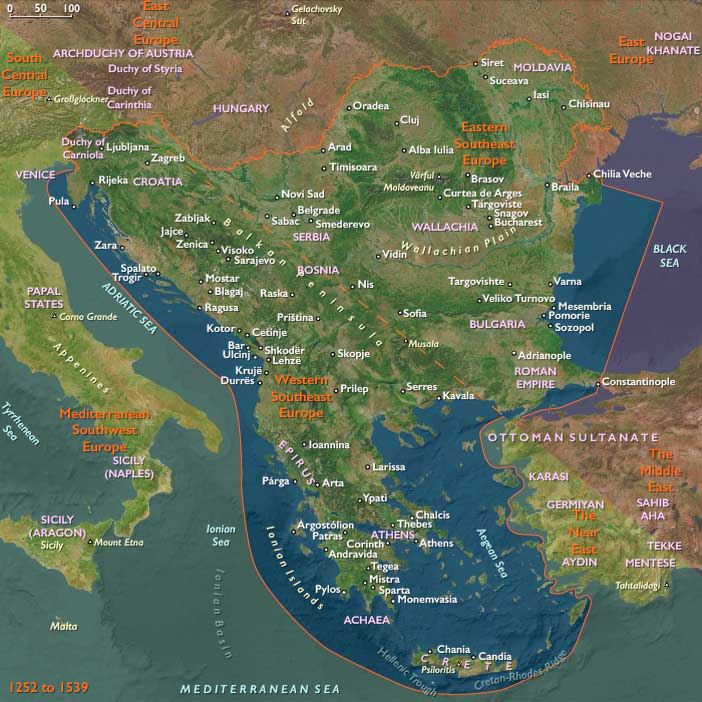
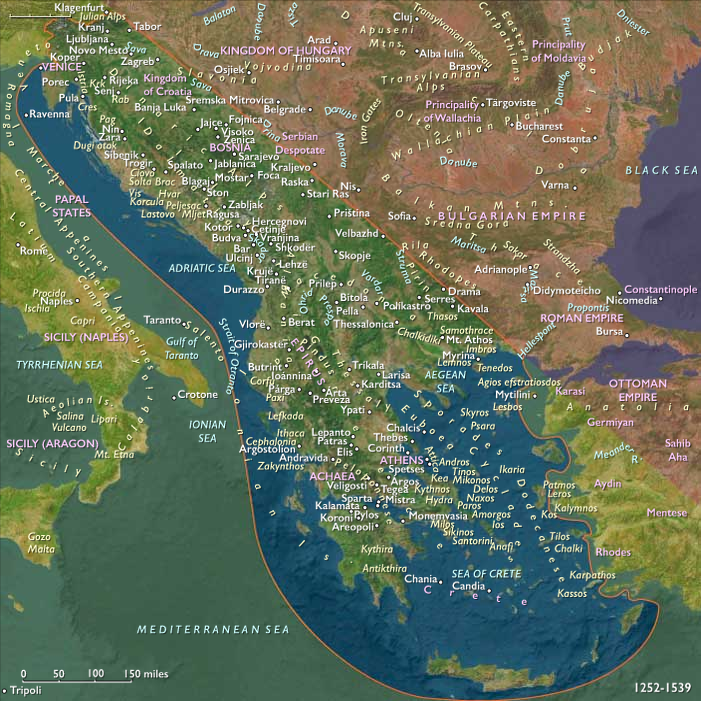
...the recovery of Leros, whose native Greek population had rebelled in the name of the emperor in Constantinople, and by another victory in the next year over a Turkish fleet poised to invade Rhodes.
Pope John XXII rewards Schwarzburg by restoring him to the post of grand preceptor of Cyprus, whence he had been dismissed two years earlier, and promised the commandery of Kos, if he could capture it.
Efforts begin to form a Christian naval league to counter Turkish piracy, but the defeat off Chios cannot halt the rise of Aydinid power in the immediate future.
The Zaccarias will soon after be forced to surrender their mainland outpost of Smyrna to Mehmed's son Umur Beg, under whose leadership Aydinid fleets will roam the Aegean for the next two decades, until the Smyrniote crusades (1343–1351) break the Aydinid emirate's power.
Locations
People
Groups
- Genoa, (Most Serene) Republic of
- Menteş, Beylik of
- Aydınoğlu Beylik (Turkmen Emirate) of
- Knights Hospitaller (of Rhodes), Order of the
Topics
Subjects
Regions
Subregions
Related Events
Filter results
Showing 10 events out of 77 total
Southern Africa (1828–1971 CE)
Mineral Revolutions, Migrant Labor, and Struggles for Sovereignty
Geography & Environmental Context
Southern Africa comprises two fixed subregions:
-
Tropical Southwest Africa — northern Namibia and northern Botswana, including the Etosha Salt Pan, the Skeleton Coast, the Okavango Delta, the Caprivi Strip (Bwabwata National Park), and the Chobe River basin.
-
Temperate Southern Africa — all of South Africa, Lesotho, and Eswatini; the southern halves of Namibia, Botswana, and Zimbabwe (south of approximately 19.47°S); and southwestern Mozambique.
Anchors include the Drakensberg, Kalahari, Highveld and Lowveld grasslands, and major river systems such as the Zambezi, Limpopo, Okavango, and Orange. This vast region spans coastal deserts and fog plains in the west, savannas and deltas in the north, and temperate uplands and fertile river valleys in the south—its environments repeatedly restructured by drought, migration, and industrial expansion.
Climate & Environmental Shifts
The end of the Little Ice Age gave way to alternating drought and flood. The rinderpest pandemic (1896–97) wiped out livestock and game, reshaping pastoral economies. Twentieth-century irrigation and dam projects—most notably Kariba Dam (1959) on the Zambezi—transformed watersheds and displaced communities. Soil exhaustion and erosion followed overgrazing and plough expansion in the Highveld and Shire Highlands, while the Okavango Delta’s flood pulse and the fog-fed Skeleton Coast sustained unique microclimates within arid belts.
Subsistence & Settlement
-
Tropical Southwest Africa: Ovambo, Herero, and San communities maintained mixed economies of millet, sorghum, and pastoral herding. Seasonal migration, fishing, and trade along the Okavango and Chobe floodplains balanced subsistence and exchange. German and later South African colonial regimes imposed labor recruitment, taxation, and territorial segregation but left subsistence cycles tied to delta hydrology.
-
Temperate Southern Africa: European expansion intensified after 1828. Trekboer migrations (the Great Trek, 1830s) spread pastoral and settler agriculture inland. The discovery of diamonds (1867) and gold (1886)transformed the interior into an industrial hub, drawing African labor from across the region. Indigenous farmers were confined to reserves or incorporated into cash economies as migrant workers. Urbanization accelerated around Johannesburg, Kimberley, Pretoria, Cape Town, and Durban.
Technology & Material Culture
Railways and telegraphs connected mines to coasts: the Cape–Kimberley line, the Beira and Benguela corridors, and inland extensions to the Zambian Copperbelt. Compound housing and deep-level mining shafts defined industrial life. Mission presses and schools expanded literacy, while iron-smelting, beadwork, and woodcarving endured as living arts. Twentieth-century cities introduced electricity, automobiles, and modern architecture—often segregated under racial zoning.
Movement & Interaction Corridors
-
Migrant labor formed the backbone of the economy: recruiting networks drew men from Lesotho, Botswana, Mozambique, and Namibia to South African mines and farms.
-
Caravan and river trade linked interior settlements to coastal ports until displaced by rail.
-
Mission and education networks circulated teachers, clergy, and ideas, fostering early nationalist consciousness.
-
Wildlife and conservation corridors evolved from colonial game preserves to national parks such as Etosha (1907) and Kruger (1926).
Cultural & Symbolic Expressions
Christian missions spread schooling and print culture, but African Independent Churches and prophetic movements (Zionist, Apostolic, and Ethiopian) localized theology and healing. Oral praise poetry (izibongo), initiation songs, drumming, and bead artistry persisted. Urban centers fostered jazz, marabi, mine-dance (ingoma), and protest music. In floodplain and desert communities, rainmaking and cattle rituals linked ecology to spirituality, while liberation hymns emerged from mission choirs and trade-union halls.
Environmental Adaptation & Resilience
Communities diversified crops and livestock to hedge against drought. In Tropical Southwest Africa, seasonal herding and fishing exploited the Okavango’s variable floods. Flood-recession agriculture, granaries, and kinship redistribution sustained resilience. In the south, irrigation cooperatives and state water schemes mitigated drought but deepened inequality under apartheid land laws. Veterinary control campaigns (dipping tanks, anti-tsetse measures) altered wildlife migration patterns.
Political & Military Shocks
-
Colonial conquest and resistance: The Herero and Nama genocide (1904–07) in German South-West Africaepitomized settler brutality. British and Portuguese forces subdued African polities from the Ndebele and Zulu to the Gaza state.
-
Boer and British conflicts: The Anglo-Zulu War (1879) and Anglo-Boer Wars (1880–81, 1899–1902)reshaped sovereignty, culminating in the Union of South Africa (1910).
-
Apartheid consolidation: The Natives Land Act (1913) and, after 1948, apartheid legislation institutionalized racial segregation; mass resistance grew, marked by events such as Sharpeville (1960).
-
Portuguese colonial wars: Revolts in Angola (1961) and Mozambique (1964) destabilized borders, with liberation movements crossing the Caprivi and Okavango corridors.
-
Independence wave: Malawi and Zambia (1964), Botswana and Lesotho (1966), and Eswatini (1968) achieved sovereignty. Namibia remained under South African mandate; Mozambique and Zimbabwe remained colonial territories until the mid-1970s.
Transition
Between 1828 and 1971, Southern Africa was transformed by mining, migration, and empire into a landscape of industrial cores and dependent peripheries. Tropical Southwest Africa preserved its floodplain economies under mounting labor demands; Temperate Southern Africa became a crucible of industrial capitalism and racial rule. Railways and mines tied deserts, deltas, and mountains to global markets; missions and schools seeded resistance; conservation and apartheid both fenced landscapes and people. By 1971, the region stood divided between apartheid’s strongholds and newly independent states—its people poised between dispossession and renewal, and its ecosystems marked by both enduring adaptation and environmental strain.
Tropical West Southern Africa (1828–1971 CE)
Cattle Frontiers, Colonial Conquest, and the Transformation of Wetland Societies
Geography & Environmental Context
Tropical West Southern Africa includes northern Namibia, northern Botswana, the Etosha Salt Pan, the Skeleton Coast, the Okavango Delta, the Caprivi Strip (Bwabwata National Park), and the Chobe River basin. Anchors are the Etosha Pan, the Okavango Delta floodplains, the Chobe–Zambezi corridors, and the Atlantic Skeleton Coast. Ecological contrasts were profound: desert and savanna landscapes in Namibia, rich inland wetlands in the Okavango–Chobe, and salt and fog along the Skeleton Coast.
Climate & Environmental Shifts
The 19th century saw alternating droughts and wet cycles. Severe droughts in the mid-19th century devastated cattle herds, while the Okavango Delta and Chobe River sustained refuge zones of fishing, gardening, and foraging. The 20th century brought erratic Sahelian-like droughts in northern Namibia and Botswana, influencing colonial agricultural schemes. The Skeleton Coast remained inhospitable, its fogs legendary among sailors.
Subsistence & Settlement
-
Cattle and herding: Herero and related groups dominated inland Namibia, building cattle wealth and spiritual authority. Ovambo and Kavango societies cultivated millet, sorghum, and beans while keeping cattle and small stock.
-
Okavango and Chobe: Flood-retreat gardening, fishing, and seasonal hunting supported diversified riverine communities.
-
San foragers: Continued hunting and gathering across desert margins, often laboring for or trading with cattle herders.
-
Salt and trade: Etosha Pan remained a key salt source; salt caravans circulated into Herero and Ovambo networks.
-
Colonial shift: By the late 19th century, German South West Africa and British Bechuanaland Protectorate pressed settlements into reserves, missions, and administrative stations.
Technology & Material Culture
Traditional cattle culture—corrals, milking, hides—remained vital. Reed canoes plied Okavango channels; salt was packed and traded in bulk. Imported rifles, cloth, and iron tools entered via Angolan, Cape, and Zambezi traders. By the 20th century, missions and colonial stations introduced schools, clinics, and masonry dwellings. In Botswana, boreholes and windmills reshaped grazing.
Movement & Interaction Corridors
-
Precolonial trade: Ivory, cattle, salt, and captives flowed north toward Angola and east along the Zambezi.
-
Colonial expansion: German control in Namibia (from 1884) imposed settler ranching and railways, especially in Herero and Ovambo lands. British Bechuanaland (from 1885) linked Chobe and Okavango to Cape Town markets.
-
Missions and stations: Rhenish and Finnish missions in Ovamboland and Kavango spread Christianity and literacy.
-
20th-century labor migration: Ovambo, Kavango, and Caprivi men recruited to South African mines; Tswana and Chobe men entered South African and Rhodesian labor pools.
Cultural & Symbolic Expressions
-
Cattle cosmology: Herero rituals of cattle sacrifice and ancestor veneration continued, though challenged by colonial expropriation.
-
Oral tradition: San rock art and trance dances persisted in refugia, while Herero praise poetry remembered cattle, war, and exile.
-
Christianity: Mission churches translated hymns into Oshiwambo, Otjiherero, and Setswana; syncretism blended cattle ritual and Christian liturgy.
-
Memory of war: Herero and Nama remembered the genocidal wars of 1904–1907 in oral laments; Okavango and Chobe communities preserved river myths and ancestral spirit stories tied to crocodiles and hippos.
Environmental Adaptation & Resilience
-
Mobility: Pastoralists moved cattle across drought–flood cycles, though colonial boundaries increasingly restricted grazing.
-
Diversification: Fishing, gardening, and foraging persisted in Okavango and Chobe; salt and crafts buffered Ovambo economies.
-
Colonial engineering: Boreholes, dams, and fences restructured grazing and water use, often worsening overgrazing.
-
Labor remittances: By mid-20th century, wages from mines in South Africa became survival strategies for many households in northern Namibia and Botswana.
Political & Military Shocks
-
Herero and Nama Wars (1904–1907): German campaigns devastated Herero and Nama populations; survivors fled to Botswana or into reserves.
-
Colonial rule: German South West Africa (until 1915) gave way to South African mandate rule; Bechuanaland remained a British protectorate.
-
WWI & WWII: Military campaigns in Namibia and troop recruitment in Botswana linked the region to global wars.
-
Nationalism and independence: Herero and Ovambo political groups mobilized under South African rule, laying the groundwork for SWAPO. Botswana, after decades as a British protectorate, gained independence in 1966, while Namibia remained under South African occupation.
Transition
Between 1828 and 1971, Tropical West Southern Africa transformed from an autonomous landscape of cattle, salt, and riverine exchange into a colonial frontier marked by dispossession, genocide, and wage labor. Wetlands and salt pans remained cultural anchors, but settler ranching, missions, and colonial borders reshaped lifeways. The Herero genocide scarred collective memory; Okavango and Chobe societies endured through ecological adaptation and fishing-gardening traditions; Ovambo and Kavango people bore the brunt of labor migration. By 1971, Botswana had achieved independence, but Namibia remained under apartheid occupation—its salt pans, deltas, and savannas now theaters of both survival and resistance.
Interior East Africa (1828–1971 CE): Slave Caravans, Imperial Revival, and Colonial Partition
Geographic & Environmental Context
The subregion of Interior East Africa includes Eritrea, Djibouti, Ethiopia, South Sudan, Uganda, Rwanda, Burundi, Zambia, northern Zimbabwe, northern Malawi, northwestern Mozambique, inland Tanzania, and inland Kenya. Anchors included the Ethiopian highlands, the Great Rift lakes (Victoria, Tanganyika, Turkana, Kivu, Mweru), the interlacustrine kingdoms of Rwanda–Burundi–Uganda, the savanna–woodland mosaics of inland Tanzania and Zambia, and the Nile–Sudd marshes in South Sudan. By this period, the region was increasingly reshaped by Indian Ocean trade, European exploration, and later colonial boundaries.
Climate & Environmental Shifts
The 19th century saw alternating droughts and heavy rain years. The mid-1880s famine years devastated highland Ethiopia and the Great Lakes, tied to rinderpest outbreaks that decimated cattle. Fluctuating lake levels affected fisheries and floodplain cultivation. In the mid-20th century, population growth, soil depletion, and drought cycles placed further stress on subsistence systems, especially in pastoral belts of South Sudan and northern Kenya.
Subsistence & Settlement
-
Highlands (Ethiopia/Eritrea): Terrace agriculture of teff, barley, and wheat persisted; ox-plowing remained central. Coffee expanded as a cash crop. Sheep, goats, and cattle supplemented diets.
-
Great Lakes kingdoms (Buganda, Bunyoro, Rwanda, Burundi): Banana groves, sorghum, beans, and cattle supported dense populations. Tribute flows supplied royal courts.
-
Savanna zones (inland Tanzania–Zambia–Malawi–Mozambique): Sorghum, millet, and maize (now widespread) structured village subsistence; cassava spread as a famine reserve. Fisheries on Victoria and Tanganyika supported large communities.
-
Pastoral belts (South Sudan–Turkana–Karamoja): Cattle herding remained central; milk, hides, and bridewealth structured society. Grain was acquired via exchange with cultivators.
Technology & Material Culture
Iron hoes and knives remained vital, supplemented by imported textiles, beads, and firearms. Canoe fleets on the Great Lakes expanded for trade and warfare. Court regalia included drums, spears, and thrones, while Christian Ethiopia produced illuminated manuscripts and stone churches. In the 20th century, colonial regimes built roads, railways, and administrative compounds. Mission schools and printing presses introduced new literacies. Urban craft traditions developed in Kampala, Addis Ababa, Kigali, and Lusaka.
Movement & Interaction Corridors
-
19th-century caravan trade: From inland Tanzania and Zambia, ivory and enslaved people moved to coastal entrepôts like Bagamoyo, Kilwa, and Zanzibar, under Swahili and Omani merchant control.
-
Ethiopia: Caravans carried salt, coffee, and grain across the highlands to Red Sea ports; arms and textiles moved inland.
-
Nile–Sudd routes: Linked South Sudanese cattle and captives to Egyptian markets.
-
Colonial era: Railways tied Mombasa to Kampala, Dar es Salaam to Kigoma, and Benguela (Angola) to Zambian copper mines. Roads and steamers integrated Victoria and Tanganyika into wider circuits.
-
Air and road networks: By mid-20th century, Nairobi, Addis Ababa, Kampala, and Lusaka became aviation and trade hubs.
Cultural & Symbolic Expressions
-
Ethiopia: The Solomonic dynasty revived under Menelik II, who built Addis Ababa and symbolized Christian kingship. The victory over Italy at the Battle of Adwa (1896) became a touchstone of African resistance.
-
Great Lakes kingdoms: Courtly rituals of drums, regnal names, and oral epics remained central, while Christianity and Islam spread through missions and traders.
-
Colonial missions: Introduced Christian festivals, hymnody, and schools, while Islamic brotherhoods deepened ties across the Nile and Sahel.
-
Postcolonial culture: Writers, musicians, and political leaders articulated national identity—Congolese rumba influenced Uganda and Rwanda, while Ethiopia projected imperial grandeur through Haile Selassie’s court rituals.
Environmental Adaptation & Resilience
Communities diversified crops—cassava and maize buffered famine risk. Pastoralists rebuilt herds after rinderpest, adjusted transhumance routes, and negotiated pasture rights. Fisherfolk smoked and dried catches to stabilize diets. Colonial governments attempted irrigation (Gezira scheme, Tanganyika sisal estates), though often favoring export crops. Kinship, clan systems, and cooperative labor traditions sustained resilience, supplemented by missions and churches that organized relief during famine.
Technology & Power Shifts (Conflict Dynamics)
-
Ethiopia: Menelik II expanded territory southward; the empire endured Italian invasion attempts, defeating them at Adwa (1896). Later, Haile Selassie I modernized state institutions, only to face Italian occupation (1936–1941) before liberation with Allied support.
-
Great Lakes: Buganda expanded under British alliance; Rwanda and Burundi fell under German, then Belgian rule. Colonial indirect rule reshaped clan and clientship systems.
-
Savannas and Zambia: Caravans gave way to colonial railroads; copper mining in Katanga and Zambia drew massive labor migrations.
-
Resistance and nationalism: Maji Maji Rebellion (1905–1907) in Tanzania resisted German rule; later independence movements mobilized unions, churches, and student groups. Uganda (1962), Tanzania (1961), Zambia (1964), Malawi (1964), Rwanda (1962), and Burundi (1962) emerged as new states; Ethiopia and Liberia stood as symbols of African sovereignty.
Transition
By 1971 CE, Interior East Africa was a patchwork of newly independent nations and enduring monarchies. Ethiopia remained an empire under Haile Selassie, though unrest grew. The Great Lakes had transitioned from kingdoms to fragile republics. Zambia and Tanzania led pan-African movements, while Uganda under Idi Amin (from 1971) entered authoritarian rule. Across the region, legacies of caravans, Christian and Islamic traditions, and resilient subsistence systems met the challenges of sovereignty, development, and Cold War geopolitics.
World outrage focuses on the camps, led by a large faction of the Liberal Party in Britain.
However, the United States gives its support.
The Boer republics are merged into Union of South Africa in 1910; it has internal self-government but its foreign policy is controlled by London and is an integral part of the British Empire.
Interior East Africa (1912–1923 CE): The First World War, Colonial Consolidation, and Early Nationalist Responses
Between 1912 and 1923, Interior East Africa was profoundly shaped by global conflicts, colonial expansion, and intensified exploitation. The First World War (1914–1918) dramatically altered colonial boundaries, disrupted societies, and significantly influenced the region’s trajectory into the twentieth century.
The Impact of the First World War in East Africa
The war, primarily between British and German colonial powers, had a direct, devastating impact. German East Africa (encompassing modern-day Tanzania, Rwanda, and Burundi) became a major battleground, where British-led forces, including African and Indian troops, fought prolonged and difficult campaigns against the renowned German commander Paul von Lettow-Vorbeck.
Lettow-Vorbeck's guerrilla warfare tactics forced massive resource mobilizations by Britain, Belgium, Portugal, and South Africa, while African civilians suffered extensively from disease, famine, and forced labor. By the war’s end, populations in parts of Tanganyika were severely depleted, infrastructure destroyed, and economies disrupted.
Redistribution of Colonial Territories
Following Germany's defeat in 1918, its African colonies were redistributed under League of Nations mandates. The territory of German East Africa was partitioned, with:
-
Tanganyika (mainland Tanzania) mandated to Britain.
-
Ruanda-Urundi (Rwanda and Burundi) mandated to Belgium.
Belgian administration deepened social stratification in Rwanda and Burundi, reinforcing the power of Tutsi chiefs and indirectly laying foundations for later ethnic conflicts. Meanwhile, Britain sought to reconstruct Tanganyika, emphasizing cash crops and infrastructural rebuilding.
Uganda Protectorate: Continued Centralization and Economic Transformation
In the British Uganda Protectorate, colonial rule intensified, with Buganda serving as the administrative and economic heartland. The introduction of cotton and coffee as cash crops increasingly reshaped rural economies, particularly among the Baganda, who prospered as intermediaries for British economic interests.
However, tensions persisted with neighboring kingdoms—most notably Bunyoro, which remained aggrieved over territorial losses. British administrative expansion into northern and eastern regions also solidified colonial authority, though often through harsh measures, compulsory labor systems, and economic exploitation.
British Kenya: White Settlement and Indigenous Responses
British East Africa (officially declared Kenya Colony in 1920) experienced intensified European settlement. The White Highlands, fertile lands reserved for Europeans, saw significant displacement of indigenous peoples, notably the Kikuyu, Maasai, and Kalenjin, sparking resistance movements, increased poverty, and a developing sense of ethnic nationalism. Nairobi grew rapidly as an administrative and commercial hub, drawing increased European and Indian settlement, but also creating distinct racial and economic hierarchies.
In response, early nationalist organizations began to form. The Young Kikuyu Association (1921), led by Harry Thuku, emerged as one of East Africa's earliest organized resistance movements against colonial exploitation, land alienation, and forced labor, marking the start of Kenya’s modern nationalist politics.
Ethiopia: Succession Crisis and Political Consolidation
In Ethiopia, the death of Emperor Menelik II (1913) precipitated a turbulent succession crisis. His designated heir, Lij Iyasu, proved controversial due to his perceived sympathies with Ethiopia’s Muslim population and links with Ottoman Turkey during the war. Iyasu was deposed in 1916, replaced by Empress Zewditu, Ethiopia’s first female ruler, with Ras Tafari Makonnen (later Emperor Haile Selassie) as Regent and Heir Apparent.
Under Ras Tafari’s leadership, Ethiopia continued modernization initiatives, improving administrative structures, education, infrastructure (notably the completion of the Djibouti-Addis Ababa Railway in 1917), and foreign diplomatic relations. Ethiopia remained a rare example of African sovereignty during this intense period of colonial expansion.
Anglo-Egyptian Sudan: Resistance and Reforms
The Anglo-Egyptian Sudan witnessed increasing British control, especially through irrigation projects and agricultural expansions along the Nile, significantly increasing cotton production. However, in Southern Sudan, colonial authorities adopted a policy of "Closed Districts," deliberately isolating the region from Arab influence to preserve African cultural traditions—though in practice, this deepened economic marginalization and cultural isolation.
Resistance persisted among southern groups, such as the Nuer and Dinka, who periodically opposed colonial rule, especially resenting forced labor and heavy taxation. This period solidified divisions between northern and southern Sudanese societies.
French Somaliland: Economic and Strategic Importance
In French Somaliland (Djibouti), French colonial rule continued to enhance the territory’s importance as a critical port and railway terminus linking Ethiopia with international trade. Djibouti’s strategic position grew, especially as it handled Ethiopia’s burgeoning coffee exports and other goods, reinforcing French political and economic dominance in the Horn of Africa.
Malawi (Nyasaland) and Northern Rhodesia: Consolidation and Resistance
In Nyasaland (Malawi), Britain consolidated control, promoting cash crops—particularly tobacco and cotton—to integrate the colony into the global economy. British missionaries continued extensive educational and religious work, profoundly shaping local societies, especially among the Chewa, Tumbuka, and Yao peoples.
In Northern Rhodesia (Zambia), British South Africa Company administration intensified mineral extraction, notably copper mining. By the early 1920s, copper became a major export commodity, transforming regional economies and attracting increased European settlement, fundamentally changing indigenous land use and economic structures. Resistance occurred sporadically among groups like the Ngoni, responding to colonial labor demands, taxation, and land displacement.
Rwanda and Burundi under Belgian Mandate
Under Belgian rule, Rwanda and Burundi experienced heightened ethnic stratification. Belgian administrators solidified the dominance of Tutsi monarchies, exploiting pre-existing hierarchical structures for easier control and resource extraction, laying long-term foundations for ethnic tensions. Economic reforms included the introduction of forced labor systems to construct roads and public works, intensifying hardship among rural populations.
Legacy of the Era
The period 1912–1923 set in motion critical transformations, including:
-
Profound economic integration of Interior East Africa into the global capitalist system.
-
Increased European settlement, racial hierarchies, and indigenous dispossession.
-
The emergence of early nationalist organizations (e.g., Kenya's Young Kikuyu Association).
-
Significant infrastructural developments reshaping regional economic patterns.
-
Intensification of ethnic tensions in colonial mandates, notably Rwanda and Burundi, with lasting consequences.
These developments would profoundly shape the region’s twentieth-century trajectory, laying foundations for future nationalist movements, independence struggles, and social transformations across Interior East Africa.
In 1912, middle-class, urban-based professionals and chiefs form the South African Native Congress as a nonviolent civil rights organization.
Indian lawyer and civil rights activist Mohandas K. Gandhi agitates on behalf of the Indian community and leads successful campaigns of nonviolent protest against racial discrimination in South Africa.
Smuts represses a 1913 strike by revolution-minded white workers on the Witwatersrand.
Kimberley’s Open Mine closes in 1914, after having produced about 14,508,000 carats of diamonds.
South Africa, on the side of the Allies in the Great War, sends General Smuts to suppress a pro-German revolt in 1914; subsequently, Smuts’ South African forces occupy German Southwest Africa.
Years: 1319 - 1319
Locations
People
Groups
- Genoa, (Most Serene) Republic of
- Menteş, Beylik of
- Aydınoğlu Beylik (Turkmen Emirate) of
- Knights Hospitaller (of Rhodes), Order of the
Topics
Subjects
Regions
Subregions