The code duello, adopted at the Clonmel …
Years: 1777 - 1777
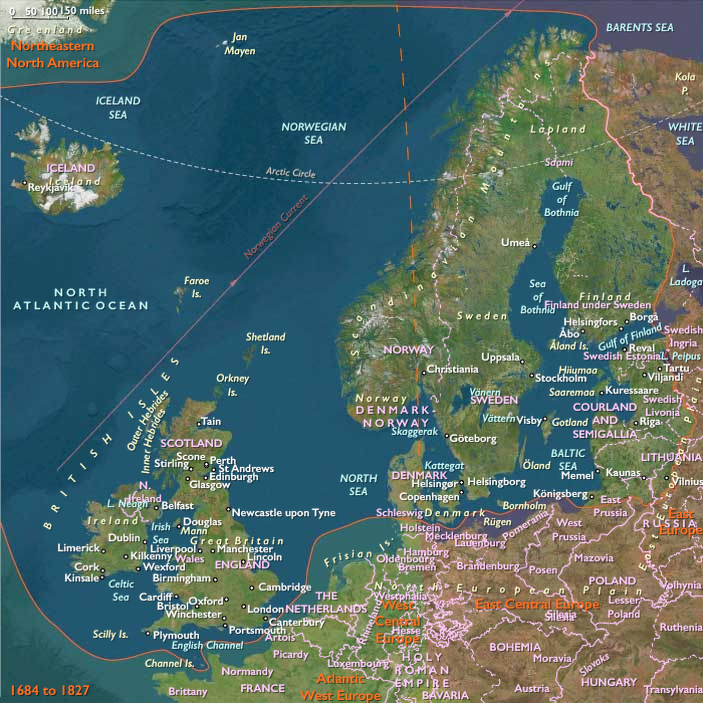
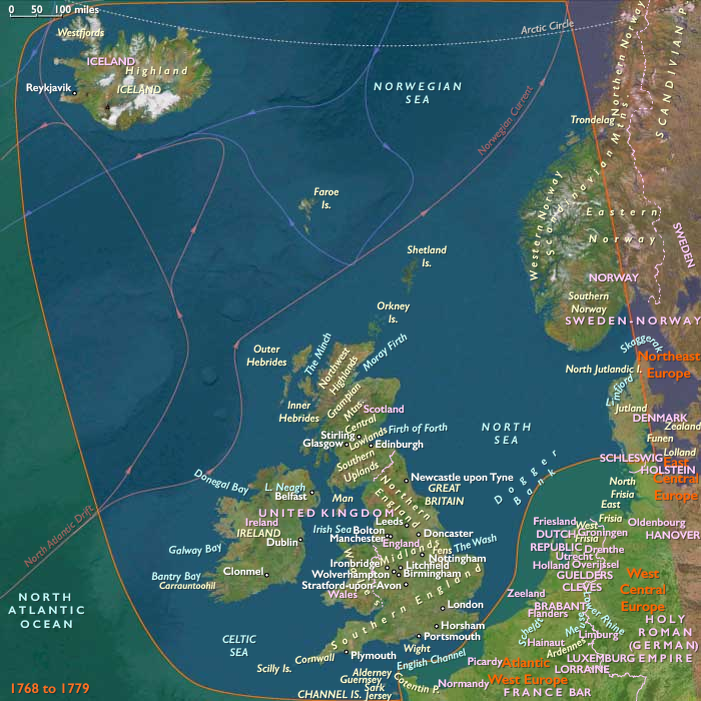
The code duello, adopted at the Clonmel Summer Assizes as the form for pistol duels in Ireland, is quickly denounced but nevertheless widely adopted throughout the English-speaking world.
Locations
Groups
Topics
Commodoties
Subjects
Regions
Subregions
Related Events
Filter results
Showing 10 events out of 71 total
The Americans have suffered significant casualties and lost important supplies, but Washington has managed to retain the core of his army and avoid a decisive confrontation that could end the war.
With the bold strokes of Trenton and Princeton, he has regained initiative and boosted morale.
The areas around New York City in New York, New Jersey, and Connecticut will be an ongoing battleground for the rest of the war.
He successfully fends off an attempt by Howe to draw him into a general engagement in northern New Jersey, but is unable to prevent Howe's later success taking Philadelphia.
He does send material help to General Horatio Gates, who is tasked with defending against Burgoyne's movements.
Major General Benedict Arnold and Daniel Morgan's riflemen all play a notable role in the defeat of Burgoyne, following which France enters the war.
The first is an ambitious plan to gain control of the Hudson River valley, whose central thrust is a move along Lake Champlain by the army from Quebec under General John Burgoyne.
Execution of this plan ultimately fails, ending with the surrender of Burgoyne's army at Saratoga, New York, in October.
The second operation is General Howe's plan to take Philadelphia, which, after a difficult start, meets with success in September.
Britain's ambassador to France, Lord Stormont, is preparing complaints to France's foreign minister, the Comte de Vergennes, concerning the semi-secret financial and logistical support France has been giving to the rebels.
Stormont has learned that supplies bound for America are to be shipped under French flags, where they had previously sent under American colors.
He writes that the French court is extremely happy with the news, and that the French diplomatic position noticeably hardens: "that M. de Vergennes is hostile in his heart and anxious for the success of the Rebels I have not a shadow of a doubt."
He reassembles an army of more than six thousand men, and marches most of them against a position Washington has taken south of Trenton.
Leaving a garrison of twelve hundred at Princeton, Cornwallis now attacks Washington's position on January 2, 1777, and is three times repulsed before darkness sets in.
During the night, Washington once again stealthily moves his army, going around that of Cornwallis with the intention of attacking the Princeton garrison.
Howe said that if Germain sends him substantial reinforcements, he can launch multiple offensives, including sending ten thousand men up the Hudson River to take Albany, New York.
Then, in the autumn, Howe can move south and capture the U.S. capital of Philadelphia.
Howe had soon changed his mind after writing this letter: the reinforcements might not arrive, and the retreat of the Continental Army over the winter of 1776–77 has made Philadelphia an increasingly vulnerable target.
Therefore, Howe has decided that he will make the capture of Philadelphia the primary object of the 1777 campaign.
Howe sends Germain this revised plan, which Germain receives on February 23, 1777.
Burgoyne, seeking to command a major force, proposes to isolate New England by an invasion from Quebec into New York.
This had already been attempted by General Carleton in 1776, although he had stopped short of a full-scale invasion due to the lateness of the season.
Carleton had been heavily criticized in London for not taking advantage of the American retreat from Quebec, and he is also intensely disliked by Germain.
This, combined with rival Henry Clinton's failed attempt to capture Charleston, South Carolina, places Burgoyne in a good position to get command of the 1777 northern campaign.
Burgoyne had presented a written plan to Lord Germain on February 28, 1777; Germain has approved it and has given Burgoyne command of the main expedition.
Burgoyne's invasion plan from Quebec has two components: he will lead the main force of about eight thousand men south from Montreal along Lake Champlain and the Hudson River Valley while a second column of about two thousand men (which Barry St. Leger is chosen to lead), will move from Lake Ontario east down the Mohawk River valley in a strategic diversion.
Both expeditions will converge upon Albany, where they will link up with troops from Howe's army marching up the Hudson.
Control of the Lake Champlain-Lake George-Hudson River route from Canada to New York City will cut off New England from the rest of the American colonies.
The last part of Burgoyne's proposal, the advance by Howe up the Hudson from New York City, proves to be the most controversial part of the campaign.
Germain had approved Burgoyne's plan after having received Howe's letter detailing his proposed offensive against Philadelphia.
Whether Germain told Burgoyne, who was still in London at the time, about Howe's revised plans is unclear: while some sources claim he did, others state that Burgoyne was not notified of the changes until the campaign was well underway.
Historian Robert Ketchum believes that Burgoyne would probably have been aware of the problems that lay ahead had he been notified of the Philadelphia plan.
Whether Germain, Howe, and Burgoyne have the same expectations about the degree to which Howe is supposed to support the invasion from Quebec is also unclear.
What is clear is that Germain has either left his generals with too much latitude, or without a clearly defined overall strategy.
In March 1777 Germain approves of Howe's Philadelphia expedition and does not include any express orders for Howe to go to Albany.
Yet Germain also sends Howe a copy of his instructions to Carleton, which plainly state that the northern army is to make a junction with Howe's army at Albany.

However, provisions for both armies are limited, and commanders on both sides have sent out parties to forage for food and other supplies.
For the past few months, they have engaged in a forage war, in which each targets the foraging parties of the other.
This leads to numerous skirmishes and minor confrontations including the Battle of Millstone.
The British also snipe with each other over the subject of provisions.
Lord Percy resigns his command after a series of disagreements with Howe come to a head over the ability of the Newport station to provide forage to the New York and New Jersey forces.