
The civil war has officially ended but …
Years: 70 - 70
The civil war has officially ended but a state of anarchy and lawlessness pervades in the first days following the demise of Vitellius.
In early 70, Vespasian is still in Egypt, the source of Rome's grain supply, and has not yet left for Rome.
According to Tacitus, his trip was delayed due to bad weather.
Modern historians theorize that Vespasian had been and was continuing to consolidate support from the Egyptians before departing.
Stories of a divine Vespasian healing people circulate in Egypt.
During this period, protests erupt in Alexandria over his new tax policies and grain shipments are held up.
Vespasian eventually restores order and grain shipments to Rome resume.
In the short-term, administration of the empire has been given to Mucianus, who soon restores order, aided by Vespasian's younger son, Domitian.
Like his elder brother Titus, Domitian, who acts as the representative of the Flavian family in the Roman Senate, receives the title of Caesar and is appointed praetor with consular power.
Tacitus describes Domitian's first speech in the Senate as brief and measured, at the same time noting his ability to elude awkward questions.
Domitian's authority is merely nominal, however, foreshadowing what is to be his role for at least ten more years.
By all accounts, Mucianus holds the real power in Vespasian's absence and he is careful to ensure that Domitian, still only eighteen years old, does not overstep the boundaries of his function.
Strict control is also maintained over the young Caesar's entourage, promoting away Flavian generals such as Arrius Varus and Antonius Primus and replacing them by more reliable men such as Arrecinus Clemens.
Mucianus starts off Vespasian's rule with tax reform that is to restore the empire's finances.
After Vespasian arrives in Rome in mid-70, Mucianus continues to press Vespasian to collect as many taxes as possible.
On arrival, Vespasian immediately embarks on a series of efforts to stay in power and prevent future revolts.
He offers gifts to many in the military and much of the public.
Soldiers loyal to Vitellius are dismissed or punished.
He also restructures the Senatorial and Equestrian orders, removing his enemies and adding his allies.
Regional autonomy of Greek provinces is repealed.
Additionally, he makes significant attempts to control public perception of his rule.
With the return of Vespasian in late September, Domitian’s political role is rendered all but obsolete and Domitian withdraws from government, devoting his time to arts and literature.
Vespasian and Mucianus renew old taxes and institute new ones, increase the tribute of the provinces, and keep a watchful eye upon the treasury officials.
The Latin proverb "Pecunia non olent" ("Money does not smell") may have been created when he introduced a urine tax on public toilets.
By his own example of simplicity of life—he causes something of a scandal when it is made known he takes his own boots off—he initiates a marked improvement in the general tone of society in many respects.
In addition to the uprising in Egypt, unrest and civil war continue in the rest of the empire in 70.
In Judea, where rebellion has continued from 66, Vespasian's son, Titus, finally subdues the rebellion with the capture of Jerusalem and destruction of the Jewish Temple in 70.
According to Eusebius, Vespasian then ordered all descendants of the royal line of David to be hunted down, causing the Jews to be persecuted from province to province.
Several modern historians have suggested that Vespasian, already having been told by Josephus that he was prophesied to become emperor while in Judaea, was probably reacting to other widely known Messianic prophecies circulating at the time, to suppress any rival claimants arising from that dynasty.
An edict issued in about 70 by Vespasian forces Roman property owners to rebuild fire-damaged structures under penalty of confiscation.
Locations
People
Groups
Topics
Commodoties
Subjects
- Commerce
- Engineering
- Environment
- Labor and Service
- Conflict
- Faith
- Government
- Custom and Law
- Technology
- Economics
Regions
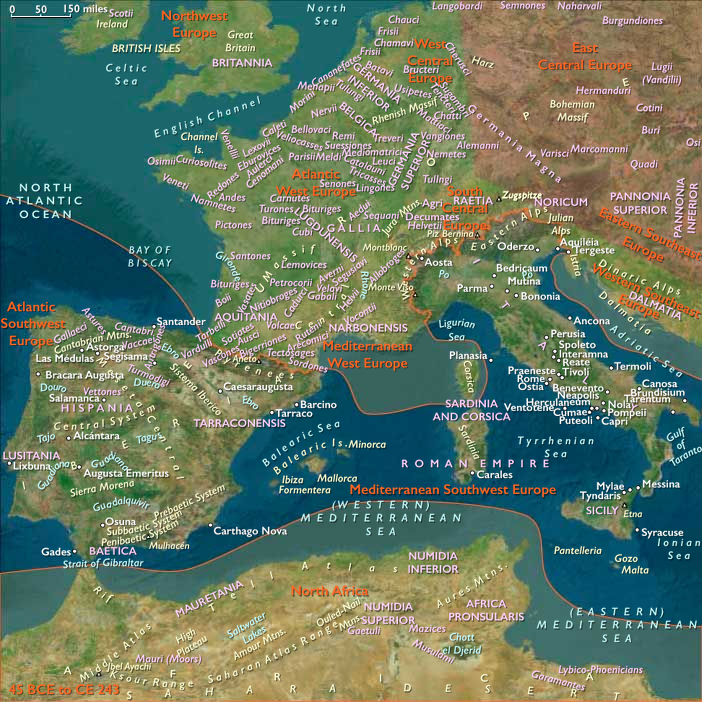
Subregions
Years: 70 - 70
Locations
People
Groups
Topics
Commodoties
Subjects
- Commerce
- Engineering
- Environment
- Labor and Service
- Conflict
- Faith
- Government
- Custom and Law
- Technology
- Economics
Regions
Subregions