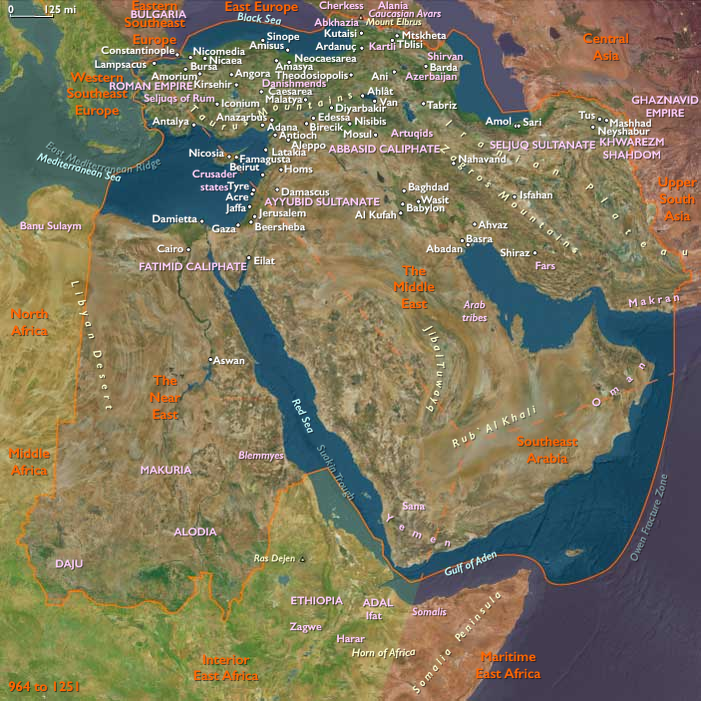
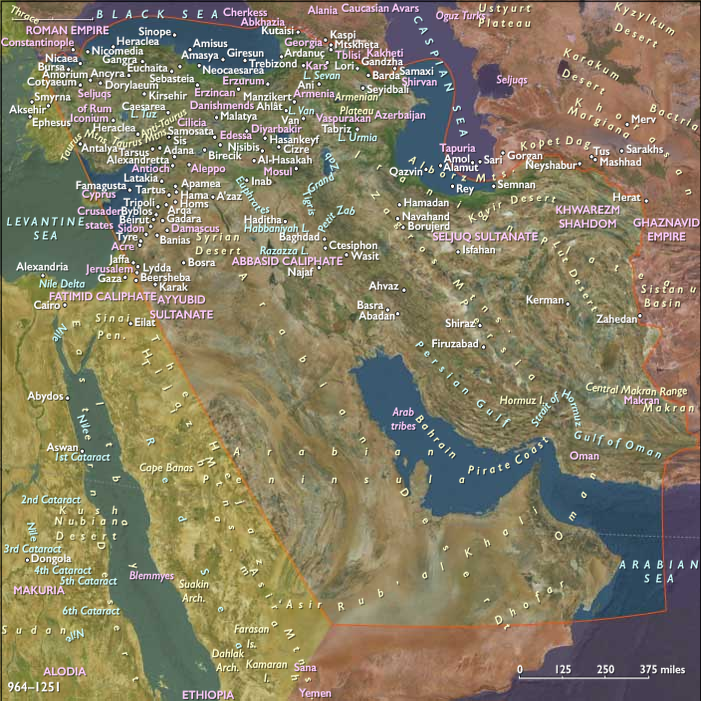
The city of Tabriz, its oldest sites …
Years: 1041 - 1041
The city of Tabriz, its oldest sites dated to around 1500 BCE, will be associated with a long and turbulent history following the conquest of Iran by Muslims.
The Islamic geographer Yaqut says that Tabriz was a village before the arrival of Rawwad from the Arabic Azd tribe from Yemen.
Zubaidah bint Ja`far, the wife of Abbasid caliph Harun al-Rashid, had rebuilt Tabriz in 791, after a devastating earthquake, so beautifying the city that she will be long credited as its founder.
Another devastating earthquake had occurred in 858; yet another devastates the city in 1041.
Severe earthquakes will continue to plague the region.
Locations
Groups
Subjects
Regions
Subregions
Related Events
Filter results
Showing 10 events out of 51378 total
The number of enlisted soldiers in the Song Dynasty Chinese military reaches well over one million two hundred and fifty thousand troops in 1041, an increase since 1022, when there had been a million soldiers.
Hungarian troops have plundered Bavaria in 1039 and 1040.
Peter of Hungary, overthrown in 1040, by Samuel Aba, flees to Germany, where Henry receives him well despite the enmity formerly between them.
Bretislaus is thus deprived of an ally, and Henry renews preparations for a campaign in Bohemia.
He and Eckard set out once more on August 15, almost exactly a year after his last expedition.
This time he is victorious, and Bretislaus signs a peace treaty at Regensburg.
The audacious King Peter Urseolo of Hungary confiscates Queen Giselle's property and takes her into custody.
She seeks help from Hungarian lords, who blame one of Peter's favorites (Budo) for the monarch's misdeeds and demand that Budo be put on trial.
When the king refuses, the lords seize and murder his unpopular advisor and depose the monarch in 1041.
They elect a new king, Samuel Aba, who is a brother-in-law or another nephew of King Stephen I. Samuel had held important offices during the reign of King Stephen; he was a member of the royal council and became the first palatine of Hungary.
Samuel's family, according to the anonymous author of the Gesta Hungarorum, descends from two "Cuman" chieftains, Ed and Edemen, who had received "a great land in the forest of Mátra" from Árpád, Grand Prince of the Hungarians.
In contrast, the fourteenth-century Hungarian chronicles describe Ed and Edemen as the sons of Csaba —himself a son of Attila the Hun—by a lady from Khwarezm.
Since all Hungarian chronicles emphasize the Oriental—either "Cuman" or "Khwarezmian"—origin of Ed and Edemen, the historians Gyula Kristó, László Szegfű and others propose that the Aba clan descending from them ruled the Kabars, a people of Khazar origin who had joined the Hungarians before their arrival in the Carpathian Basin.
Kristó argues that both Samuel's Khazar origin and his first name suggest that he was born to a family that adhered to Judaism.
Despite the uncertainty over the clan's origins, Samuel undoubtedly descends from a distinguished family, since an unnamed sister of Stephen I, the first King of Hungary, had been given in marriage to a member of the Aba clan around 1009.
However, historians still debate whether Samuel himself or Samuel's father married the royal princess.
If Samuel was her husband, he must have been born before 990 and converted—either from Judaism or paganism—to Christianity when he married Stephen I's sister.
This is further evidenced by Samuel's establishment of an abbey at Abasár, which was recorded by Hungarian chronicles.
According to Gyula Kristó and other historians, Samuel's conversion coincided with the creation of the Roman Catholic Diocese of Eger, encompassing the Mátra region.
As king, Samuel abolishes all laws introduced by Peter the Venetian and has many of his predecessor's supporters killed or tortured.
Hungarian chronicles sharply criticize him for socializing with the peasants instead of the nobles.
Samuel even abolishes some levies payable by the commoners.

Eckard II, as guardian of the eastern frontiers against Poland and Bohemia, has often served Conrad II or Henry III against these menaces, including “the Bohemian Achilles,” Duke Bretislaus I.
This last, allied with Peter Urseolo of Hungary, who has been aiding Bavaria, had made great gains in Lusatia and Poland such that the emperor fears him.
Eckard takes part in both of Henry's campaigns, for he is Henry's most loyal and most trusted ally, in 1040 and 1041: the first unsuccessful, the latter a victory which forces a peace treaty.
Michael IV the Paphagonian, who ascended the imperial throne in 1034, suffers from epilepsy, a condition that has continually worsened.
Returning from the Bulgarian campaign mortally ill, he retires to the monastery of Saints Cosmas and Damian, where he dies on December 10, 1041.
Shortly before his death, Michael IV had granted his nephew the title of Kaisar (Caesar), and, together with Zoe, had adopts his nephew as a son, who now succeeds to the throne as Michael V.
His father had been a caulker before becoming an admiral under Michael IV (hence the new emperor’s nickname, Kalaphates, “caulker”) and botching an expedition to Sicily.
Although the emperor had preferred another of his nephews, the future Michael V had been advanced as heir to the throne by his other uncle John the Orphanotrophos and the Empress Zoe.
John, having seen brother Michael elevated to the imperial throne, makes his nephew Constantine his protégé with the object, according to Psellos, of ensuring his succession.
Determined to rule on his own, Michael V comes into conflict with John, whom he almost immediately banishes to the Monastery of Monobatae, then, again according to Psellos, has all of John's male relatives castrated.
Michael now reverses his uncle's decisions, recalling the nobles and courtiers who had been exiled during the previous reign, including the future patriarch Michael Keroularios and the general George Maniakes.
Maniakes is promptly sent back to southern Italy in order to contain the advance of the Normans.
Muhammad dies in September 1041 while campaigning in Kurdistan against the Annazids.
His eldest son Faramurz succeeds him in Isfahan, while …
…his younger son Garshasp I gains Hamadan.
However, they have a difficult task in protecting these regions from the expansionist Seljuqs, who have become neighbors with the Kakuyids.
Tughril, the co-leader of the Seljuqs, makes Rey the capital of his kingdom after his defeat of the Ghaznavids.
Petar II Delyan's successes end, however, with the interference of his cousin Alusian.
Alusian, whose father Ivan Vladislav had murdered Peter's father Gavril Radomir in 1015, had joined Petar II's ranks as an apparent deserter from the imperial court, where he had been disgraced.
Alusian had been welcomed by Peter II, who had give him an army with which to attack Thessalonica.
The siege, however, had been raised by the imperial forces, and the army had been defeated.
Alusian barely escaped and returned to Ostrovo, a part of Skopje.
While Delyan is drunk one night during dinner in 1041, Alusian cuts off his nose and blinds him with a kitchen knife.
Since Alusian is of the blood of Samuel of Bulgaria, he is quickly proclaimed emperor in Petar II's place by his troops, but he conspires to defect to the Empire.
As the Bulgarian and Greek troops are preparing for battle, Alusian deserts to the enemy and heads for Constantinople, where his possessions and lands are restored to him, and he is rewarded with the high court rank of magistros.
Alusian's subsequent fate is unknown, but his descendants, the Alousianoi, will continue to prosper in the ranks of the imperial aristocracy until the fourteenth century.
Meanwhile, Petar II Delyan, although blind and disfigured, resumes command of the Bulgarian forces, but Emperor Michael IV determines to take advantage of the situation and advances against them.
In an obscure battle of Ostrovo, the imperial forces defeat the Bulgarian troops and Petar II Delyan is either killed by an arrow or captured and taken to Constantinople, where he is perhaps executed.
According some legends he was later exiled to a monastery in Iskar Gorge, in the Balkan Mountains, where he died.
Norse sagas refer to the participation of the future Norwegian King Harald Hardråda, who allegedly cut down Peter II in the field of battle as a member of the Varangian Guard.
This tradition may be supported by a laconic reference in the so-called "Bulgarian Apocryphal Chronicle".
In either case, Peter II Delyan might have perished in 1041.
A Lombard-Norman revolt erupts in southern Italy at the end of the imperial expedition to Sicily.
Michael Doukeianos replaces Nikephoros Doukeianos.
His first major act is to offer the rule of Melfi to the Greek-speaking Lombard Arduin with the title topoterites.
However, Arduin soon betrays him and leads his Norman mercenaries in support of the Apulian rebellion of Argyrus.
He meets the Lombard-Norman army, led by the former imperial ally William Iron Arm, but is defeated on March 16, 1041, near Venosa, on the Olivento.
This is followed by another battle at Montemaggiore, near Cannae, a field that had served as the site for the famous battle of 216 BCE and the first Norman engagement in the Mezzogiorno in 1018.