The city of Nola had been given …
Years: 80BCE - 80BCE
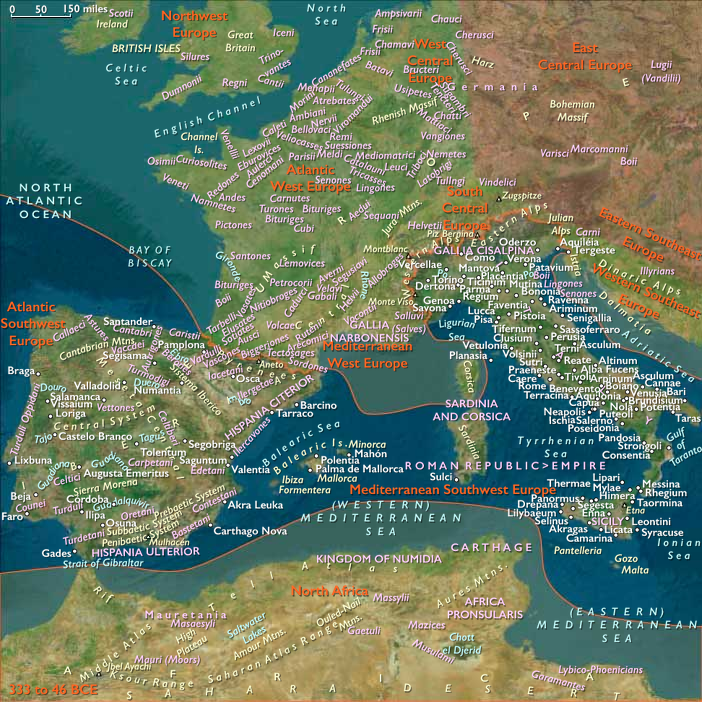
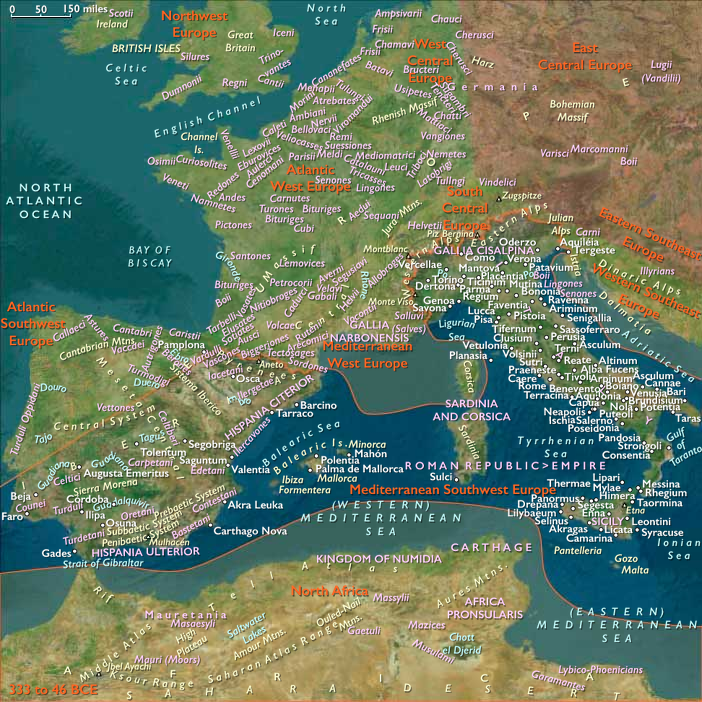
The city of Nola had been given by treason in the Social War into the hands of the Samnites, who kept it until Marius, with whom they had sided, was defeated by Sulla, who in 80 BCE subjects it together with the rest of Samnium.
Locations
People
Groups
Topics
Commodoties
Subjects
Regions
Subregions
Related Events
Filter results
Showing 10 events out of 62731 total
Berenice III reigns over Egypt for about a year.
Ptolemy XI Alexander, who had been carried off to Rome, had been befriended by Sulla; he is now sent to Egypt to be married to his Berenice, who is his stepmother.
Neither the queen nor the people of Alexandria, who greatly admire her, have been consulted about the matter.
When Ptolemy realizes, after about nineteen days of joint rule, that Berenice is loath to surrender her accustomed authority, he unwisely arranges for the murder of the popular queen, for which the enraged Alexandrians kill him in revenge, thus eliminating the last fully legitimate member of the Ptolemaic dynasty.
As Ptolemy XI has died without a male heir, the only available male descendants of the Ptolemy I lineage are the illegitimate sons of Ptolemy IX by an unknown Greek concubine.
The boys had been living in exile in Sinope, at the court of Mithridates VI, King of Pontus.
As the eldest of the boys, Ptolemy XII is proclaimed king as Ptolemy XII Neos Dionysos and marries his sister, Tryphaena.
However, Ptolemy XI had left the throne to Rome in his will, therefore Ptolemy XII is not the legitimate successor.
Nevertheless, Rome does not challenge the succession of Ptolemy XII because the Senate is unwilling to acquire an Egyptian expansion.
His precarious kingship depends heavily on Roman support.
Pompeii, like Nola and the rest of the Samnite towns, is forced in 80 BCE to surrender its autonomy, culminating in many of Sulla's veterans being given land and property, while many of those who had gone against Rome are ousted from their homes.
It becomes a Roman colony with the name of Colonia Cornelia Veneria Pompeianorum.
Pompeii will grow into an important passage for goods that arrive by sea and have to be sent toward Rome or Southern Italy along the nearby Appian Way.
Sulla devastates the Etruscan cities in 80 BCE; the remaining Etruscans become Roman citizens.
Marcus Licinius Crassus is no stranger to Roman politics, or to military command, as he had been a field commander under Sulla during the second civil war between Sulla and the Marian faction in 82 BCE, and had served under Sulla during the following dictatorship.
His concern now is to rebuild the fortunes of his family, which had been confiscated during the Marian-Cinnan proscriptions.
Sulla's own proscriptions have ensured that his survivors will recoup their lost fortunes from the fortunes of wealthy adherents to Gaius Marius or Lucius Cornelius Cinna.
Proscriptions mean that their political enemies lose their fortunes and their lives; that their female relatives (notably, widows and widowed daughters) are forbidden to remarry; and that in some cases, their families' hopes of rebuilding their fortunes and political significance are destroyed.
Crassus is said to have made part of his money from proscriptions, notably the proscription of one man whose name was not initially on the list of those proscribed but was added by Crassus who coveted the man's fortune.
Crassus's wealth is estimated by Pliny at approximately two hundred million sestertii.
The rest of Crassus's wealth is acquired more conventionally, through traffic in slaves, the working of silver mines, and judicious purchases of land and houses, especially those of proscribed citizens.
Most notorious is his acquisition of burning houses: when Crassus receives word that a house is on fire, he arrives and purchases the doomed property along with surrounding buildings for a modest sum, and then employes his army of five hundred clients to put the fire out before much damage has been done.
Crassus's clients employ the Roman method of firefighting—destroying the burning building to curtail the spread of the flames.
After rebuilding his fortune, Crassus's next concern is his political career.
As an adherent of Sulla, and the wealthiest man in Rome, and a man who hails from a line of consuls and praetors, Crassus's political future is apparently assured.
His problem is that despite his military successes, he is eclipsed by his contemporary Pompey, who is pushing Sulla into granting him a triumph for victory in Africa over a ragtag group of dissident Romans; a first in Roman history on a couple of counts.
First, Pompey is not even a praetor, on which grounds a triumph had been denied in 206 BCE to the great Scipio Africanus, who had defeated Rome’s outstanding enemy, Hannibal, and brought Rome an entire province in Hispania.
Second, Pompey has defeated fellow Romans; however, a precedent had been set when the consul Lucius Julius Caesar (a relative of Gaius Julius Caesar) had been granted a triumph for a small victory over Italian peoples in the Social War.
Yet, until now, no triumph has been granted to any Roman for victory over another Roman general.
Crassus's rivalry with Pompey and his envy of Pompey's triumph will influence this subsequent career.
Pompey, after his string of victories in Sicily and Africa, had been proclaimed Imperator (a title roughly equivalent to commander under the Roman Republic) by his troops on the field in Africa; once back in Rome, he is given an enthusiastic popular reception and hailed by Sulla as Magnus (the Great)—probably in recognition of Pompey's undoubted victories and popularity, but also with some degree of sarcasm.
The young general is still officially a mere privatus (private citizen) who had held no offices in the cursus honorum.
The title may have been meant to cut Pompey down to size; he himself will use it only later in his career.
When Pompey demands a triumph for his African victories, Sulla refuses; it would be an unprecedented, even illegal, honor for a young privatus—he must disband his legions.
Pompey refuses, and presents himself expectantly at the gates of Rome.
Sulla concedes.
However, Sulla has his own triumph first, then allows Metellus Pius his triumph, relegating Pompey to an extralegal third place in a quick succession of triumphs.
On the day, Pompey attempts to upstage both his seniors in a triumphal chariot towed by an elephant, representing his exotic African conquests.
The elephant would not fit through the city gate.
Some hasty replanning is needed, much to the embarrassment of Pompey and amusement of those present.
His refusal to give in to his troops' near-mutinous demands for cash probably impresses his mentor and Rome's conservatives.

Sertorius holds supreme authority when he arrives to the lands of the Lusitanians, bringing additional forces from Africa; he begins conquering the neighboring territories of Roman Hispania (modern Spain).
Quintus Sertorius, an able Roman general earlier appointed governor of Lusitania, had been forced to flee to North Africa after Sulla became dictator and took vengeance upon all his former enemies, including Sertorius.
He had carried on a campaign in Mauretania, in which he defeated one of Sulla's generals and captured Tingis (Tangier).
The North Africa success had won him the fame and admiration of the people of Hispania, particularly that of the Lusitanians in the west (in modern Portugal), whom Roman generals and proconsuls of Sulla's party have plundered and oppressed.
The Lusitanians now offer Sertorius to be their general.
The Ptolemid prince's brother becomes, according to the Roman historian and politician Cicero, king of Cyprus, while …
…the prince himself, now known as Ptolemy XII Auletes (Greek: “Flute Player”), arrives in Egypt, and shortly afterwards marries Cleopatra V Tryphaeana, who is perhaps his sister.
Cicero, whose father is a well-to-do member of the equestrian order with good connections in Rome but as a semi-invalid cannot enter public life, has compensated for this by studying extensively.
He has used his knowledge of Greek to translate many of the theoretical concepts of Greek philosophy into Latin, thus translating Greek philosophical works for a larger audience.
It is precisely his broad education that ties him to the traditional Roman elite.
Cicero according to Plutarch was an extremely talented student, whose learning attracted attention from all over Rome, affording him the opportunity to study Roman law under Quintus Mucius Scaevola.
Cicero's fellow students were Gaius Marius Minor, Servius Sulpicius Rufus (who became a famous lawyer, one of the few whom Cicero considered superior to himself in legal matters), and Titus Pomponius.
The latter two became Cicero's friends for life, and Pomponius (who later received the nickname "Atticus") would become Cicero's longtime chief emotional support and adviser.
Cicero had wanted to pursue a public civil service career along the steps of the Cursus honorum.
An intellectual first and foremost with no taste for military life, he had nevertheless served both Gnaeus Pompeius Strabo and Lucius Cornelius Sulla in 90 BCE–88 BCE as they campaigned in the Social War.
Cicero in around 83-81 BCE had started his career as a lawyer.
His first major case, of which a written record is still extant, was his defense of Sextus Roscius in 80 BCE on the charge of patricide.
Taking this case was a courageous move for Cicero; patricide was considered an appalling crime, and the people whom Cicero accused of the murder, the most notorious being Chrysogonus, were favorites of Sulla.
It would have been easy for the dictator Sulla at this time to have the unknown Cicero murdered.
Cicero's defense was an indirect challenge to Sulla, and on the strength of his case, Roscius had been acquitted.
Cicero leaves in 79 for Greece, Asia Minor and Rhodes, perhaps because of the potential wrath of Sulla.
He journeys first to Athens, where he becomes reacquainted with his old classmate Titus Pomponius, who so loves Athens and its culture that he has taken upon himself the nickname "Atticus", or "Man of Attica.”
Atticus introduces Cicero to some significant Athenians, where his his chief instructor is the rhetorician Apollonius Molon of Rhodes.
Sertorius, brave, noble, and gifted with eloquence, is just the man to impress the Lusitanians favorably, and the native warriors, whom he organizes, speak of him as the "new Hannibal."
His skill as a general is extraordinary, as he repeatedly defeats forces many times his own size.
Many Roman refugees and deserters join him, and with these and his Hispanian volunteers he completely defeats several of Sulla's generals (Fufidius, Lucius Domitius and to some less-direct extent Thoranius) and drives Quintus Caecilius Metellus Pius, who had been specifically sent against him from Rome, out of Lusitania, or Hispania Ulterior as the Romans call it at this time.