The city of Mérida rebels against al-Hakam’s …
Years: 811 - 811
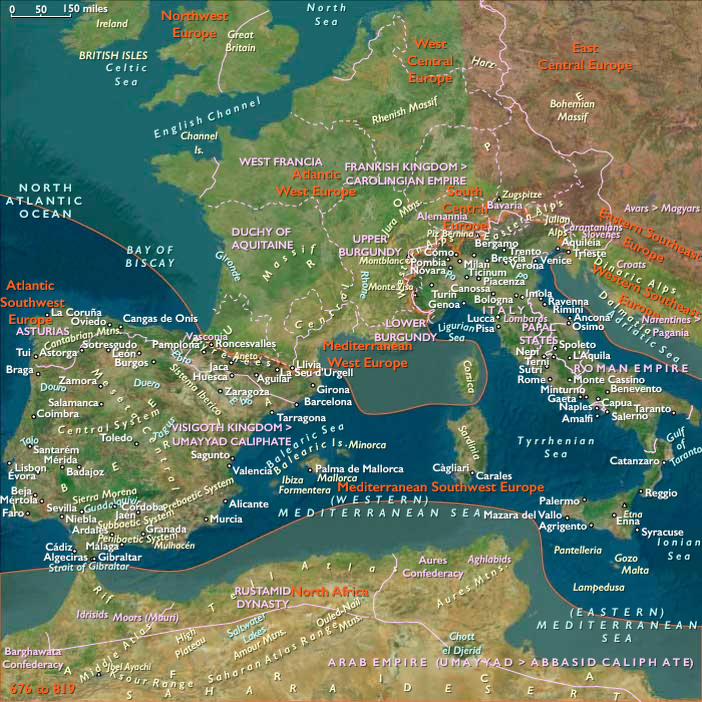
The city of Mérida rebels against al-Hakam’s rule in 811.
Locations
People
Groups
- Arab people
- Berber people (also called Amazigh people or Imazighen, "free men", singular Amazigh)
- Jews
- Christianity, Chalcedonian
- Córdoba, Umayyad Emirate of
Commodoties
Subjects
Regions
Subregions
Related Events
Filter results
Showing 10 events out of 54740 total
Michael Rangabe, the emperor’s son-in-law, is proclaimed emperor by a coup d'etat, despite the claims of Nikephoros' son Staurakios, who had been mortally wounded in Bulgaria.
Under the influence of the abbot and theologian Theodore Studites, Michael supports the proponents of the use of religious images, or icons.
The first emperor to bear a family name, Michael's use of the patronymic, Rangabe, bears witness to the emergence of the empire’s great families, whose accumulation of landed properties will soon threaten the integrity of those smallholders upon whom the empire depends for its taxes and its military service.
The name Rangabe seems to be a Hellenized form of a Slav original (rokavu), and, if so, Michael's ethnic origin and that of his successor, Leo V the Armenian, provide evidence enough of the degree to which the empire in the ninth century has become not only a melting-pot society but, further, a society in which even the highest office lays open to the man with the wits and stamina to seize it.
Krum mobilizes as many soldiers as possible, giving weapons even to peasants and women.
This army is assembled in the mountain passes to intercept the imperial troops as they return to Constantinople.
At dawn on July 26, the Bulgarians manage to trap the retreating Nikephoros in the Vărbica pass.
The imperial army is wiped out in the ensuing battle and Nikephoros was killed, the second Eastern Emperor to suffer this fate since Valens in the Battle of Adrianople (August 9, 378).
His son Staurakios is carried to safety by the imperial bodyguard after receiving a paralyzing wound to the neck.
Fleeing with him are his brother-in-law, the curopalates Michael Rangabe, the Domestic of the Schools Stephen, and the magistros Theoktistos.
Gathered around Staurakios’s bedside, they debate the succession.
Because of his uncertain condition, he is hastily proclaimed Emperor by Stephen, who has the backing of the army.
This is the first time an Emperor of the Eastern Empire has been crowned outside Constantinople.
It is said that Krum had the Emperor's skull lined with silver (or gold) and used it as a drinking cup.
Theoktistos has been pressing Michael Rangabe at the same time however, to claim the Imperial throne for himself—given Staurakios’ injuries, and his being the son-in-law of the slain Nikephoros, Theoktistos believes he is best placed to deal with the imminent Bulgar threat.
Michael, however, continues to support his brother-in-law.
Meanwhile, to secure his accession to the throne, Staurakios presents himself feebly before the remains of the imperial army at Adrianople and seeks to reassure them by indulging in some criticism of his now dead father, which meets with their approval.
Staurakios is soon taken by litter from Adrianople to Constantinople.
It is quickly evident that Staurakios will be unable to exercise actual authority due to his debilitating wound, paralysis of the legs and constant pain.
As his condition worsens, the court is split between the factions of his wife Theophano and his sister Prokopia, who hopes that her husband, Michael Rangabe, will be chosen as the Emperor's heir.
As he has no children of his own to succeed him, it soon becomes evident that Staurakios intends to designate Theophano as his successor.
Under his wife’s influence, he begins to freeze out both the Domestic Stephen and the magistros Theoktistos, and to ensure the transfer of power, he attempts to have Michael blinded on October 1, 811.
This act is frustrated by the actions of Stephen.
There is also a popular rumor that Staurakios plans to abolish the Empire and reestablish a republic.
The supporters of Michael, who now include both Stephen and Theoktistos, as well as the Patriarch Nikephoros I, who is alarmed at Staurakios’ plans to pass the throne to Theophano, forces the Emperor to abdicate on October.
2 Hearing of the accession of his brother-in-law, Staurakios takes Holy Orders.
Before being escorted from the palace, he is visited by his sister Prokopia, brother-in-law Michael, and the Patriarch, all of whom justify their actions by the fact of his severe injuries, while Staurakios reproaches them bitterly, in particular the Patriarch.
Staurakios retired to a monastery where he will died from the effects of his wound on January 11, 812.
Michael Rangabe becomes Emperor as Michael I.

Agnello Participazio had taken up the defense of Venice during the subsequent siege of Pepin of Italy in 810 after the city’s reigning doges, Obelerio, Beato, and Valentino, had called in Pepin to support their tottering power.
Following the flight of Pepin and exile of the doges, Agnello is elected to the dogeship in 811.
Charles establishes a Christian church in 811 at Hammaburg (Hamburg), where he constructs the Hammaburg fortress at the confluence of the Elbe and Alster rivers about sixty-eight miles (one hundred and ten kilometers) from the point at which the Elbe empties into the North Sea.
Charles draws up laws for his empire in 811 and composes his will.
Al-Ma'mun, effectively stripped by al-Amin of his rights to the succession, is supported by al-Fadl ibn Sahl, whom he is to make his vizier, as well as by an Iranian general, Tahir ibn al-Husayn, descended from the mawali of the great Arab leader to whom his forbears had become clients in eastern Khorasan.
Open hostilities begin in January 811.
Caliph al-Amin appoints Ali ibn Isa ibn Mahan as governor of Khurasan, and sends him with an army against his brother al-Ma'mun, thereby beginning the Abbasid Civil War or Fourth Fitna.
General Tahir's victory over al-Amin's army on the outskirts of the present Tehran allows al-Ma'mun's troops to occupy western Iran.
The situation becomes critical in Baghdad, where many began to accuse Amin of idleness and complacency and Fadl of inefficient leadership after Ma'mun's forces score an unexpected victory over the caliphal army at the Battle of Rayy.
As Ma'mun's general Tahir ibn Husayn advances through Iran, Fadl tries to reinforce the Baghdad troops (the abna′ al-dawla) with levies from the Arab tribes of Syria and the Jazira, but they soon fall out with the abna′, who are jealous of their pay and privileges, so that this project comes to nothing.
Fadl, seeing Amin's cause as lost, and with Ma'mun's troops approaching the capital, goes into hiding as Baghdad is besieged.
Years: 811 - 811
Locations
People
Groups
- Arab people
- Berber people (also called Amazigh people or Imazighen, "free men", singular Amazigh)
- Jews
- Christianity, Chalcedonian
- Córdoba, Umayyad Emirate of