The city of Melid on the Tohma …
Years: 717BCE - 706BCE
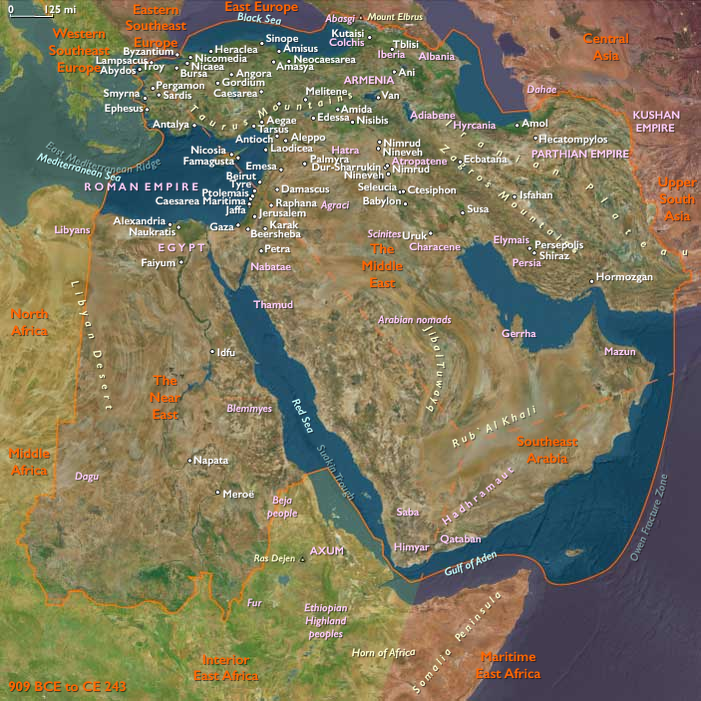
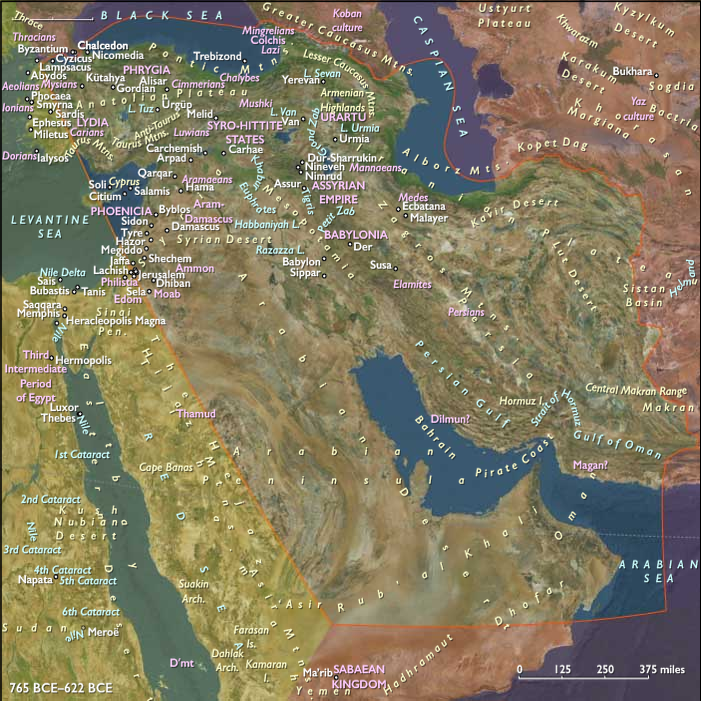
The city of Melid on the Tohma River, a tributary of the upper Euphrates rising in the Taurus Mountains, had from the twelfth to seventh century BCE become the center of an independent Luwian Neo-Hittite state of Kammanu, formed from part of Kizzuwatna after the collapse of the Hittite Empire.
A palace had been built and monumental stone sculptures of lions and the ruler erected.
The encounter of the kingdom of Melid with the Assyrian king Tiglath-Pileser I (1115-1077 BCE) had resulted in its being forced to pay tribute to Assyria.
Melid has been able to prosper until the Assyrian king Sargon II sacks the city in 712 BCE.
Around the same time, the Cimmerians and Scythians invade Anatolia and the city declines.
Locations
People
Groups
- Mesopotamia
- Syro-Hittite states
- Cimmerians
- Assyrian people
- Scythians, or Sakas
- Assyria, (New) Kingdom of (Neo-Assyrian Empire)
Topics
- Younger Subboreal Period
- Iron Age, Near and Middle East
- Iron Age Cold Epoch
- Classical antiquity
- Assyrian Wars of c. 745-609 BCE
Commodoties
Subjects
Regions
Subregions
Related Events
Filter results
Showing 10 events out of 66324 total
King Ping of Zhou had appointed Duke Zhuang of Zheng “Left Advisor,” but Ping's successor, King Huan, removed him from office.
In return for this slight, Duke Zhuang refused to go to the capital to meet with King Huan, who then led a coalition in 707 BCE against Zhuang.
Duke Zhuang's army humiliates the king, defeating the royal army and inflicting an arrow wound on Huan's shoulder.
The Middle East: 717–706 BCE
Sargon II and the Imperial Capital of Dur Sharrukin
In 717 BCE, the Assyrian king Sargon II embarks upon an expansive series of military and political campaigns that reshape the Near Eastern geopolitical landscape. His conquests begin notably with the capture of the strategically critical Neo-Hittite city-state of Carchemish in the same year. Sargon continues these campaigns vigorously, and in 714 BCE, he launches a decisive expedition against the northern kingdom of Urartu, successfully defeating its forces and incorporating it firmly within the Assyrian imperial system. These victories strengthen Assyrian dominance in the north, securing its frontiers and further consolidating imperial control.
As a symbolic testament to his power and administrative vision, Sargon II constructs a meticulously planned new capital city named Dur Sharrukin ("Fortress of Sargon") in 713 BCE. Situated at the present-day site of Khorsabad, approximately twelve miles (twenty kilometers) northeast of Mosul, Iraq, the city exemplifies Assyrian imperial might and grandeur. Dur Sharrukin is encircled by thick, fortified walls punctuated by guard towers, with colossal human-headed winged bulls (lamassu) of carved stone guarding each of its seven monumental gateways.
At its heart, the upper citadel contains Sargon’s grand palace, adorned with rooms of varying sizes built around courtyards, richly decorated with sculpted bas-reliefs and vividly painted scenes portraying royal hunts, military triumphs, and ceremonial rites. Nearby stands a prominent ziggurat, its stepped structure constructed from vibrant, colored bricks. The lower citadel houses official residences, administrative buildings, and a temple dedicated to the god Nabu. By 710 BCE, Sargon formally relocates the Assyrian capital to this new city, marking a significant administrative and symbolic shift in the empire.
Conflict and Diplomacy with Phrygia under Midas (Mita)
Concurrent with Assyrian ascendancy, the powerful kingdom of Phrygia, centered at Gordium along the upper Sakarya River valley, expands its territorial and cultural influence across central and western Anatolia during the eighth century BCE. Under the reign of King Midas (known as Mita in Assyrian records), Phrygia achieves the height of its power. This historical Midas, who rules approximately from 720 BCE, presides over a prosperous kingdom renowned for its distinct "Polished Ware" pottery and the widespread use of a writing system derived from the Phoenician alphabet.
Phrygia maintains robust trade connections both eastward with Assyria and Urartu, and westward with the Greeks, with whom Midas fosters close diplomatic and cultural relationships—reputedly including marriage to an Aeolian Greek princess. Initially, tensions flare in 716 BCE when Midas foments rebellion against Assyrian rule in Cilicia. Sargon swiftly suppresses the uprising, yet by 709 BCE, Assyrian inscriptions indicate a diplomatic reconciliation, reflecting Phrygia’s pragmatic approach to coexistence with larger powers.
The Fall of Melid and Regional Instability
In the upper Euphrates region, the ancient Luwian Neo-Hittite kingdom of Melid (Kammanu) has thrived independently for several centuries from its capital along the Tohma River. Previously forced into tribute by Assyrian incursions as early as the eleventh century BCE under Tiglath-Pileser I, Melid manages to prosper until its decisive sack by Sargon II in 712 BCE. This destruction coincides with regional turmoil driven by invasions of Anatolia by nomadic groups such as the Cimmerians and Scythians, accelerating Melid’s decline and leading to widespread instability.
Babylonian Affairs and Chaldean Resistance
Further south, in Babylonia, Sargon confronts persistent resistance led by the Chaldean prince Marduk-apla-iddina II, ruler of Babylon. After prolonged conflict involving alliances between Marduk-apla-iddina and powers such as Elam, Aram, and Israel, Sargon finally drives him from power around 710 BCE. Rather than complete destruction, however, Sargon strategically allows the deposed monarch to retain leadership of his tribal base, ensuring some degree of stability and loyalty among the Chaldeans.
This period (717–706 BCE) thus marks a peak in Assyrian imperial strength and consolidation, exemplified by military conquests, administrative innovations, diplomatic maneuvers, and the construction of Dur Sharrukin—reflecting both the strategic brilliance and enduring legacy of Sargon II’s rule.

Sargon establishes a well-planned new capital, Dur Sharrukin (“Fortress of Sargon”) in 713 at the site of the present village of Khorsabad, twelve miles (twenty kilometers) northeast of Mosul in Iraq.
He surrounds his new city with a thick wall fortified with towers; huge, winged human-headed bulls of carved stone guard the seven entrances.
Built around courtyards, its variously sized rooms lined with sculptured and painted scenes of hunting, battles, and ceremonies, Sargon's palace stands, together with temples and a ziggurat with steps made of colored brick, on the upper terrace of the fortified citadel at the northwest wall.
Official residences and a temple to the god Nabu occupy the lower citadel; the imperial arsenal stands beside the southwest wall.
Sargon moves the Assyrian capital to the new location in 710.
The Phrygian kingdom, with its capital at Gordium in the upper Sakarya River valley, has expanded during the eighth century BCE into an empire dominating most of central and western Anatolia and encroaching upon the larger Assyrian Empire to its southeast and the kingdom of Urartu to the northeast.
A distinctive Phrygian pottery called Polished Ware appears, and a system of writing in the Phrygian language develops and flourishes in Gordium, using a Phoenician-derived alphabet similar to the Greek one.
The powerful kingdom founded by the Phrygians is to last until the Lydian ascendancy in the early seventh century BCE.
Under kings alternately named Gordias and Midas, the independent Phrygian kingdom maintains close trade contacts with her neighbors in the east and the Greeks in the west.
Phrygia seems to have been able to coexist with whatever power is dominant in eastern Anatolia at the time.
The Assyrians had detached the eastern part of the Phrygian confederation by about 730, and the locus of power has shifted to Phrygia proper.
According to the classical historians Strabo Eusebius and Julius Africanus, the king of Phrygia during this time was another Midas.
This historical Midas is believed to be the same person named as Mita in Assyrian texts from the period and identified as king of the Mushki.
Scholars figure that Assyrians called Phrygians "Mushki" because the Phrygians and Mushki, an eastern Anatolian people, were at that time campaigning in a joint army.
This Midas is thought to have reigned Phrygia at the peak of its power from about 720 BCE to about 695 BCE (according to Eusebius) or 676 BCE (according to Julius Africanus).
In 716, Sargon of Assyria suppresses a rebellion in Cilicia fomented by Mita; an Assyrian inscription mentioning "Mita" as an ally, dated to 709 BCE, suggests Phrygia and Assyria had struck a truce by that time.
This Midas appears to have had good relations and close trade ties with the Greeks, and reputedly married an Aeolian Greek princess.
Sargon conquers Carchemish in 717 BCE.
The Assyrian king has spent his life in the field, campaigning not only in the west but also in the north, in present eastern Turkey, against the kingdom of Urartu, against whom he undertakes an expedition in 714.
Sargon’s account of this campaign details Urartu’s defeat and incorporation into the imperial system.
Sargon, having repressed the allies of Chaldean prince Marduk-apla-iddina II, ruler of Babylon, in Elam, Aram and Israel, eventually drives him from Babylon in about 710 BCE, but permits the deposed monarch to remain chief of his tribe.
Near East (717–706 BCE): Religious and Political Transformations
Syncretism and the Rise of Samaritan Identity
After the fall of Samaria, its new inhabitants—colonists from diverse parts of the Assyrian Empire—initially worship their own deities. According to later Jewish tradition, when dangerous wild animals infest the region, these colonists appeal to the Assyrian king for priests from Israel to instruct them on how to worship the local god, Yahweh. This leads to the emergence of a syncretistic form of religion, blending the worship of Yahweh with their original gods. Today's Samaritans, who regard themselves as descendants of the tribes of Ephraim and Manasseh, continue to honor the Pentateuch as their sacred scripture and worship at Mount Gerizim. Modern genetic studies confirm Samaritan claims of Israelite lineage through male ancestors, with maternal lines indicating Assyrian and other foreign origins.
Nubian Religious Revival: The Shabaka Stone
During the reign of Pharaoh Shabaka of Egypt’s Nubian Twenty-fifth Dynasty, a significant religious artifact known as the Shabaka Stone is produced. Discovered by Shabaka himself at the temple of Ptah in Memphis, this slab records the deteriorating text of an ancient papyrus. The Shabaka Stone preserves the Memphite Theology, a sophisticated religious doctrine elevating Ptah, god of craftsmen, as the creator of all existence. According to this theology, Ptah conceives all things mentally and brings them into existence by speech—a concept reflecting a high level of abstraction and philosophical sophistication in Egyptian religious thought.
Moab Under Assyrian Influence
Moab, despite linguistic and cultural affinities with its Israelite neighbors, faces religious and political marginalization from Judahite society. This isolation is underscored by scriptural prohibitions (Deuteronomy 23:3-6) and prophetic denunciations (Isaiah 25:10). By the late eighth century BCE, Moab becomes a tributary of Assyria, signaling its integration into the expanding Assyrian sphere of influence.
Religious and Political Reforms in Judah
The fall of the northern kingdom deeply influences the southern kingdom of Judah, prompting religious introspection and political caution. Under King Hezekiah, who succeeds Ahaz in 715 BCE, Judah initiates significant religious reforms aimed at eradicating Canaanite religious practices and reaffirming the worship of Yahweh. These reforms contrast sharply with Ahaz's earlier policies, which had subjected Judah to Assyrian dominance. The prophet Isaiah resumes his activity during this period, addressing Hezekiah’s political efforts to extricate Judah from Assyrian suzerainty, notably during a failed rebellion involving Tyre and Sidon against Sargon II in 710 BCE.
Cyprus and the Assyrian Hegemony
In 709 BCE, Cyprus submits to Assyrian King Sargon II, who consolidates his regional authority by erecting a stela at Citium. Seven Cypriot city-kings—Curium, Paphos, Marion, Soli, Lapithos, Salamis, and Amathus—formally acknowledge his dominance. Subsequent Assyrian records add four more kingdoms—Citium, Kyrenia, Tamassos, and Idalium—to the list of tributary states. Although nominal, this acknowledgment underscores the broad reach of Assyrian imperial power, which extends over Cyprus until approximately 663 BCE.
Legacy of the Era
The period from 717 to 706 BCE is marked by profound transformations in religion and politics across the Near East. The emergence of Samaritan identity, theological innovation in Nubian-controlled Egypt, and Judah’s religious reforms under Hezekiah significantly shape the cultural and political landscape. Meanwhile, Assyria’s expanding influence, exemplified by its dominance over Moab and Cyprus, sets the stage for further imperial entanglements and cultural exchanges in the region.
Samaria’s post-conquest inhabitants are allegedly colonists who adopt what later Jewish tradition will characterize as a distorted form of Judaism.
The new inhabitants had originally worshipped their own gods, but when the then-sparsely populated areas became infested with dangerous wild beasts, they appealed to the king of Assyria for Israelite priests to instruct them on how to worship the "god of that country."
The result is a syncretistic religion, in which national groups worship the Lord, but they also serve their own gods in accordance with the customs of the nations from which they had been brought.
Some Samaritans claim to be descendants of Israelites from the Northern Kingdom who had escaped deportation and exile.
Today’s Samaritans, who hold to the Pentateuch as their Scripture and honor Moses as the only prophet, claim descent from the tribes of Ephraim and Manasseh and maintain that they have preserved the way and will of Yahweh, though they accept little of later Jewish theology.
Their temple, which is at Mount Gerizim, not Jerusalem, will by destroyed by the Macabbean king John Hyrcanus late in the second century BCE, although their descendants still worship among its ruins.
A genetic study in the beginning of the twenty-first century concluded from Y-chromosome analysis that Samaritans descend from the Israelites (including Cohen, or priests), and mitochondrial DNA analysis shows descent from Assyrians and other foreign women, effectively validating both local and foreign origins for the Samaritans. (Shen et al, 2004)
The Shabaka Stone, a relic from the Nubian Twenty-fifth Dynasty of Egypt, is a stone slab measuring sixty-six centimeters in height and one hundred and thirty-seven centimeters in width and is incised with the surviving hieroglyphs of a worm-ridden, decaying papyrus.
This papyrus was found as the pharaoh Shabaka was inspecting the temple of Ptah in Memphis, Egypt.
Concerned about the loss of the information on the papyrus, Shabaka had the rest of the text written into this stone.
However, in later years, the stone will be used as a millstone and some of its hieroglyphics damaged.
Nevertheless, it has been a fruitful source of insight into the culture and religious doctrines of the ancient Egyptians.
The Shabaka Stone is also noteworthy in that it places Ptah, known as the patron of craftsmen, as the center of existence and as the creator god.
It is the principal surviving source of the Memphite theology in Ancient Egyptian culture, the teachings of which, ascribed to Menes, bring all local and former mythological traditions to their theological goal in the god Ptah, who created everything from notions that were in his heart and were then pronounced by his tongue.
All things—the universe, living beings, justice, beauty, and so on—were created in this fashion.
The gods were also created in this way; springing forth first as Ptah’s mental concepts, they entered into the material forms of the world—stone, metal, wood—that Ptah had equally created.
The creation myth associated with Ptah is more abstract than those of the pre-dynastic period, and testifies to the sophistication of the Memphite priesthood.
The Moabite language differs only dialectally from Hebrew, and Moabite religion and culture are very closely related to those of the Israelites.
Despite these similarities, Moabites are excluded from the Judahite community (Deuteronomy 23:3-6), where the name Moab has become a typical denomination for the enemies of God (Isaiah 25:10).
Moab becomes a tributary of Assyria by the late eighth century BCE.
Years: 717BCE - 706BCE
Locations
People
Groups
- Mesopotamia
- Syro-Hittite states
- Cimmerians
- Assyrian people
- Scythians, or Sakas
- Assyria, (New) Kingdom of (Neo-Assyrian Empire)
Topics
- Younger Subboreal Period
- Iron Age, Near and Middle East
- Iron Age Cold Epoch
- Classical antiquity
- Assyrian Wars of c. 745-609 BCE